


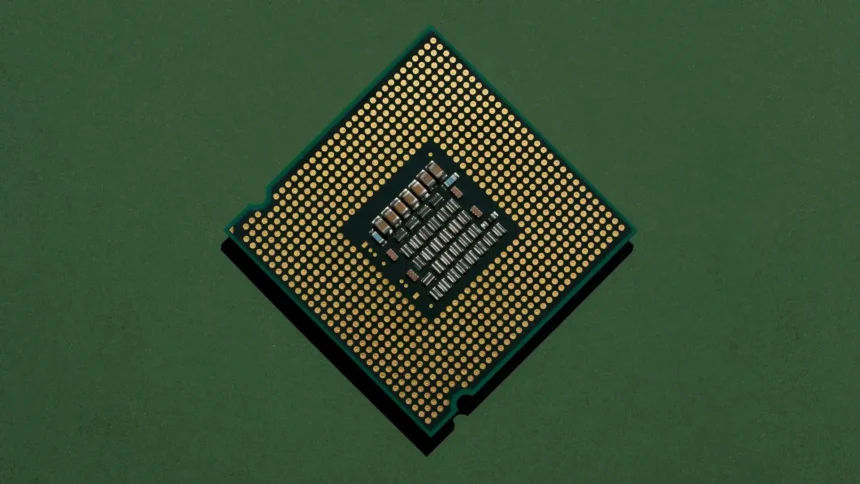
Researchers developed stacked semiconductor devices with tunable ionic memory, enabling wearable systems to process motion signals locally while achieving over 90% classification accuracy in simulations.
KAIST researchers, working with UNIST and POSTECH, have developed a stacked AI chip architecture that gives wearable electronics local memory for processing time-dependent signals. The research device uses all-solid ion-gated carbon nanotube transistors with different response speeds, allowing recent and earlier inputs to be retained without a separate memory element.
The architecture uses a solid ion-containing thin film to tune ionic conductance and create multiple response times. Faster transistor layers respond to recent signals, while slower layers retain information over longer intervals. This enables the hardware to distinguish temporal patterns rather than relying only on instantaneous sensor readings.
In device tests, the researchers distinguished all 16 possible patterns produced by four consecutive input signals being switched on or off. The measured responses were then used to build a reservoir-computing simulation for classifying videos of moving handwritten digits. The system achieved validation accuracy above 90% across sequences played at different speeds, demonstrating its ability to process information that changes over time.
The researchers fabricated the devices on 4-inch wafers as well as flexible substrates, supporting their potential integration into wearable electronics. The devices also maintained stable electrical characteristics for 55 months after fabrication. The approach uses existing thin-film semiconductor processes and supports vertical stacking, which could help increase functionality without substantially expanding device footprint.
Potential applications include low-power chips for smartwatches and other wearable systems that analyse movement and physiological signals locally. Local processing could reduce the need to transmit raw sensor data to external processors, potentially lowering latency and energy consumption.
However, the work remains at the research stage. The reported motion-recognition result comes from a simulation based on measured device responses, and further testing is required to establish performance and power savings in complete wearable systems.