


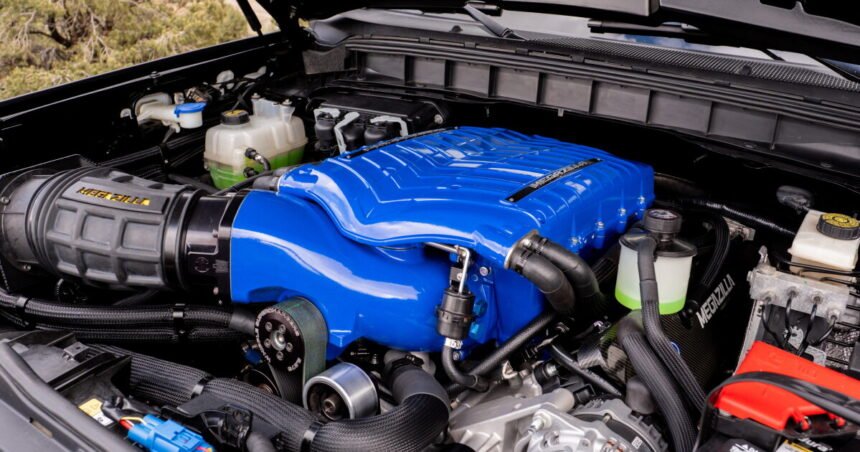
The world of the factory ‘crate engine’ might sound like an obscure niche industrial supply – but it’s the lifeblood of car customization culture. And Ford has just revealed what it claims is the most powerful ever created by a mainstream manufacturer.
A crate engine is a complete internal combustion powerplant shipped directly from a manufacturer’s factory in a wooden crate, ready to be dropped into a vehicle’s engine bay. Historically, thousands of car builders and hot-rodders have used classic drop-in powerplants to transform average platforms.
For decades, home mechanics would source a legendary small-block Chevy 350 engine to turn a 1970s family cruiser into a high-powered street machine or drop a Ford 302 Windsor V8 into a lightweight classic car. Rather than spending months sourcing, cleaning and machining a high-mileage junked engine block from a salvage yard, modern DIYers purchase factory-engineered reliability and massive horsepower straight from a catalog.
We’ve previously noted high-profile custom builders using these crate engines for monsters like 1,000-hp 1969 Mustang Mach 1 Hitman. However, Ford’s latest crate rewrites the rules for off-the-shelf powertrains.
Ford
At this year’s Specialty Equipment Market Association show in Vegas, Ford Racing celebrated its 125th anniversary by dropping this nuclear option inside a radical, one-off concept called the Frostwarden Bronco.
Designed with an Arctic search-and-rescue theme, the massive SUV with giant 42-inch BFGoodrich tires is a piece of theater to prove that this powerplant is a force built to tackle even impossible terrain.
The statistics behind the Megazilla 2.0 are staggering. On race fuel, the massive 7.3-liter (445-cubic-inch) engine pumps out more than 1,200 horsepower and over 1,000 lb.ft (1,356Nm) of peak torque. Its twisting force exceeds the capabilities of even the most hardcore turbo-diesel units.
The Megazilla 2.0’s lineage dates back to Ford’s robust cast-iron pushrod engine designed for the unglamorous Super Duty commercial truck line. Ford evolved that truck motor into the naturally aspirated Megazilla 1.0, with a respectable 612 horsepower and 670 lb.ft (908 Nm) of torque on premium pump gas.

Ford
To double that horsepower output for the new 2.0 variant, the Ford Racing Parts planning team had to redesign the unit. The massive block now features cooling cuts machined between the cylinder bores to optimize thermal management.
The bottom end is anchored by rock-solid six-bolt main caps, utilizing four fasteners entering from the bottom and two from the sides to prevent the crankshaft from walking under load. High-strength steel alloy racing head studs provide the huge clamping force (up to 220,000 psi) necessary to seal the combustion chambers against massive forced induction pressures. Inside, the engine has specialized forged pistons and a custom camshaft profile, ground to maximize airflow.
Feeding this is a Generation-6 3.0-liter (183-cubic-inch) twin-screw supercharger, driven by a heavy-duty, 10-rib accessory belt and paired with massive high-capacity fuel injectors.
Megazilla 2.0 marks a distinct fork in American V8 evolution. Historically, the factory crate engine market was defined by iron 1960s and 70s pushrod engines that prioritized cubic-inch volume over efficiency. Builders seeking lightweight, high-revving naturally-aspirated platforms have gravitated toward options like the aluminum Chevy LS427/570 crate engine, which outputs 570 horsepower from a 7.0-liter footprint.
For years, Dodge held a virtual crate monopoly with its supercharged Hellcat families, culminating in the fierce 7.0-liter (426-cubic-inch) Hellephant V8 series. This relies on an aluminum block and overhead-valve layout to pump out 1,000 horsepower and 950 pound-feet (1,288 Nm) torque out of the box.

Ford
Megazilla 2.0 is aimed right at the Hellephant’s territory. While Dodge utilizes a lighter aluminum block, Ford sticks to a massive cast-iron block. Cast iron has superior structural rigidity under extreme conditions, allowing the Ford V8 to work with more than 1,200 horses without the cylinder-bore distortion risks that plague aluminum blocks at the limit.
Relying on a larger 7.3-liter displacement and massive 3.0-liter twin-screw supercharger allows the Megazilla 2.0 to eclipse the Hellephant’s output at a lower, less high-strung thermal threshold. It gives custom car builders an OEM-engineered option that handles extreme loads better than smaller-displacement, ultra-boosted units.
Ford Racing will announce pricing closer to the actual launch. The naturally aspirated Megazilla 1.0 is US$25,295 so the more sophisticated 2.0 is expected to debut somewhere above $35,000. Whatever the price, for many drag racers, high-end resto-mod shops and extreme off-road builders, the ability to drop 1,200 factory-tested horsepower into their latest projects is likely to be a game-changer.
Source: Ford