

A compact connected controller now enables AI-generated industrial control programs to be tested on real hardware, improving fault coverage, timing validation and regression testing.
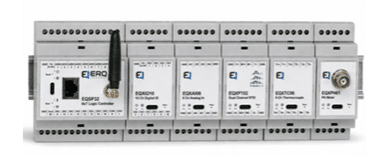
Erqos has introduced hardware-verified agentic programming for its EQSP32 Connected MicroPLC, adding native Hardware-in-the-Loop (HIL) capabilities that allow an AI agent to test the control software it generates directly on the physical controller.

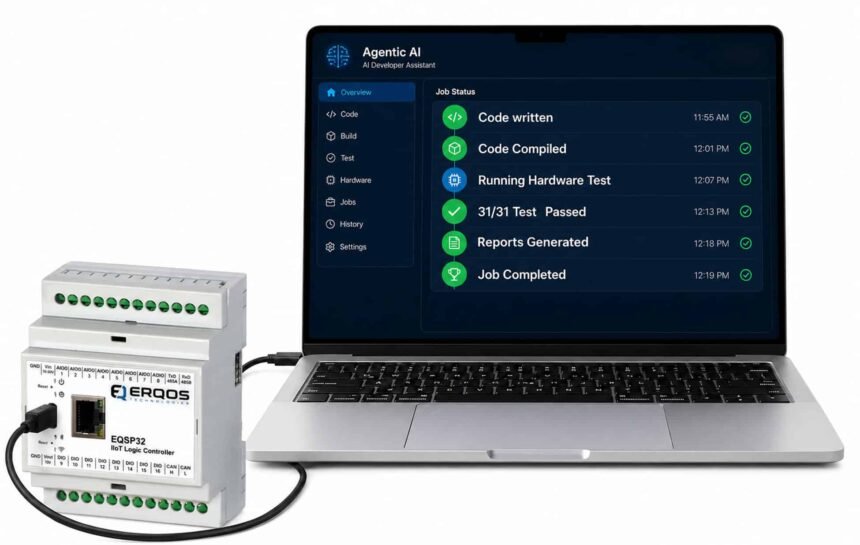
The approach changes the role of AI from simply generating PLC code to generating, executing and validating that code against a defined test plan. The EQSP32 runs the actual control program on its own silicon while the AI agent supplies simulated sensor conditions and observes the resulting outputs through a serial connection.
This creates a closed verification loop. The agent can write a program, load it onto the controller, apply operating conditions, inspect the hardware responses, compare them with expected behavior and revise the program when a test fails. The hardware therefore provides an independent check on the AI-generated logic rather than allowing the software to assume its own correctness.
The key features are:
- Real-silicon execution during automated verification
- Deterministic sensor-state and actuator-state injection
- Repeatable testing of safety interlocks
- Compressed testing for long-duration control sequences
- Persistent test artifacts for regression workflows
For industrial automation applications, the HIL capability can test conditions that would be difficult or unsafe to reproduce on physical machinery. Pressure, temperature, level and switch inputs can be injected at precise values, while outputs controlling pumps, valves and alarms can be observed. Fault conditions such as sensor failures, out-of-range measurements and threshold violations can also be introduced without exposing connected equipment to the corresponding physical fault.
Timing-dependent logic benefits from the same approach. Long operating sequences, flush cycles, delays and interlocks can be compressed into much shorter test runs. This makes it practical to evaluate more combinations of operating states, fault conditions and control transitions than conventional manual testing.
The platform is designed to provide this capability without a dedicated simulation rig or expensive test bench. According to Erqos, the verification setup can use a sub-$200 EQSP32 MicroPLC, USB connectivity and an AI agent. The HIL functionality is included in the EQSP32 library rather than being offered as a separate paid feature.
A documented reverse-osmosis water-treatment example demonstrates the workflow. Starting from system documentation and a natural-language prompt, an AI agent generated the functional specification, control program, 31-case HIL test plan, test harness and final report. The complete process reportedly took 18 minutes of unattended operation, with all 31 tests passing on the real controller.
The company positions the technology for AI-assisted industrial programming, machine control, water treatment and other automation systems where software errors can affect equipment or processes. HIL does not replace physical commissioning, however, as it cannot reproduce every characteristic of real sensors, plant dynamics, electrical behavior or long-term system operation.