


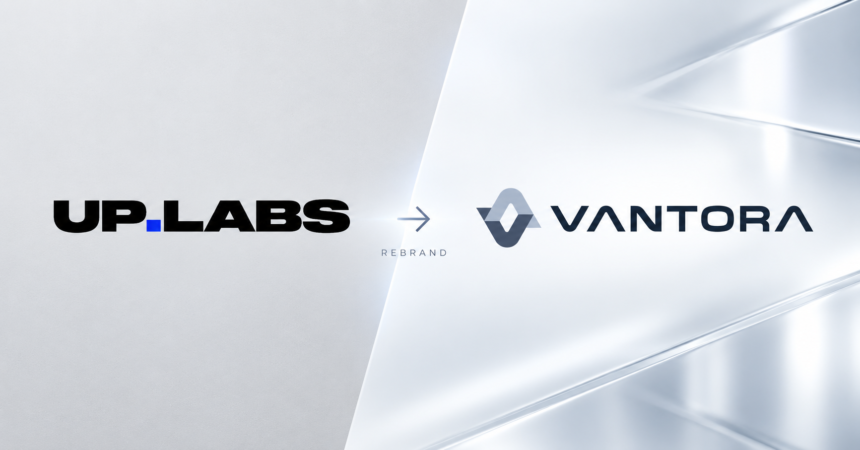
The clearest sign that a company needs to rebrand is not an outdated identity. It is a growing distance between what the business has become and what the market still believes it to be.
That was the challenge facing our client UP.Labs. The company had earned the trust of major enterprises, including Porsche, Alaska Airlines, and J.B. Hunt, yet the brand still pulled people toward venture building, mobility, aviation, and the idea of an innovation lab. The business had moved further. UP.Labs was becoming a broader enterprise build partner, helping corporations turn difficult industrial problems into new capabilities and measurable value.
The company had outgrown the way it was understood.
This week UP.Labs officially became Vantora. The work offers a useful lesson for any leadership team considering a rebrand: the goal isn’t to make the company look different. It is to make its value easier to see.
This article is part of Branding Strategy Insider’s FREE newsletter. Join the world’s smartest marketers and subscribe here for actionable insights delivered directly to your inbox.
Start With The Business Shift
Rebrands often begin with outward-facing questions. Should the name change? What should the identity look like? What should the website say? At The Blake Project, we begin with the business.
Our stakeholder interviews revealed a strong company with an inconsistent explanation. Some people described venture creation. Others saw an external skunkworks that could move faster than a large corporation. Others saw a broader model emerging around AI, proprietary data, and enterprise capabilities.
The capability was not the problem. Clarity was.
Rebranding cannot rescue a weak business, but it can make a strong business easier to understand, easier to value, and harder to confuse with something else.
For UP.Labs, the strategic shift came into focus around a simple change in meaning. The narrower perception was, “We build startups.” The larger opportunity was, “We build the system that turns hard enterprise problems into multiple sources of value.”
One describes an activity. The other describes a role in the customer’s economics.
That shift became the foundation for the new brand.
Own A Problem, Not A Category
Companies naturally explain themselves through what they do. Customers care more about what they need solved.
When you think about large enterprises, they don’t suffer from a shortage of innovation activity. They have consultants, transformation teams, technology providers, and internal innovation groups. Yet some problems persist. Management understands them. Teams test solutions. Investment gets made. Still, the problem remains.
Often, the same systems that make a corporation effective at operating at scale make it harder to build something fundamentally new.
Vantora works in that gap. It goes inside consequential enterprise problems, identifies where the leverage sits, and builds around them. Sometimes the answer is a new company. Sometimes it is a new capability. The output matters less than the shift it creates for the enterprise.
That led us toward the brand promise: Vantora turns the problems holding enterprises back into the advantages that move enterprise value forward.
Build The Brand On Proof
Rebranding creates another risk: leadership teams can become so intent on the future they want to claim that they build a brand ahead of the business capable of delivering it.
A brand can stretch a company. It should not fictionalize one.
UP.Labs already had the proof. Major corporations trusted it with consequential problems, and its model was built around outcomes, not innovation theater or pilots that never reached the core business.
Our job was not to invent a better story. It was to uncover the strongest truth already inside the company and make it unmistakable.
The strongest brand strategies connect an external promise to an internal truth. If the market is promised speed, confidence, and enterprise value, the organization must already have the behaviors and capabilities to deliver them. Otherwise, the brand becomes aspiration without evidence.
Name The Future, Not The Past
Naming only became useful after defining the strategic shift. Without a clear view of what the business must mean next, naming turns into an argument about taste.
“Labs” had served UP.Labs well. It communicated experimentation, invention, and building, but it also carried the company’s old boundaries. The new name needed to feel credible in the boardrooms of major corporations without becoming institutional. It needed to fit a fast-moving technology builder without sounding like a product.
More importantly, it needed to capture the emotional territory beneath the strategy.
Enterprise leaders cannot control the future, but they can improve their position relative to it. That led to Vantora.
Vantora is an invented name built around the idea of future advantage. It evokes vantage: a stronger position from which to see the landscape. It echoes advantage without making the word itself the claim.
The thought beneath it became: Vantora gives enterprise leaders the stronger position to shape what comes next.
A good name does not need to explain the business. It needs enough strategic meaning for the business to grow into.
Speak From The Customer’s Side Of The Table
Sophisticated businesses often sound most complicated when they are explaining themselves accurately. The problem is that customers do not experience your company from inside your organization. They experience it from inside theirs.
Vantora had plenty of language available around venture building, AI, product development, and enterprise transformation. All of it was true, but none was where the conversation should begin.
The customer begins with the problem.
So the language moved toward the stakes: Conquer Your Toughest Enterprise Problems.
The line does not begin with AI or venture creation. It begins with the problem already commanding the executive’s attention. From there, Vantora can explain how it builds AI-native companies and capabilities around those problems and turns them into growth, revenue, and enterprise value.
The order matters. Start with what matters to the customer, then explain how you create the outcome.
Brand should strengthen competitive position, pricing power, and enterprise value. The Blake Project helps make that happen.
Make The Strategy Visible
Carry the same discipline into creative expression.
AI companies have developed a visual uniform remarkably quickly: dark backgrounds, glowing networks, electric gradients, and abstract representations of intelligence. Those devices signal the category, which was precisely what we wanted to avoid.
Vantora works inside corporations that move people and goods, manufacture products, power systems, and operate large physical assets. So we established a simple creative principle: Show the world Vantora works inside, not a visual metaphor for AI. That pushed the identity toward a brighter, more physical, and more precise visual language built around glass, metal, industrial surfaces, and modern enterprise environments.
AI remains central to what Vantora builds. It doesn’t need to become the brand’s identity.
A distinctive strategy expressed through generic creative eventually becomes a generic brand.
Rebranding Should Create A Bigger Future
The best rebrands decide what deserves to move forward and what has begun to limit the business.
UP.Labs had already built trust, speed, enterprise relationships, and a distinctive operating model. Vantora carries those strengths forward. What changes is the frame around them.
That may be the most useful question for any CEO considering a rebrand: Is your brand still helping the market understand the business you are building, or is it preserving an older, smaller understanding of what your company can do?
UP.Labs didn’t become Vantora because the old brand failed. It became Vantora because the company had succeeded beyond the meaning the old brand could comfortably contain.
Which is not a cosmetic reason to rebrand. It is the best one.
Dr. Derrick Daye is the Managing Partner of The Blake Project and Publisher of Branding Strategy Insider.
At The Blake Project, we help leaders turn brand into a disciplined driver of financial performance — strengthening pricing power, competitive position, and enterprise value. Email us to start a conversation about enduring profitable growth. For The EBITDA.
Branding Strategy Insider is a service of The Blake Project, a strategic brand consultancy focused on turning brand into pricing power, growth, and enterprise value.