


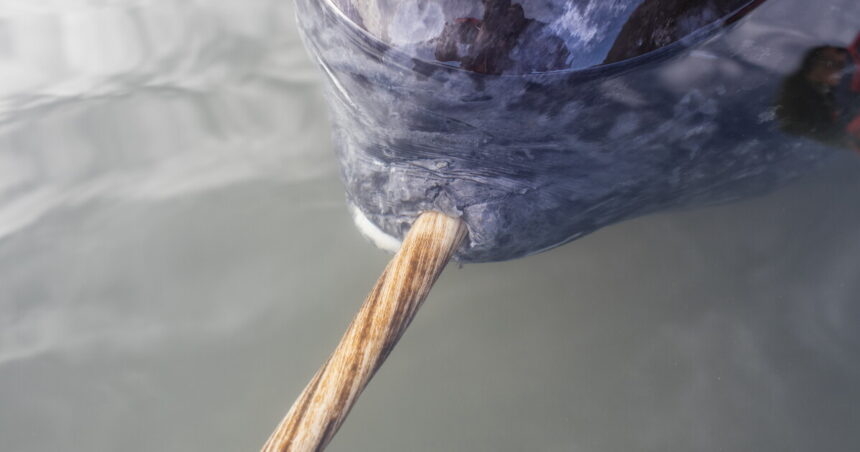
The narwhal’s defining feature – its continuously growing tusk – is the only straight structure of its kind seen in nature. Now, scientists have cracked the code on how these elusive Arctic whales grow such an impressive and unique tool.
An international team of researchers, including scientists from Denmark’s Aarhus University, have uncovered that these straight, spiraled tusks – which can grow to more than two meters (6.6 ft) over the whale’s 80-plus years – are no fluke. There’s a complex mix of physics and minerals involved in their formation.
Recently, we wrote about how, in nature, such features are loaded with an evolutionary cost – usually energy that could be allocated elsewhere. For narwhals, such energy could have otherwise been spent on more efficient fat storage or other metabolic functions to make life easier in their cold, harsh environment.
This is a clear indication that the tusk is critical for survival.
Mads Peter Heide-Jørgensen
We know a fair bit about the tusk already. In an earlier study, Harvard University scientists confirmed that the tusk plays an important role in water temperature and salinity detection, adding to its list of uses that include sexual selection and in tapping and stunning prey.
It’s also technically one of a set of two canine teeth that grows through the animal’s upper lip, with the other remaining inside the mouth. And while it may look like a solid piece of spiraling bone, the Harvard researchers detailed how its structure was like the inverse of our teeth; it has a hard center with a highly sensitive and flexible outer layer that features millions of tiny holes.
But how it’s formed has eluded researchers, until now.
Using a suite of imaging technology, Henrik Birkedal and the team comprehensively mapped the tusk’s structure across multiple scales and found masterful structural work at play on the microscopic level.
The tusk’s helical – or spiraling – shape is largely made up of mineralized collagen fibrils that run the length of the tusk. However, the inner (dentine) layer of these building blocks twist to the right, while the outer (cementum) layer twists left. So what to us may look like a distinctive left-twisting helical structure is actually the result of these two layers of fibrils oriented in opposite directions. This keeps the tusk on the straight and narrow.
“We show that the macroscopic helical structure is reproduced from the molecular-scale arrangement of mineralized collagen in a double helix with opposite chirality,” the researchers write. “While mineralized collagen predominantly aligns along the tusk long axis, systematic axial deviations build helical arrangements of fibrils. Cementum has a left-hand helix of collagen fibrils, while dentine contains a right-hand arrangement extending across annual growth layers that feature distinct biomineral properties.”
Every individual narwhal will also sport a tusk featuring a spiral that runs counterclockwise.

Carsten Egevang
Interestingly, the spiral, or helix, itself doesn’t appear to play any additional roles – increased surface area, for example – except to ensure the tusk grows straight. It’s a form of biological self-correction, in a way, because the growth materials needed are not deposited evenly around the tooth’s root.
The new findings provide fascinating insight into how underlying biomechanics work to shape – quite literally – the highly specialized features like tusks seen throughout the animal kingdom.
“The structural arrangement of tusk building blocks has remained elusive,” the team writes. “This discovery advances understanding of how biological tissues integrate multiscale structural patterns to achieve specific mechanical and biological functions.”
The researchers add that further investigation is needed to fully understand just how the tusk is formed from the set of teeth during development.
The study was published in the journal Nature Communications.
Source: Aarhus University via Scimex