


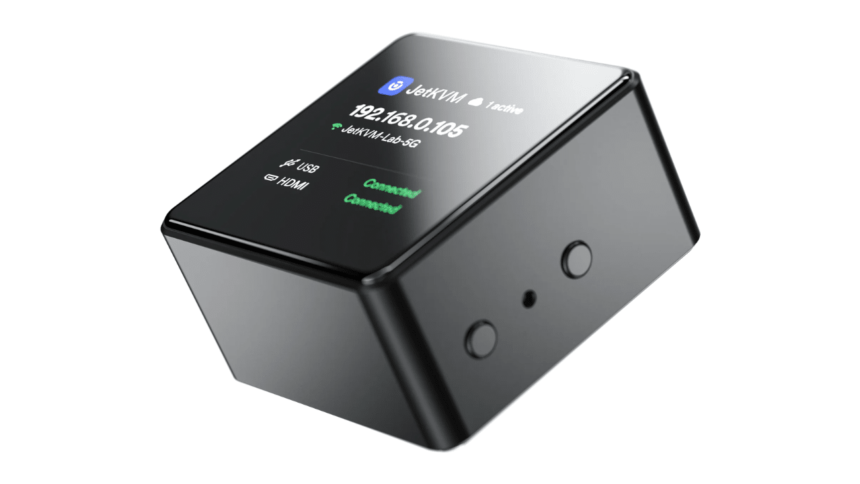
JetKVM Mini replaces the Linux processor in a KVM-over-IP device with an ESP32-P4X, supporting 1080p30 HDMI capture and scheduled to ship from 26 October at 39 dollars.
JetKVM has announced JetKVM Mini, a KVM-over-IP device built around Espressif’s ESP32-P4X microcontroller. A KVM-over-IP device sits between a computer and the network, allowing a remote user to access its keyboard, video and mouse remotely, including during stages that conventional remote-desktop software cannot normally access, such as BIOS or UEFI setup, bootloader operation and kernel panics.
Two variants are available. The JetKVM Mini uses wired Ethernet, while the Mini W adds Wi-Fi 6 and Bluetooth connectivity. Both models measure 42 × 42 × 23 mm and are specified for 5 volts at 500 mA.
The interesting part is what is not in it. KVM-over-IP devices have traditionally used an application processor running Linux, which typically requires external memory, storage and an operating-system stack. JetKVM Mini instead handles the same remote-access role using a microcontroller-based architecture.
At its core is Espressif’s ESP32-P4X, which provides dual RISC-V cores running at up to 400 MHz. The JetKVM Mini implementation pairs the processor with 32 MB of PSRAM and 16 MB of flash. Video encoding is handled by the ESP32-P4’s hardware H.264 encoder rather than relying entirely on software processing, helping the device handle real-time video within its microcontroller-class power budget.
By replacing a Linux-capable application processor and its associated memory and storage requirements with a microcontroller-based design, JetKVM aims to reduce hardware complexity and system cost while retaining the core KVM-over-IP functionality.
HDMI input supports capture at up to 1080p30 or 720p60, with the video streamed to a browser over WebRTC. The device also has a 240 × 240-pixel IPS display for local status information. Connectivity includes one USB 2.0 High-Speed port supporting up to 480 Mbps and one USB 2.0 Full-Speed port at up to 12 Mbps. The wired variant provides Ethernet connectivity through an RJ45 port at up to 100 Mbps.
A TF card slot provides virtual-media storage, allowing a remote user to mount an ISO image and perform tasks such as operating-system installation or recovery without physically accessing the host machine. JetKVM publishes the firmware as open source through its GitHub repositories. Optional expansion boards provide ATX power control, DC power control and serial-console connectivity, extending the device beyond basic keyboard, video and mouse access.
The JetKVM Mini is priced at 39 dollars for a single unit or 99 dollars for a three-pack. The Mini W is priced at 42 dollars for one unit, while its three-pack is listed at 36 dollars per unit. Both variants are scheduled to become available from 26 October 2026. According to JetKVM’s product page, JetKVM Cloud remote access is included with the devices.
The 100 Mbps Ethernet ceiling and the 1080p30 capture limit are the two main constraints engineers should consider when sizing the device. For BIOS screens, console text and installer dialogues, which are typical KVM-over-IP workloads, neither is likely to be a major limitation. Applications requiring a continuously moving desktop at 60 frames per second, however, will be constrained by the 1080p30 capture limit.
Remote hands at an Indian colocation facility is typically charged per visit, making remote access to a machine that will not boot a practical use case for a KVM-over-IP device. At 39 dollars, the JetKVM Mini is positioned below many conventional IP-KVM appliances, although the final cost of a direct import into India will depend on shipping, applicable customs duties and GST.
JetKVM currently states that the Mini will be sold through authorised resellers from 26 October 2026, but its current product information does not identify an Indian reseller. This should be checked again before publication. The applicable customs duty should also be confirmed against the final HS classification rather than estimated from the product category.
The wired Mini has no wireless radio, while the Mini W includes 2.4 GHz and 5 GHz wireless connectivity. India’s Department of Telecommunications states that Equipment Type Approval (ETA) applies to wireless equipment operating in permitted licence-exempt bands, with self-declaration available for eligible finished products. Importers should therefore verify the applicable WPC requirements for the Mini W before bringing it into India rather than assuming certification in another market is sufficient.
For Indian engineering colleges, laboratories and small server rooms, the three-unit pricing is particularly relevant. JetKVM lists the three-pack at 99 dollars for the wired Mini, equivalent to 33 dollars per unit, and 108 dollars for the Mini W, equivalent to 36 dollars per unit.
For more information, click here.