


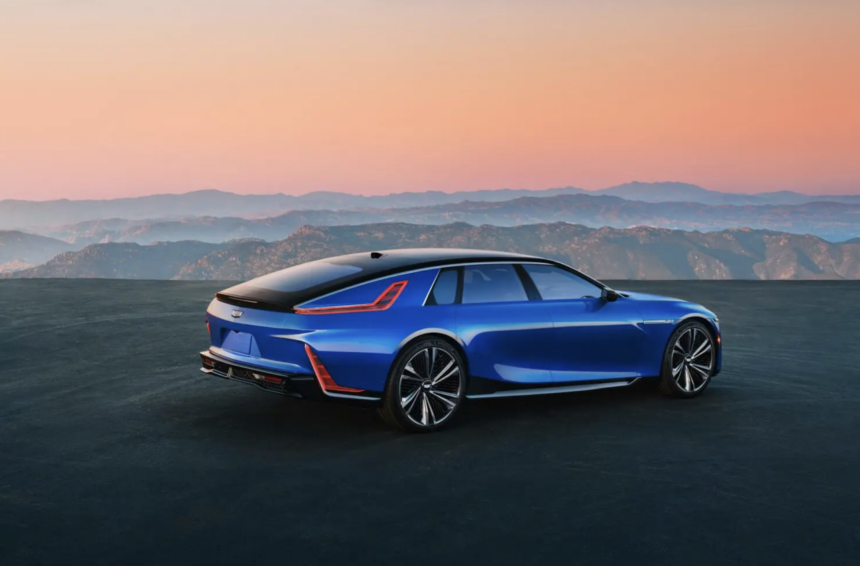
If you read The Wall Street Journal Magazine that accompanied the Saturday-Sunday Wall Street Journal this weekend, you were exposed to an ad from Cadillac for its new Celestiq model.
Not surprising to see a luxury automotive brand advertising in The Wall Street Journal Magazine among the ads for Cartier, Armani, and Dior. What is surprising is that you must actually seek the brand name Cadillac. Yes, it is there. But the Cadillac logo is in small type as part of the brand’s URL. What you see is a two-page spread showcasing a sleek arrest-me-red vehicle with a Cadillac logo floating above.
This article is part of Branding Strategy Insider’s FREE newsletter. Join the world’s smartest marketers and subscribe here for actionable insights delivered directly to your inbox.
Decades ago, before Nike and its Swoosh, before the ubiquity of the Golden Arches and the bitten Apple, Marlboro cigarettes used print and billboard advertising that did not include the name Marlboro. You knew when you saw the cowboy’s gloves holding a cigarette that this was Marlboro. You knew when you saw the terrain that this was Marlboro Country. At the time, there were no other advertised brands that ran without naming the brand.
This has changed.
A logo has enormous power. But that power must be built over time. Logo power must be built on a brand’s powerful, relevant, differentiated brand promise.
A logo is important. A logo is the brand flag. But a logo is not what generates customer relationships or employee pride. People are motivated by what the logo represents. What is the meaningfulness that the logo symbolizes?
Logo management is big business. But logo management and brand management are not the same.
The purpose of brand management is to achieve enduring, profitable growth for the business. Brand management is about organizational alignment and commitment to profitably promising and delivering a relevant and differentiated promise. The logo is the sign, symbol, or design that represents this strategic intent.
For example, there are journal articles on customer preferences for one design or another. Identity firms will provide opinions on customer preference for Pantone’s color of the year 2026, Cloud Dancer, relative to other colors in the palette, such as Pantone Nimbus Cloud and Pantone Orchid Tint. However, it is more difficult to find research showing how actual brand profitability correlates with a new color.
Logos have a place, but it is important to understand just what that place is. A new logo can be a visual representation of a transformed brand, not the other way around. A new logo with a mediocre or uninspiring brand promise will not galvanize employees, nor will it enthrall customers or cement B-to-B relationships. In fact, without a strong, compelling, relevant, differentiated, trustworthy brand promise, it is business as usual all over again, just with a new logo. A brand revitalization project – aka brand turnaround, if that is where your brand is now- will only succeed if it is a disciplined, customer-focused, multidimensional initiative of which a logo is a symbolic element.
Let’s not forget what a brand means. A brand is a promise; a promise of a relevant, differentiated, trustworthy experience. A promise creates an expectation. The product or service is the evidence that you conform to that expectation. The logo is the distinctive identity, which differentiates the promise associated with a product, service, or organization and indicates the source of the product or service.
Before deciding on the logo, marketers must focus on the relevant, differentiated, trustworthy promise that will be attached to the mark.
Focusing on the logo too early in the process, rather than focusing on the relevant differentiation of the promise behind the logo, is a formula for failure.
Cadillac has a recognizable logo. The Cadillac logo has been around for a long time.
However, here is the conundrum: in today’s world, what is the meaning of Cadillac? What is the relevant, differentiated expected experience?
Like the Lincoln brand, Cadillac has seemingly been less specific about its promised brand experience.
Lincoln states the following: “Lincoln’s purpose is to help build a better world, where every person is free to move and pursue their dreams.” This is slightly better than the “serenity” proposition Lincoln was pedaling a few years ago.
Cadillac states that its vehicles are the brand’s “newest expression of American luxury, and our vision for tomorrow.” There is some online chatter that indicates the Cadillac driving force is “Audacity.” But, the Cadillac mission statement appears to be designed to make employees happy: “…to earn our customers’ loyalty by delivering sales and service experiences with high quality, excellent value, integrity and enthusiasm.”
Brand should strengthen competitive position, pricing power, and enterprise value. The Blake Project helps make that happen.
The Celestiq ad states that it is “… a vehicle as remarkable as you.” Hopefully, those Cadillac buyers believe they are remarkable and can imagine the connectedness of their specialness to driving the special vehicle.
No matter how strong your logo, leaving the brand promise up to the customer is mismarketing. Ford’s Mercury division did this ages ago with the statement: “Imagine yourself in a Mercury.” Without knowing the promised brand experience, potential customers could not imagine not knowing what a Mercury was. Mercury died soon after Ford asked customers to be imagineers.
Contributed to Branding Strategy Insider by Joan Kiddon, Partner, The Blake Project, Author of The Paradox Planet: Creating Brand Experiences For The Age Of I
At The Blake Project, we help leaders turn brand into a disciplined driver of financial performance — strengthening pricing power, competitive position, and enterprise value. Email us to start a conversation about enduring profitable growth. For The EBITDA.
Branding Strategy Insider is a service of The Blake Project, a strategic brand consultancy focused on turning brand into pricing power, growth, and enterprise value.