


Very few people understand what it actually takes for a company to become a household name. With small-ticket products, the odds are at least somewhat kinder. Something sitting on a supermarket shelf can grab your attention, cost little enough to try on a whim, and, if you like it, be bought again and again. Familiarity builds quickly when the barrier to entry is a few dollars.
Motorcycles don’t work that way. Nobody casually throws a few thousand dollars at a bike they’ve never heard of just because the badge looks interesting.
It’s a big-ticket purchase, it’s deeply personal, and for a lot of riders, the name on the tank carries almost as much weight as the machine itself. Building that kind of trust takes years, sometimes generations.
Take, for instance, some of the brands we now take for granted. Harley-Davidson didn’t become synonymous with American motorcycling overnight. Indian Motorcycle has roots stretching back more than a century, despite disappearing and being resurrected along the way. Triumph Motorcycles has spent decades turning a once-fading British marque into a genuinely global name. And Royal Enfield, which is now one of the most recognizable brands on the planet, has had an even longer, stranger journey from its British beginnings to becoming an Indian motorcycle powerhouse.
Ultraviolette
That’s the thing about becoming a household motorcycle name: there really isn’t a shortcut.
And you’d think all the advancements in tech would have made that easier. There are more ways than ever to discover a new brand, more sophisticated motorcycles to build, more accessible manufacturing technology, and a global audience sitting just a click away. Getting attention is one thing. Convincing somebody to actually hand over their money, and then come back for another motorcycle years later, is considerably harder.
Which brings us to Ultraviolette. It isn’t a household name in the motorcycle market yet. It’s not a one-hit wonder, either. It might be lesser-known in Western circles, but where it’s from, the brand is carrying a lot of momentum with it. And maybe that’s why its imminent US arrival is getting people talking.
The company has spent the past few years building a reputation around electric motorcycles that are unapologetically performance-focused and technologically ambitious. All in a country that already produces a ton of motorcycles every year – most of which are affordable, small-bore city commuters.
But what separates Ultraviolette from a very populated two-wheeler segment in India is how unapologetically it has positioned itself as a technology and performance brand. Rather than trying to beat the likes of TVS, Royal Enfield, and Bajaj at their own game with yet another commuter, Ultraviolette has gone after the enthusiast with motorcycles that look, feel, and perform like they belong several rungs higher up the ladder.

Ultraviolette
And what’s even more impressive is that the company doesn’t rely on cheap white-labeled components to slap on its bikes and call it a day. There’s a heavy emphasis on in-house engineering, from its battery and powertrain technology to software, connected features, and radar-based safety systems.
And now, after expanding into 20 European countries and raising another US$85 million to scale production and develop its next generation of global EV platforms, Ultraviolette is setting its sights on an altogether bigger prize: America.
The company says it plans to enter the US market in 2027, potentially turning what started as an ambitious Indian electric-motorcycle startup into a genuinely global two-wheeler brand.
That new funding was led by Yali Capital and TDK Ventures. Intel CEO Lip-Bu Tan has also backed the company personally, with the veteran tech executive – who also serves as chairman of investment firm Walden International – joining Ultraviolette in an advisory role.

Ultraviolette
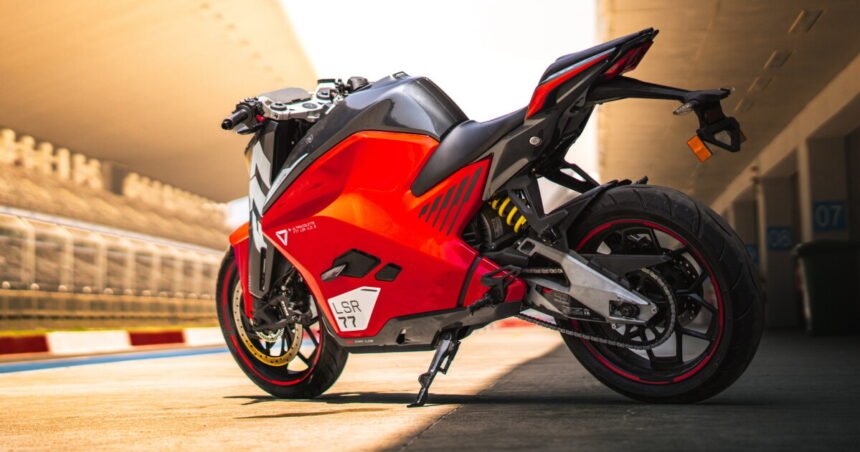
The fresh capital will help Ultraviolette ramp up manufacturing of its F77 and X-47 electric motorcycles, bring the Tesseract scooter and Shockwave electric enduro into production, and fund the development of its next generation of electric moto platforms.
We’ve been told that Ultraviolette is preparing for considerably greater production volumes for now, with the company having announced plans for a new manufacturing facility in India with an eventual capacity of up to 500,000 bikes a year.
Ultraviolette’s current lineup is as diverse as it can be for a moto brand that’s barely a decade old. At one end sits the F77, its performance-focused electric motorcycle and the model that put the company on the map.
On the other sits the newer X-47 that brings radar-assisted safety tech and an altogether more everyday-friendly approach to electric two-wheelers. Then there’s the Tesseract, which takes the scooter formula and crams it with an almost unreasonable amount of technology. And the most recent announcement that’s set to be released in the first quarter of 2027 is the Shockwave, an electric enduro aimed squarely at riders who’d rather spend their weekends throwing a bike at dirt than commuting through traffic.

Ultraviolette
Lurking above all of them is the F99, Ultraviolette’s seriously quick, fully faired electric superbike that serves as a rather unsubtle demonstration of what the company’s engineering department is capable of. Also dubbed “India’s first superbike.”
For a company still finding its feet on the global stage, that’s a surprisingly broad spread. One that looks considerably more ambitious than most newfound moto brands.
But putting America on a presentation slide and actually establishing yourself in the US motorcycle market are two very different propositions. Of course, there’ll be homologation and regulatory hurdles, distribution and service quirks, parts availability and pricing details that will need some ironing out before all of that.
Added to all that, the US is home to some of the world’s most established motorcycle brands, arguably the most influential enthusiast culture, and riders who have more choice than ever. If Ultraviolette can establish itself there, it won’t merely have added another export market to its map.
It’ll have taken a significant step toward becoming the thing every young motorcycle company ultimately wants to be: a name people know before they’ve even seen the motorcycle.
Source: Ultraviolette via Business Standard