


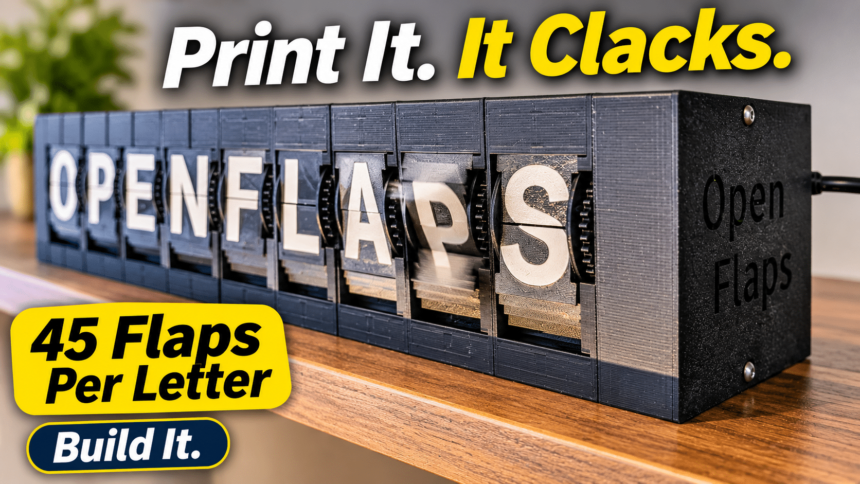
OpenFlaps combines 3D-printed characters, stepper motors and custom controller boards to build a Wi-Fi-enabled split-flap display.
Developer Ivan Marchand created an open-source split-flap display project called OpenFlaps, where it allows makers to print and assemble their own character boards. The core of the project is a Raspberry Pi Pico W to receive messages through Wi-Fi and control character modules individually. Repository shows a 16-character setup but it is expandable by connecting additional blocks.
Each character has 45 flaps, covering letters, numbers, punctuation and symbols and uses a rotating wheel. The 28BYJ-48 stepper motor is controlled by ATtiny84 microcontroller on a custom PCB through a pair of gears. For detection of each revolution and establishing the wheel’s home position a limit switch has been used. The Pico W communicates with the individual controllers over I2C, while a backboard PCB connects characters in groups of four.
Instead of controlling each motor directly the Pico w sends text while individual controllers calculate the movement needed to display each character. The default firmware settings limit the simultaneous motor operation, with power drawing around 0.25A for each motor while moving. This keeps the power requirements under control.
Mechanical parts used in the project are 3D printed, including the frames, wheels, gears and flaps. Normal PLA can be used for printing but PETG is suggested because it handles higher temperature. The project requires a custom controller along with the backboard and Pico carrier PCBs. The power required to run this project is 5V with at least 3A .
Configuration of the project included fitting the flaps and motor, connecting the character modules and programming the Pico W and ATtiny84 controllers. ATtiny84 firmware can be programmed through an Arduino IDE and ISP programmer and the Pico W runs MicroPython 1.25 or later.
The project is publicly available in the GitHub repository. So firmware, web interface code, tools, PCB files and assembly instructions are easily accessible. Firmware, web interface, tools and PCB designs are listed under MIT licence, where the 3D models are under CC BY-SA 4.0.
For more information, click here.