


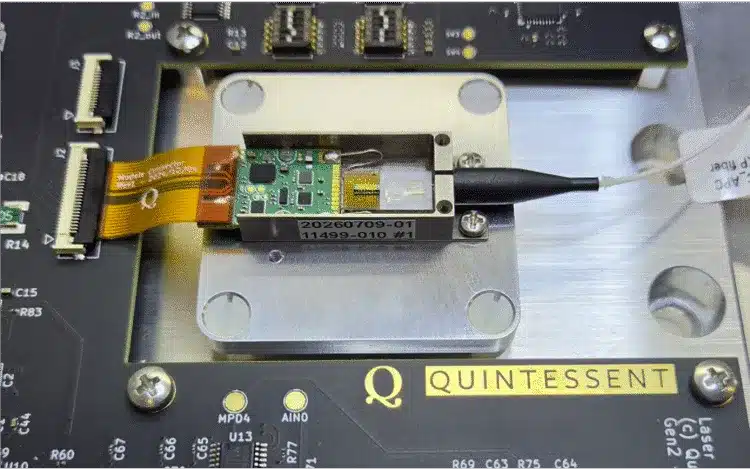
A new comb laser could simplify optical connectivity, cut power use and reduce data movement for AI-focused datacentre interconnect applications across emerging systems worldwide.
Quintessent is sampling its single-chip quantum dot-based DWDM comb laser, designed to provide multiple optical wavelengths from a single light source for optical interconnect applications in AI datacentres. The development follows a Series A funding round that raised $40 million for the optical interconnect startup.

The comb laser generates eight precisely spaced wavelengths from a single laser using a single bias control, rather than requiring a bank of individually tuned lasers. Quintessent says this architecture removes the need for high-power pump lasers and complex wavelength-control electronics, helping to reduce power consumption.
The design is also intended to lower the cost of DWDM wavelengths and reduce data movement by up to 40% compared with other narrow-and-fast architectures, according to the company. Using fewer components could additionally simplify manufacturing and improve reliability for optical connectivity within AI datacentres.
The laser architecture uses GaAs O-band quantum dot gain material instead of InP, which the company says is experiencing a worldwide shortage. The material is heterogeneously integrated on standard silicon photonics to support high-volume, wafer-scale manufacturing.
The architecture can be scaled to support more or fewer wavelengths, as well as additional CWDM wavelength bands. This could enable bi-directional optical fibre communication, with a single laser required for each direction.
Quintessent plans to use its Series A funding to invest in sampling, reliability and qualification, while also ramping up manufacturing of the comb laser. The company also intends to develop additional optical components, including semiconductor optical amplifiers and semiconductor optical amplifiers on SOAs, alongside an optical engine for pluggable module interconnect applications in AI datacentres.
The development highlights an effort to simplify optical interconnect hardware as AI workloads increase demand for higher-capacity and more efficient datacentre connectivity.