


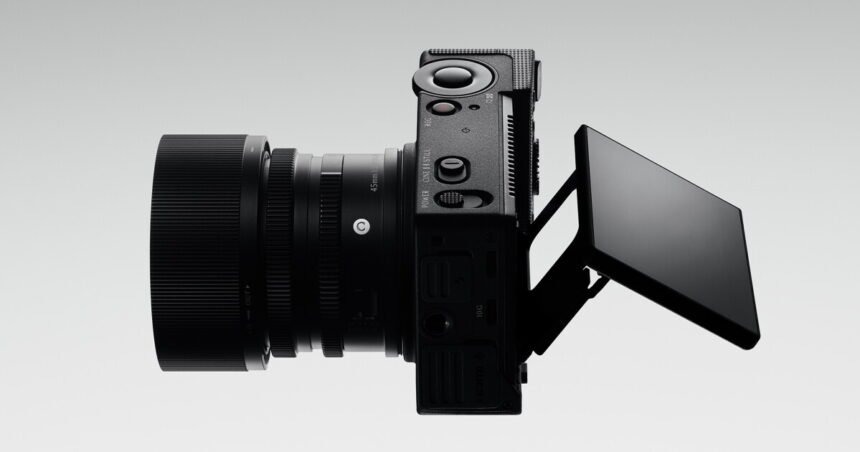
Seven years after the original fp, Sigma’s FP2 keeps the tiny full-frame formula intact while overhauling nearly everything inside it for snappier stills and much more serious video.
Compact full-frame cameras have become a fairly crowded corner of the market, with models like Panasonic’s Lumix S9 and Sony’s A7C II trying to make big sensors feel less like a commitment. Sigma got there early: we covered the original fp in 2019 when it was billed as the smallest and lightest full-frame mirrorless camera around. The company followed it up with the 61-MP fp L in 2021, then took an even more minimalist turn last year with the aluminum unibody BF.
Sigma
The FP2 is the true successor to that first fp, and Sigma is once again claiming the title of world’s smallest full-frame body. The brick-like look and modular philosophy are still here, but the internals have been rebuilt around a newer, faster sensor, with a far stronger push into cinema territory.
Rather than reinventing the concept, Sigma seems focused on fixing the quirks that made the original a tough sell for many shooters.
At the heart of the FP2 is a 24.5-MP partially stacked full-frame CMOS sensor, likely the same chip found in the Nikon Z6III and Lumix S1II. Its faster readout matters a lot here because, like its predecessors, the FP2 relies solely on an electronic shutter. That means far less rolling-shutter wobble, along with bursts of up to 20 frames per second (fps) for as many as 200 frames. Autofocus has been upgraded too, and subject detection now recognizes birds as well as people and animals.

Sigma
Video is where the FP2 really flexes. A dedicated switch on top flips between Still and Cine modes, each with its own interface. The camera records 6K open gate internally, including ProRes RAW at up to around 30 fps, and offers L-Log, 4K at up to 120 fps in crop mode, and up to 14.1 stops of dynamic range. Add the optional hot shoe unit and Panasonic’s XLR adapter, and it’ll even capture 32-bit float audio.
Practical upgrades include a screen that tilts up 90 degrees and down 45, 70 GB of internal storage alongside a UHS-II SD slot, and roughly 30% more battery life than the original fp. There’s still no in-body stabilization, though, just electronic stabilization for video. The body measures 112.8 x 69.9 x 41.8 mm (4.4 x 2.8 x 1.6 in) and weighs 446 g (15.7 oz) with its battery.

Sigma
The Sigma FP2 goes on sale on November 11, priced at US$2,199 body-only. You can also pick it up for $2,749 bundled with either the 50mm F2 DG Contemporary lens or the new EVF-21, a tilting 5.76-million-dot OLED viewfinder that plugs into one of the camera’s two USB-C ports. Other new add-ons include a hot shoe unit, a base plate with a 3/8-inch mount for video rigs, and an LCD loupe.
That body-only price undercuts the fp L’s $2,499 launch price and lands in the same ballpark as more conventional 24-MP hybrids. The trade-offs remain very Sigma, though: no mechanical shutter, no IBIS, and a grip-free brick that arguably feels most at home once it’s built into a rig. Early hands-on reviews broadly agree that the FP2 leans toward filmmakers, even though Sigma pitches it as an even split between stills and video.
Still, the FP2 looks like the most complete take on the fp idea yet. If you want a genuinely pocketable full-frame camera that can scale up into a proper cinema setup when the job calls for it, there’s still very little else out there quite like it.
Product page: Sigma FP2