


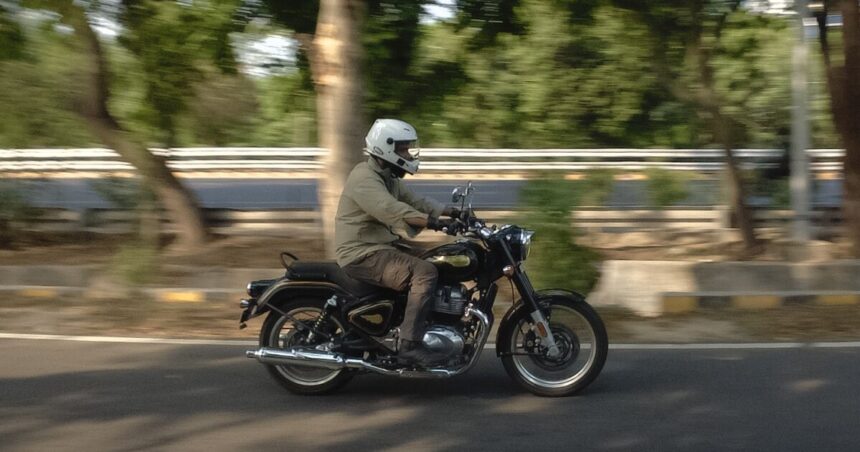
When you have the longest-running production motorcycle in your hands, the responsibility to carry it through changing times is unparalleled. The Royal Enfield Bullet has existed since 1932, and in all its years of existence, it’s never been offered with an engine as big as this.
I’m talking about Royal Enfield’s famed 650 parallel-twin engine, the same platform on which the likes of the Interceptor, the Continental, the Super Meteor are based, along with new models like the Bear and the Classic 650. Yup, the Bullet just got ‘650ied.’
Let’s run through the specs quickly before I share my thoughts on the motorcycle. The 648cc twin puts out 46.4 hp at 7,250 rpm and peak torque of 38.6 lb.ft (52.3 Nm) at 5,650 rpm – that’s more or less identical to the other 650s in Royal Enfield’s stable. It sits on a steel tubular frame suspended by 43-mm telescopic forks and twin shocks at the rear, which offers preload adjustability.
Braking comes in the form of two-piston floating calipers with a 320-mm disc at the front and a 300-mm disc at the back – both with ABS. It rolls on a 19-inch front wheel and an 18-inch rear wheel.
Utkarsh Sood / New Atlas
But there’s one thing you’ll notice right off the bat before you even turn on the Bullet 650, and that is its weight. The thing weighs a monstrous 535 lb (243 kg). That is no lightweight, especially when you consider the likes of the Honda Rebel 1100 and Triumph Bonneville T120 weigh less than that.
And notice it, you will. Now I’ve had the motorcycle with me for a few days, and I’ve mostly ridden in New Delhi – coffee runs, short freeway commutes, and evening jaunts to the football turf – the usual. Each time I swung my leg over the Bullet, I was reminded exactly how heavy it is.
And much of that heft is down to just how much metal Royal Enfield has used on it. Everything, from the mudguards to the tank, and even the “Bullet 650” emblem – everything’s metal.
But all that heft almost disappears when you get going. Anything above 40 mph (65 km/h), and the Bullet 650 feels extremely comfortable. Sure, it’s not exactly like throwing around a 200-lb electric enduro, but still, for its size, it feels extremely nimble at speed.
Utkarsh Sood / New Atlas
Speaking of speed, the Bullet 650 is no slouch, that is, if you push it hard. Out of all of Royal Enfield’s 650s, it’s perhaps the slowest to accelerate, but that’s not to say it doesn’t have sufficient power.
Relying on its bottom-end grunt instead of frenetic downshifts, the Bullet will happily chug through moving traffic in third or even fourth gear. But you will definitely feel the heat from the motor on long runs.
It can do speeds of around 55 to 62 mph (90 to 100 km/h) easily all day long. But push it harder, and you’ll certainly feel the vibrations coming in hard. It does, however, easily surpass 80 mph (130 km/h), but then you know you’re pushing its limit at that point.
I love the burbly exhaust sound (very similar to that of the Classic 650), which, even though it isn’t as bassy as the Bear 650’s, is still pretty recognizable for an Enfield fanatic. After all, there’s not much that differentiates the Bullet from the Classic 650.

Utkarsh Sood / New Atlas
The differences come in the form of the handlebar and the step-up seat, besides the subtle styling touches like the pinstriped 3.9-gallon (14.8-liter) fuel tank and gold-colored 3D badging. So if there’s not that much to differentiate it from the Classic, what’s even the point of the Bullet, one may ask?
Well, it’s all about the riding dynamics, at least for the most part. Let me start with the ergonomics. Where on one hand, the Classic 650 features a wider, higher handlebar with a more upright posture, the Bullet 650’s lower, flatter handlebar with a slightly more forward reach makes the bike feel a bit more “roadster,” especially with your feet tucked a touch farther back.
In fact, that riding triangle is so well balanced that when I switched to my Himalayan, I immediately missed the lever positions of the Bullet 650. The seat itself is a lot wider and far more comfortable than any other Royal Enfield 650. And believe it or not, it helps soak in bumps far better than the Bear 650, which is technically the company’s attempt at a Scrambler.
Although the seat height of 31.5 in (800 mm) isn’t exactly tall by today’s standards, the wide seat and the extended motor do make it ever so tricky to flat foot the motorcycle perfectly. The ground clearance is 6.1 in (155 mm), and the wheelbase comes in at 58.1 in (1,475 mm).

Utkarsh Sood / New Atlas
Cornering the motorcycle feels far easier than it should for a motorcycle of this size. It feels far more planted than the Bear 650 did when I reviewed it. A big credit has to go to the slick MRF rubber and the overall weight distribution Royal Enfield has managed with the Bullet.
Also commendable is braking, which has been a regular pain point for me with modern Royal Enfields. The Bullet somehow manages to stop far more precisely than its siblings. Especially the rear brake – it might feel unnerving if you aren’t prepared for it.
But then, it has its flaws. Of course, there’s the weight. And for the modern customer, a modern cockpit is missing in there too. The largely analog cockpit still reminds you of the bike’s beginnings. Personally, I like the analog speedometer, although the lack of a tachometer does feel strange for a bike launching in 2026.

Utkarsh Sood / New Atlas
Another weak point is the gearing – far too linear for my liking. And the tube-type wire spoke wheels … in 2026 … good luck with a flat. Riding aids like ride-by-wire throttle and traction control are absent on the Bullet. Then, there are other things – like the side stand position, for instance. It sits so close to the exhaust pipe that you’re bound to rub your shoes on the pipe while trying to push the side stand down.
Another small but very irritating part is the Tripper pod in there. First of all, I dislike how small it is. Secondly, I dislike how it’s positioned so upright instead of facing the rider. And last but most importantly, I dislike how dim it is. Riding the Bullet 650 in direct sunlight? You’ll literally have to stop, lean over, and cover the pod with your hands to actually see the directions.
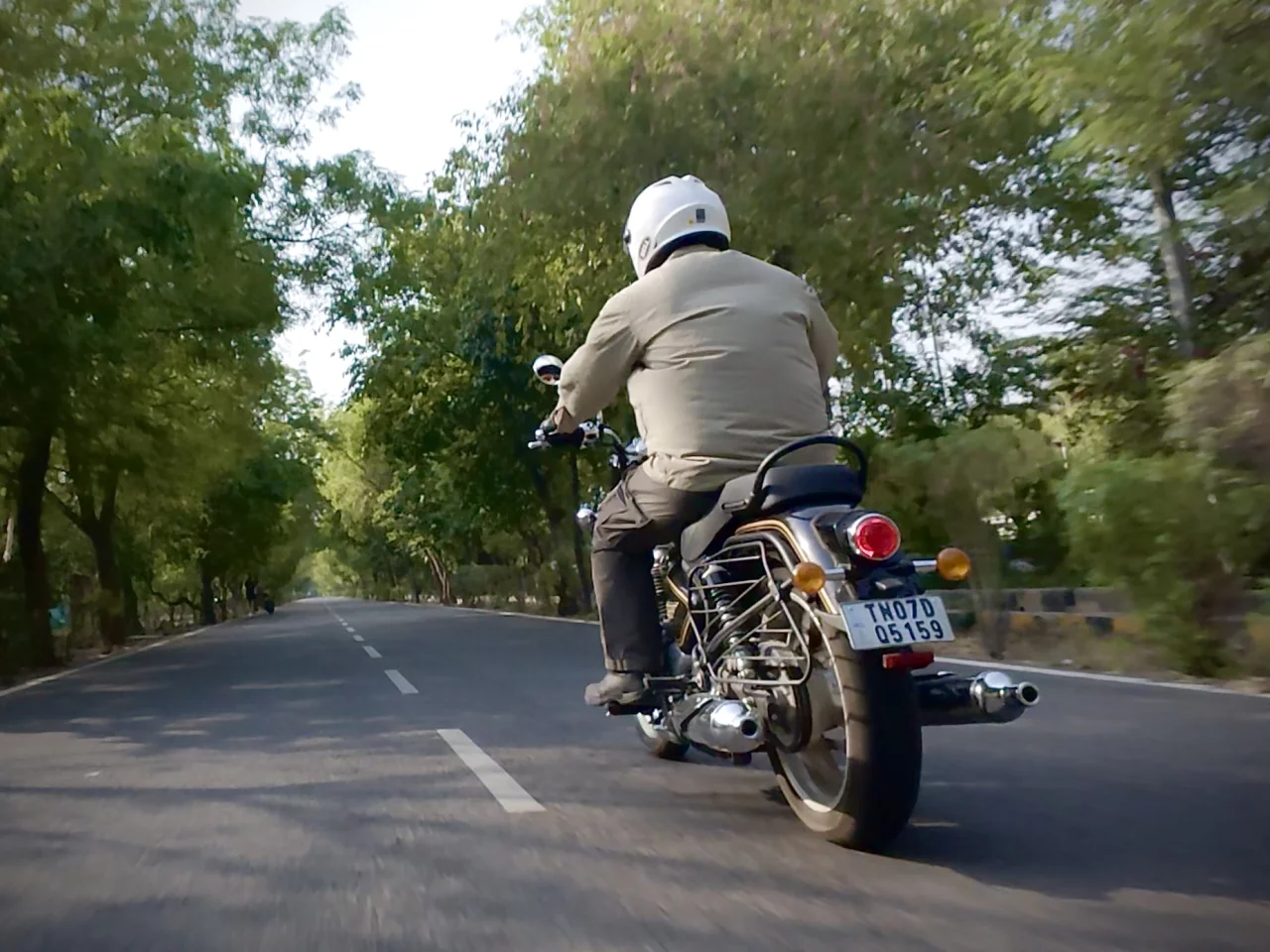
Then there are the less obvious things. Like the rear tail lamp that now resembles every other 650 in Royal Enfield’s stable. Enfield was actually better off preserving the Bullet’s traditional rectangular tail lamp, which made it instantly recognizable. Now, from the rear, you’ll have a hard time differentiating the Classic from the Super Meteor and the Bullet.

Utkarsh Sood / New Atlas
And yet, despite its flaws, the Bullet 650 still manages to come out as a rather strong offering. You see, motorcycles like the Bullet have never been about winning spec-sheet shootouts. They win you over somewhere between the first lazy twist of the throttle and the moment you find yourself taking the scenic route home for absolutely no reason.
That’s because the Bullet 650 doesn’t ask you to ride faster; it encourages you to settle into its rhythm, enjoy the mechanical pulse of the parallel twin, and remember that motorcycling isn’t always about chasing apexes or triple-digit speeds. Sometimes it’s about the simple pleasure of watching the countryside roll by with an engine that’s happy to lope along all day.
Coming to pricing and availability, the Bullet 650 has recently been launched in India for INR 3,64,856. That translates to around US$3,850 by direct conversion. Of course, when it does make its way Stateside, that pricing would reach around US$7,500 realistically. And even then, it’s a proper hoot for an authentic retro at that price.
Source: Royal Enfield