


Carbon nanotube transistors operate above 100 GHz with low power use, supporting 6G networks, wearable devices, and electronics.
Researchers at Peking University and Stanford University have developed carbon nanotube (CNT)-based transistors capable of operating above 100 gigahertz (GHz) while maintaining low power consumption, a step that could support 6G wireless communication systems and wearable electronics.
The transistors achieved a current-gain cut-off frequency of 152 GHz and a power-gain cut-off frequency of 102 GHz, while consuming less than 200 mW mm−1 of power. The devices also retained radio-frequency (RF) performance during bending tests, demonstrating their potential for use in electronics such as wearable sensors, foldable devices, and body-integrated communication systems.
Electronics have long been viewed as a direction for wireless technologies, particularly as researchers look beyond silicon-based systems. However, designing RF components that can operate at frequencies required for 6G networks—generally considered to be above 100 GHz—has remained difficult because materials trap heat more easily than rigid substrates.
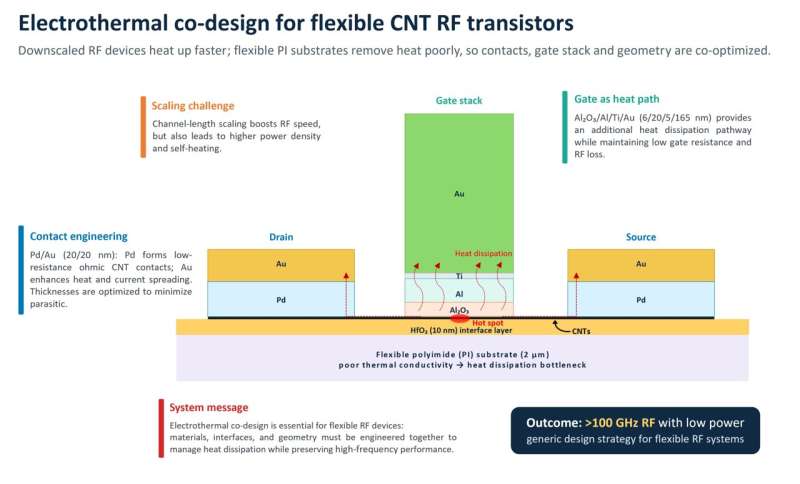
To address this, the researchers used an electrothermal co-design strategy that optimized transistor structure, device scaling, and heat dissipation simultaneously. According to the team, this approach created pathways for removing heat through the contacts and gate stack, reducing self-heating in the devices without sacrificing high-frequency performance.
The transistors use aligned carbon nanotubes as the channel material through which electrical current flows. A gate electrode controls that current at radio frequencies, allowing the device to function as a switch or amplifier. The components were fabricated on polyamide substrates, enabling them to bend and conform to surfaces while remaining operational.
One of the difficulties in scaling transistors for operation above 100 GHz is the increase in internal temperature as device dimensions shrink. This issue becomes more severe in electronics because common substrates conduct heat less effectively than silicon.
The researchers say the study also demonstrates a design framework for RF electronics, where electrical performance and thermal management are treated together rather than separately. According to the team, neglecting thermal design has been a limitation in previous attempts to create RF systems.
The group plans to continue improving the transistors by refining substrate engineering for heat dissipation, enhancing durability under repeated bending, and optimizing the device structure further. Longer term, the researchers aim to integrate CNT-based transistors with antennas, sensors, and analog or digital circuits to create RF systems for wireless and wearable technologies.