


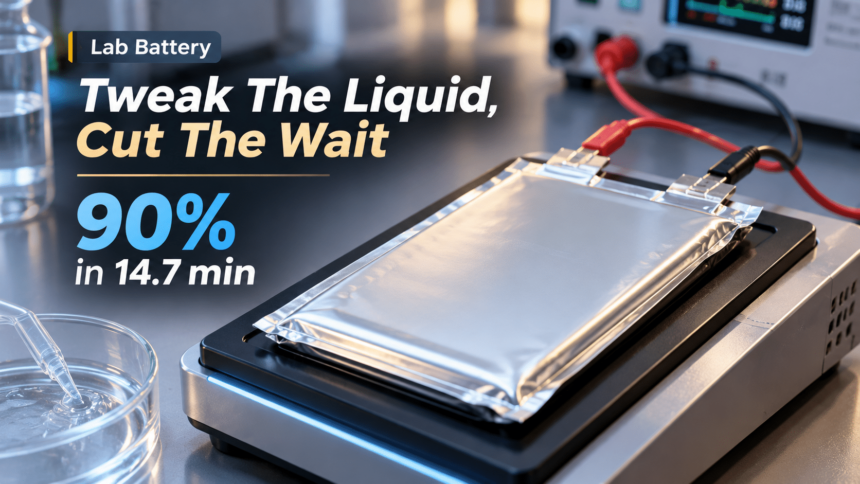
A change in electrolyte chemistry helps a lithium-ion battery test cell reach 80 per cent charge in just 12.8 minutes.
Waiting at a fast charging station is certainly not something that everyone looks forward to when driving electric cars. Researchers at the University of Maryland have demonstrated a lithium ion battery test cell that can reach 80 percent charge in 12.8 minutes and 90 percent charge in 14.7 minutes. The result was achieved by changing the chemistry of the liquid between the battery’s electrodes.

Inside a charging battery, lithium ions travel through a liquid called the electrolyte. They do not travel alone. They drag solvent molecules along with them, an effect the Maryland team calls electro-osmotic drag. During slow charging, the solvent can drift back without much difficulty. At high charging rates, however, the researchers say it cannot return easily to the porous positive electrode. This causes the electrode to dry out and limits the cell’s charging performance.
To overcome this problem, the research group introduced fluorinated functional groups into the molecules of the solvent. Thus, the interaction between the solvent and lithium ions is reduced, which enables the solvent to detach itself and go back to the positive electrode. The analogy here would be that each ion approaches with several solvent molecules clinging to it.
The cell is a four-amp-hour pouch cell, equivalent to 4000 milliamp-hours and roughly the capacity of a large phone battery. Reaching 80 per cent charge in 12.8 minutes puts it within the US Department of Energy’s target of charging an electric vehicle battery to 80 per cent in under 15 minutes. The university’s comparison places current DC fast-charging times at 20 to 60 minutes. While the reported result shows a significant improvement, a single small cell is still a long way from a complete electric vehicle battery pack.

“By the time you finish your coffee, the vehicle is charged,” said lead researcher Chang-Xin Zhao, who works in the lab of Distinguished University Professor Chunsheng Wang. The group’s stated goal is about ten minutes, so the test cell is a few minutes short of it.
This remains a laboratory result involving one pouch cell, not a complete battery pack or a production line. The university says achieving a full 100 per cent charge quickly, without compromising other battery characteristics, remains difficult. Wang says the group also wants to improve shelf life and widen the operating temperature range. Both are goals rather than demonstrated results. “We want to build a battery that can satisfy all the requirements, without sacrificing anything,” he said.
The research paper also reports an energy density of 252 Wh/kg for the four-amp-hour graphite-NMC811 pouch cell. During cycling tests, the cell maintained stable performance without noticeable capacity degradation over 200 cycles, using a 4C charging rate and a 1/3C discharging rate. However, further testing will be necessary to establish its long-term durability under repeated fast-charging conditions and across different operating temperatures.
For more information, click here.