

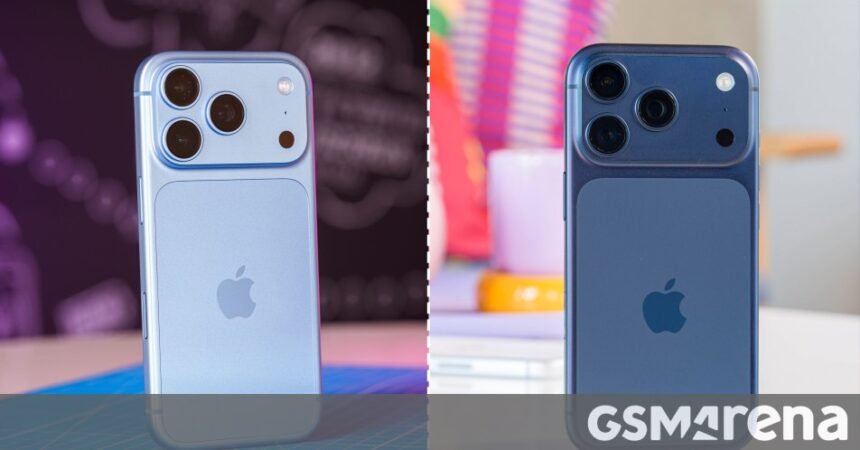
We’ve got a new iPhone in town, but the age-old question remains: do I get the new iPhone, or is last year’s model just as good? With the Apple iPhone 18 Pro now released, the Apple iPhone 17 Pro stock is running low as Apple has discontinued the model. However, if you act fast, you might find one that will feel just like the new iPhone, but at a lower price. After all, the upgrades this year are quite modest.
Looking beyond the specs, the iPhone 18 Pro does promise some improvements in certain aspects, so let’s take a closer look and try to find the nuances.
Table of Contents:
For starters, you can compare the complete specs sheets or directly continue with our editor’s assessment in the following text.
Size comparison
The previous iPhone generation was the one that introduced the new design language that will serve as a foundation for the upcoming generations, so it’s no surprise that there are almost no changes to the appearance of the two phones. Even the dimensions are identical to the point where you can put a case from the old model on the new one.
However, if you are not paying attention, it’s easy to miss the new Dynamic Island, which is narrower than before and thus takes away less screen real estate. This allows Apple to squeeze in three ongoing activities in the Dynamic Island.
Of course, there are new colors as well. The iPhone 18 Pro now comes in Black, Silver, Glacier and Burgundy, with the latter being the hero color this year. The 17 Pro, on the other hand, is offered in Silver, Cosmic Orange and Deep Blue.
Display comparison
The newer iPhone Pro comes with the same exact 6.3-inch LTPO OLED display as its predecessor. Our tests confirm it, and the supported features confirm it. In either case, you are getting a bright, feature-packed display with anti-reflective properties.
Battery life
The iPhone 18 Pro offers negligible battery capacity increase over its predecessor, so we weren’t expecting any endurance gains to begin with, but we were pleasantly surprised. The new Pro achieved better results in all of our screen-on tests and scored a higher Active Use Score as a result. Then again, one could argue that the battery life improvements are trivial at best.
It’s important to note that these tests were carried out on units with physical SIM card slots, meaning eSIM-only units will likely score a tad higher as they carry bigger batteries. In our experience, the difference is hardly a big one.
Charging speed
Apple advertised marginal charging speed improvements, and the results from our tests corroborate the company’s claims. The iPhone 18 Pro seems to be only 2 percentage points faster at the 15-minute checkpoint and 4 percentage points faster at 30 minutes. Still, the new Pro pulls ahead in the last lap and crosses the finish line about 16 minutes faster. It’s not much, but it’s something.
Speaker test
We are hard-pressed to find any meaningful changes to the overall tuning of the speakers in the newer model, so they sound just as great as before. But when it comes to loudness, the 18 Pro is considerably louder.
Usually, when you increase the volume of tiny speakers like these, you get worse audio quality, but Apple managed to maintain the excellent output while improving loudness, so kudos for that.
Performance
To be honest, the only generational-worthy upgrade that we got this year with the new iPhones is the chipset. The new Apple A20 Pro SoC appears to be considerably more powerful than the A19 Pro powering the iPhone 17 Pro. It’s also based on a more efficient 2nm manufacturing process and employs twice as many Neural Engine cores responsible for AI-related tasks.
Both iPhones ship with 12GB/256GB memory by default, but only the 18 Pro goes up to 2TB storage. The 17 Pro caps at 1TB.
Be aware, however, that independent testing has revealed that the 1TB and 2TB versions of the iPhone 18 Pro use QLC storage, which suffers a significant drop in write speeds once the storage is more than 60% full.
Benchmark performance
The new A20 Pro chip outperforms the older generation by about 27% in CPU-heavy workloads and by about 13% in GPU tests. These performance gains are far from trivial, but they can also easily go unnoticed by the vast majority of users. Flagship chipsets have gotten more than powerful enough these days.
Camera comparison
Apple introduced a couple of reasonably significant hardware changes last year (new telephoto and new selfie camera), so the 18 Pros keep the upgrades to a minimum – the main camera gets a variable aperture lens which is also brighter at the wide open end compared to the one on the 17 Pros. The range is f/1.48 to f/4.0, with two in-between settings (f/1.8 and f/2.8). The 17 Pros’ aperture is fixed at f/1.78.
Teardowns revealed there’s a new sensor model being used on the main camera, but it still has the same basic specs – 1/1.28″ optical format and 48MP resolution. The camera uses sensor-shift image stabilization, as before.
The telephoto camera remains the same as last year, with its 100mm equivalent lens providing 4x optical zoom, but the lack of close focusing remains a pain point. The ultrawide is around 13mm equivalent – again, unchanged. All these sensors have a 1/2.55″ optical format and a 48MP nominal resolution.
As last year, all three rear cameras offer 24MP shooting capability, and that’s the default setting too – you get that at 0.5x, 1x, and 4x, while the 2x and 8x zoom levels stick to 12MP. At the native zoom levels, you also get a 48MP option.
The selfie camera remains unchanged, too. Its squarish 18MP sensor provides enough image area to capture selfies in either portrait or landscape orientation, without having to rotate the phone itself.
A new development this year that just might be the most important one, and the one actual significant difference between the 18 Pros and the 17 Pros, is the manual mode in disguise. You get the option to set shutter speed and white balance, in addition to the main camera’s aperture, though manual ISO setting is still missing. It’s not a dedicated mode and you kind of have to set each parameter separately from its own sub-menu from the contextual settings pane, but it’s still something that the 17 Pros don’t have.
Image quality
Daylight
Main camera photos at 1x from the two phones are more similar than they are different, unsurprisingly. That said, the 18 Pro has a slight tendency for warmer colors in general, showing in pavements and greenery (with a particularly pronounced example in the Vespa scene, though this is more of an outlier).
We’re also liking the new generation’s detail rendition better – it’s finer and better defined, and consistently so. Between the new lens, the new processor, and possibly the new sensor, there just might be enough improvements to add up to ever so slightly better shots.








Daylight comparison, main camera (1x): iPhone 18 Pro • iPhone 17 Pro
Now, we’re not seeing much of a use case for manually choosing the wide open f/1.48 aperture on the iPhone 18 Pro in broad daylight for the vast majority of scenes. You do stand to gain some extra background blur, yes, which can be useful when trying to isolate nearby subjects. Then again, the new model’s f/1.8 results already seem to have softer bokeh than the old model’s f/1.78 photos, and the move from there to f/1.48 is a little less noticeable.















Daylight comparison, main camera (1x): iPhone 18 Pro, f/1.8 • iPhone 18 Pro, f/1.48 • iPhone 17 Pro, f/1.78
At 2x, the new generation models are also a little sharper, though it’s somehow not as universal – sometimes the images look just about the same between the two.








Daylight comparison, main camera (2x): iPhone 18 Pro • iPhone 17 Pro
At 4x zoom, there’s a bit of that warmer color rendition going on as well. We wouldn’t say there’s much of a sharpness or detail difference, though the old models’ noise performance is a bit worse in dimmer indoor scenes, so you can also try and count that as a generational improvement – that’s the magnitude of improvements you can hope for at this point.








Daylight comparison, telephoto camera (4x): iPhone 18 Pro • iPhone 17 Pro
At 8x, it’s a bit more of the same.








Daylight comparison, telephoto camera (8x): iPhone 18 Pro • iPhone 17 Pro
Comparing photos from the ultrawides, the new generation’s warmer color rendition persists. And that’s about all the difference we can spot – there’s not much to split the two on a pixel level, not in terms of detail, and not in terms of noise performance either.








Daylight comparison, ultrawide camera (0.5x): iPhone 18 Pro • iPhone 17 Pro
Low light
In the dark, the iPhone 18 Pro’s main camera will essentially exclusively shoot at f/1.48 when left in full auto, which is understandable. That said, it’s not substantially better at f/1.48 than it is at f/1.8 – in fact, we can’t say we’re certain that it is better at all. We weren’t expecting miracles and huge differences, of course, but we were kind of hoping the extra light would be beneficial more than it’s proving to be.
With that in mind, comparing against the previous generation is also not showing a whole lot of improvement, if there is any at all.








Low-light comparison, main camera (1x): iPhone 18 Pro • iPhone 17 Pro
Here’s a couple of scenes with the iPhone 18 Pro at both f/1.48 and f/1.8, next to the iPhone 17 Pro’s respective f/1.78 shot – for more immediate comparison.












Low-light comparison, main camera (1x): iPhone 18 Pro, f/1.48 • iPhone 18 Pro, f/1.8 • iPhone 17 Pro, f/1.78
We’re then faced with the slightly uncomfortable realization that at 2x zoom the previous generation is actually that little bit sharper – and it’s not just occasionally, but every time, it seems. It’s anything but a dramatic difference, but the advantage had to be in favor of the new model, and it’s not.








Low-light comparison, main camera (2x): iPhone 18 Pro • iPhone 17 Pro
The 4x images from both phones are pretty grainy and neither camera’s results are particularly sharp either. There’s apparently slightly different thresholds for the engagement of Night mode – the third scene did trigger it on the 18 Pro and not on the 17 Pro – and the fact that the photo looks better from the iPhone 18 Pro makes that an improvement, probably.








Low-light comparison, telephoto camera (4x): iPhone 18 Pro • iPhone 17 Pro
Now, is the iPhone 17 Pro a little grainier and noisier at 8x than the iPhone 18 Pro? Yes. But is the iPhone 17 Pro a little better at capturing what looks like detail than the iPhone 18 Pro is? Well, maybe yes too.








Low-light comparison, telephoto camera (8x): iPhone 18 Pro • iPhone 17 Pro
The two ultrawides capture more or less the same photos and they’re not too exciting – they’re pretty soft and noisy, not to mention dim and gloomy.








Low-light comparison, ultrawide camera (0.5x): iPhone 18 Pro • iPhone 17 Pro
Selfies
There are no changes to the selfie camera hardware and the photos you’d be getting from both phones are essentially the same.








Selfies comparison: iPhone 18 Pro • iPhone 17 Pro
Video quality
Below we have a few framegrabs from the videos taken by the two phones at each focal length so it’s easier to compare to one another.
Not a lot has changed with the iPhone Pro’s video recording capabilities this year. So, then, both phones here can record video up to 4K at 60, 30, or 24fps with all of their cameras (the three rear ones and the front-facing one), and the primary cameras on the back can also do 4K120 at both 1x and 2x zoom.
You get Dolby Vision recording capability in all modes too, plus ProRes and Apple Log 2 options, though you will need to record to external storage for some of the higher fps modes to be able to work.
One slight change on the 18 Pro is that Cinematic mode now maxes at 4K60, up from the 4K30 on the 17 Pro. The other advantage of the new model is that the manual controls (shutter speed, white balance, aperture) are available in video too – you don’t get those on the 17 Pro.
When it comes to the end results, we’d struggle to spot a meaningful difference between the footage of the two phones, much less a pattern. Perhaps the one instance where the clips don’t look the same is at 2x in daylight, where the iPhone 18 Pro has a small advantage in sharpness – the rest of the clips are as good as identical.





Daylight video screengrabs, iPhone 18 Pro: 0.5x • 1x • 2x • 4x • 8x





Daylight video screengrabs, iPhone 17 Pro: 0.5x • 1x • 2x • 4x • 8x
That doesn’t appear to translate into low-light videos – at night, the iPhone 18 Pro loses its 2x advantage. The nighttime videos are a toss-up – you can hardly tell the videos have been captured by different phones.





Low-light video screengrabs, iPhone 18 Pro: 0.5x • 1x • 2x • 4x • 8x





Low-light video screengrabs, iPhone 17 Pro: 0.5x • 1x • 2x • 4x • 8x
Verdict
In a typical year, our recommendation would have been fairly straightforward: go for the newer iPhone, unless you’re upgrading from something as recent as the iPhone 17 Pro. This year, however, the price hike complicates matters, particularly in Europe, where the iPhone 18 Pro launches at €150 more than its predecessor in some markets.
The 18 Pro has slightly better battery life, a tad faster charging, a bit louder speakers and a considerably more powerful chipset, which isn’t something you’d notice in normal day-to-day usage. It also has a smaller Dynamic Island and variable aperture on the main camera, but the latter doesn’t do much in the real world, as per our findings. And for that, the €300 price gap between the iPhone 17 Pro and the 18 Pro in Europe is hardly justifiable.
But if you are in the US, the iPhone 18 Pro might be your only option. We had a look at several online stores, and brand-new, unopened 17 Pros were already hard to find. But if you get lucky, you might be better off with a 17 Pro, and you will save a few bucks in the end.
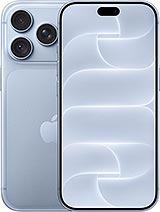
- The slightly longer battery life.
- The slightly faster charging.
- The louder speakers.
- The much more powerful chipset.
Get the Apple iPhone 18 Pro for:
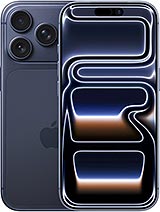
- The considerably lower price tag.
- The near-identical user experience.
Get the Apple iPhone 17 Pro for: