


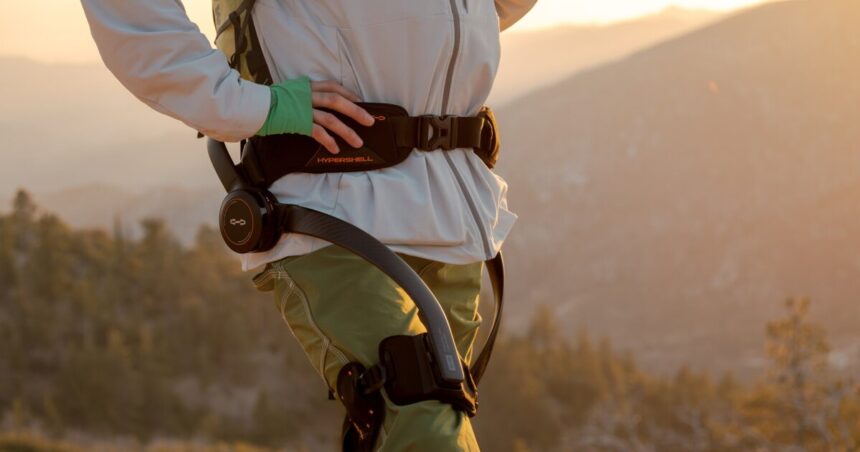
Hypershell’s new X Series exoskeletons use AI-driven motion control to give you a little extra spring in your step, offering walking and hiking assistance across different terrain, ranges, and support levels.
Consumer exoskeletons have steadily moved beyond the realm of sci-fi demos and medical devices, with companies increasingly positioning them as outdoor mobility tools for hikers, active older users, and professionals who spend long days on their feet. We saw this shift first hand when we reviewed the Hypershell Pro X last October, finding a wearable that isn’t just a gimmick, but a genuinely practical walking assistant.
The new X Series builds on this idea with three distinct models: the X Ultra S, X Max S, and X Pro S. The entire range is powered by HyperIntuition, Hypershell’s predictive movement-syncing software, and features varied power outputs and terrain-focused modes for demanding environments.
Hypershell
Rather than just adding raw power, Hypershell is focusing on seamless synchronization with the X Series – reducing your metabolic effort by aligning the machine’s output to human intent.
HyperIntuition is the main software upgrade driving the new X Series. Hypershell describes it as an AI-driven motion control system that combines perception, movement recognition, prediction, and planning into one continuous loop. In practice, the goal is to move beyond rule-based assistance, and instead, offer a type of support that adapts more naturally based on both the individual and the terrain.
According to Hypershell’s TÜV Rheinland-verified materials, the system achieves 97.5% gait synchronization and responds within just 0.31 seconds, making the algorithm 64.5% faster than the previous generation. The key claim isn’t just that the exoskeleton adds support, but that it does it at the precise moment you most need it.

Hypershell
On the hardware side, the Ultra S and the Max S use Hypershell’s M-One Ultra motor system, rated at up to 1,000 W, 22 Nm (16.2 lb.ft) of torque, and a 25-km/h (15.5-mph) max assisted pace. The Ultra S offers up to 30 km (18.6 miles) of range per battery charge. The Pro S steps things down to 800 W, 18 Nm of torque, a 20 km/h assisted pace, and 17.5 km of range.
With IP54 protection, foldable designs, and 1.8-2-kg (3.96-4.4-lb) weights, the series is built for long outdoor sessions in varied settings – not just flat urban walking.
The new lineup also comes with a few comfort and durability upgrades. These include a three-zone waist pad, honeycomb silicone anti-slip structure, and ergonomic back pad to keep the device stable during longer uses. On the flagship X Ultra S, Hypershell adds titanium alloy and carbon fiber components tested through one million high-torque swing cycles.

Hypershell
The models are split by use case and intensity. The Ultra S gets Dune and Snow modes, Boost Mode, and extra fitness-focused features. The Max S targets mixed terrain. And the Pro S is aimed at lighter outdoor movement.
Hypershell is also launching HyperLIFT: a search-and-rescue field test program planned for more than 50 SAR organizations, suggesting the company wants the technology tested beyond recreational hiking and into more demanding field work.
Pricing starts at US$999 for the X Pro S, going up to $1,499 for the X Max S and $1,999 for the X Ultra S. The series is available now in several regions, including the US, Canada, China, and Australia, and is expected to roll out in more countries in the near future.
Hypershell’s exoskeletons are undoubtedly cool gadgets, but for now, they still occupy a fairly small niche. If the company can deliver on its promises of seamless synchronization, the X Series could transition consumer exoskeletons from a pricey novelty item into an essential piece of utility gear for the global outdoor market.
New Hypershell X Series | Global Launch Event
Source: Hypershell