



April 22 -23 – Silicon Valley
How do Portfolio Acquisition Executives and COCOMs ensure they’re working on the right problem with the right priority before locking in a requirement? Discuss, share and prototype Innovation Targeting concepts with your peers. Get hands-on with the companies and venture capitalists, on how to do a “technical terrain walk” to rapidly identify, validate, assist and on-board the technology.
If you are part of a PAE or CPE register here: https://www.commonmission.us/red-queen-7
The Department of War is in the midst of the most ambitious acquisition reform in 60 years. It’s just in time as drone and missile warfare lessons (autonomy, Counter UAS, etc.) from Ukraine and the War in Iran are top of mind and reshaping what the DoW is buying. Reorganizing the DoW into Portfolio Acquisition Executives is reforming how the DoW is buying. The new Warfighting Acquisition System is working to reward speed to delivery.
These are real reforms, and they implement nearly every recommendation the defense innovation community has made for the last decade.
And yet many of the weapons and systems they are about to buy will be for yesterday’s problems.
Here’s why.
Do Something! Is Not the Same as Solving the Problem
Our combatant commands and allies desperately need an immediate solution to counter drones. We’re shipping what we have and we’re rapidly scaling up more of it. But that’s not the same as solving the Counter UAS problems.
Today, the Counter-UAS response has invested heavily in the develop, scale and deploy phases. JIATF-401 was stood up last August to proliferate counter-drone capabilities. The Army runs industry competitions. DIU scouts commercial technology. The PAE reform consolidates requirements, contracting, testing, and sustainment under a single portfolio leader. These are the middle phases of the innovation cycle, and they are getting real investment and real attention. But what’s missing is where the inputs to requirements will come from.
If this isn’t fixed, we’ll end up solving yesterday’s problems. So, how do we ensure we’re working on the right problem with the right priority before locking in a requirement?
What’s needed is a rapid Portfolio Acquisition Executive requirements process to replace the rigid and unwieldy JCDIS – one that collapses the cycle time between problems, requirements and acquisition. One that can deliver a 70% solution fielded in weeks, assessed against operational reality, with findings distributed across the force and fed back into detection of the next problem.
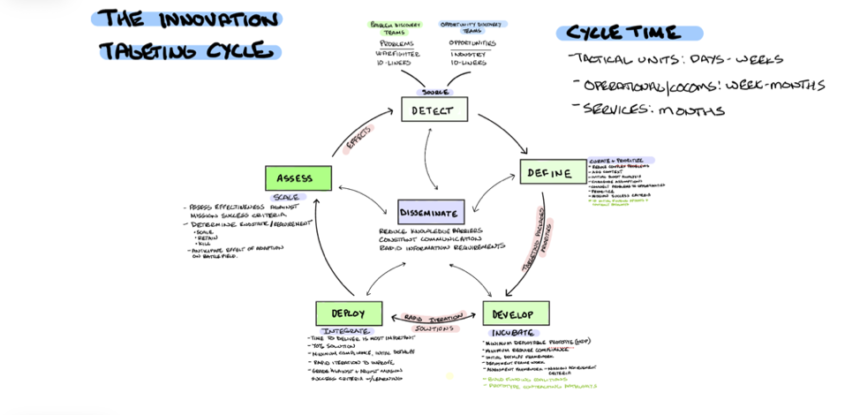
The Innovation Targeting Cycle
Each Portfolio Acquisition Executives needs four things the current organization reforms don’t provide:
- Forward-deployed Problem Discovery Teams in the Combatant Commands – embed small, cross-functional teams with operational units, sourcing and curating problems from direct observation. Not technology scouts. Problem scouts. These don’t need to be organic to the PAE.
- Fusion Cells – collect data from the field, industry and labs and rapidly do due diligence to ensure we are working on the right problems at the right tempo with the right expected outcomes.
- Rapid operational assessment is built into the cycle, not conducted as a post-mortem months after fielding. Every deployment of a capability should generate data: did it work? Did operators adopt it? Did the adversary adapt? That data feeds the next rotation.
- Lateral distribution at operational speed – what one unit learns must reach every other unit facing the same threat before the next engagement, not the next rotation. Our institutional schoolhouses operate at institutional
 The Innovation Targeting Cycle phases – Detect, Define, Develop, Deploy, Assess, Distribute – run continuously by a fusion cell, each rotation generating the input for the next. A solution fielded in weeks, assessed against reality in the field, with rapid dissemination of findings across the force.
Detect – Persistently monitor how a threat evolves at the tactical edge with forward-deployed problem discovery teams embedded with operational units, scanning for how the adversary adapted since last week. (Today’s case would be drones.)
Define – Scope the specific problem each unit faces with enough precision to drive useful solutions. A PAE leader at headquarters, no matter how empowered by the new reforms, cannot see the distinctions that matter without ground truth from the fight. Requirements still originate from within the institutional system – headquarters staffs, Service-level assessments – not from soldiers and Marines observing the problem in context.
Tying all of this together is a PAE Fusion Cell that collects the inputs from the operational force, industry and the labs and executes the discovery required to confirm we are working on actual problems (not symptoms) and the required speed to solve them.
Assess – Systematically measure whether fielded systems actually work against an adversary who adapts after every engagement. We tend to field systems and declare victory. Without assessment, there is no feedback loop. Without a feedback loop that anticipates adaptation, you cannot out-cycle the adversary. (Today this would be counter UAS systems.)
Distribute – Ensure that what one unit learns reaches every other unit facing the same threat at operational speed much less delivers that same assessment to industry.
IED’s – roadside bombs – were killing servicemen in vehicles and on foot in Iraq and Afghanistan. The parallels between the counter-IED fight and the current counter-drone fight are uncannily exact.Both the Iraq IED threat and the Ukraine/Iran drone threat have 5 characteristics that make them resistant to conventional acquisition:
- Cheap, dual-use components. IED parts were globally available commercial products. Drone components are identical — flight controllers, autopilot software, motors, all commercially sourced. A Shahed-pattern drone costs ~$20,000. We engage them with $400,000 Stingers.
- Adversarial knowledge proliferates faster than acquisition countermeasures. In Iraq IED construction techniques spread through informal networks faster than the Army could field countermeasures. Today, drone designs spread even faster — through open-source repositories, commercial supply chains, and state-sponsored proliferation from Russia to Iran to the Houthis, and Hezbollah.
- Adversaries Had a Faster OODA Loop. Every time we fielded a jammer, within weeks the adversary swapped trigger mechanisms. Drones are the same way. New radio/satellite links, new autonomy software. The adversary’s development cycle runs in days. Ours runs in years.
- Tactical variation that defeats one-size-fits-all solutions. IEDs in Helmand Province were a different problem from an IED with an explosively formed penetrator in Baghdad. The Counter-UAS threat has identical variation. A Houthi one-way attack drone flying 1,500 km is nothing like an FPV (First Person Video) kamikaze at the platoon level, which is nothing like a Chinese autonomous swarm.
- Our reflex is to throw technology at a systems problem. The U.S. spent over $75 billion on counter-IED. As War on the Rocks concluded last November: drones are “IEDs that fly now.” The failed counter-IED framework should not be replicated. But that is precisely what is happening.
Summary: The reforms to the Warfighter Acquisition System provide Portfolio Acquisition Executives (PAEs) with the organizational structures for Developing, Scaling and Deploying weapons.
An Innovation Targeting Cycle would provide the front end that connects the reality of the warfighter’s at the tip of the spear to the PAEs.
Several PAE organizations have already begun this journey. Others are just beginning. We need to develop and share best practices across PAEs and across the DoW.
 Join us at The 7th Annual Red Queen Conference
April 22 -23 – Silicon Valley
How do Portfolio Acquisition Executives and COCOMs ensure they’re working on the right problem with the right priority before locking in a requirement? Discuss, share and prototype Innovation Targeting concepts with your peers. Get hands-on with the companies and venture capitalists, on how to do a “technical terrain walk” to rapidly identify, validate, assist and on-board the technology.
If you are part of a PAE or CPE register here Register here: https://www.commonmission.us/red-queen-7
Filed under: National Security, Technology Innovation and Great Power Competition, Technology Innovation and Modern War |