


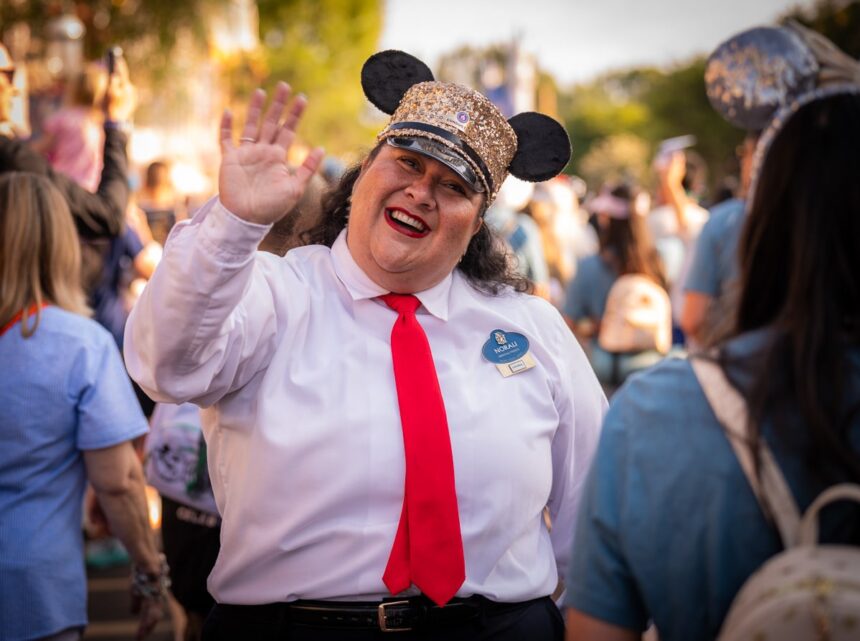

After he was named CEO, we published 11 Great Changes Josh D’Amaro Could Make at Walt Disney World for Big Wins. One of the entries highest up our list was “Invest in Cast Members.” As explained there, prioritizing a pre-closure initiative to invest millions of dollars in Cast Member morale would be an easy way for the company to signal a return to the “old school Disney way of doing things.
This would have immensely positive cascading effects. One increasingly common complaint from readers we’ve heard in the last few years is that Cast Members are not as “magical” as they used to be. There are several reasons for this very real phenomenon, from taking abuse by disgruntled guests to turnover to low morale.
Fixing low morale alone will help remedy this. Higher morale also reduces turnover. Less turnover means less pressure on other Cast Members, which further increases morale. All of this indirectly results in a better guest experience, which improves attitudes of visitors. It’s a not-so-vicious cycle of improving the experience for everyone.
Shortly after that last ‘advocacy effort’ for the new regime redoubling efforts to invest in Cast Members, I attended the Disneyland Resort Business Update. During that event, leadership from the resort shared plans for the future, along with changes they’ve made over the last year to measurably improve the guest experience.
One of the presentations during this event was made by Brenai De Haro, Director of Operations & Integration at the Disneyland Resort. She shared several changes her team has made over the last year-plus, along with problems post-COVID, and ways Cast Member training is improving, which should in turn improve the guest experience.

It was an illuminating and candid conversation, and one that vindicated some of the guest complaints we’ve heard over the last few years about Cast Members. That’s always a sensitive subject, as Cast Members truly are the magic and most have been–and continue to be–superlative.
At the same time, it’s hard to deny that standards have slipped since 2019. From the furloughs that resulted in the loss of many seasoned Cast Members to lower morale during the dark days of the Chapek era to tighter labor markets and more, it was a rough few years. The post-COVID comeback remains ongoing in some small and less visible ways.
It should be possible to accept both as true (that Cast Members are the magic but service standards have slipped), but there’s an unnecessary tension in these two positions (RIP nuance). That’s why it was refreshing to hear Disney leadership essentially say the same thing, and explain how they’re working to bring back that circa 2019 magic.

As part of the presentation, Disney officials shared that the majority of Cast Members want careers with the company, and nearly 75% intend to stay employed with Disney for a time horizon of 5 years or more. This is likely thanks to Disney famously promoting from within. Disneyland has been able to fill 2 out of 3 managerial roles from hourly applicants.
There are now approximately 36,000 Cast Members, making Disneyland the largest employer in Orange County, California. Despite that large number of Cast Members, Disneyland has an impressively low 15% annual turnover, versus an above 50% average for the hospitality industry. That’s likely due to the company paying higher wages (here are stats on that via Disneyland), offering competitive benefits, and improving morale.
“Hospitality is at the heart of everything we do,” said De Haro. “We know that when guests plan a trip to Disneyland Resort, they are looking for a truly magical experience—and it’s our privilege to make them feel welcomed, cared for and valued so these special moments with our cast members become cherished memories that last long after their visit ends.”

Disneyland leaders also outlined a unified operational strategy focused on improving the guest journey and increasing satisfaction, and reducing friction in the experience. We’ve already covered one such way in Disney Addresses Third Biggest Guest Complaint, Decreasing Downtime for 1.5 Million More Rides!
Another is that Disneyland is improving training, doubling down on its service culture, and revisiting training for Cast Members hired post-COVID. To that point, De Haro revealed that about 60% of frontline Cast Members were new hires brought on board for the reopening of Disneyland.
As you might recall, the circumstances of Disneyland’s reopening were dramatically different from those of Walt Disney World. Theme parks were one of the very last businesses allowed to reopen by the State of California. Consequently, Disneyland was closed for 412 days, whereas the Walt Disney World parks were closed for fewer than 4 months. Understandably and unsurprisingly, most Disneyland Cast Members found new employment during those 13 months.

The result was that Disneyland lost many long-tenured Cast Members. On top of that, many of the new hires lacked familiarity with the parks. According to Disney officials, many had never before visited Disneyland, something that was reflected in their product knowledge of the parks.
This was very evident to us post-reopening, and was quite the contrast between the two coasts. While each had their own unique challenges in 2020-2021, I would hazard a guess that the average guest visiting Disneyland on reopening day had spent more time in the parks than the average Cast Member.
Disney conceded that this ‘knowledge gap’ was exacerbated by training at the time. Not only was the onboarding process shortened for safety and held virtually, but a disproportionate amount focused on health safety protocol.
It’s been a long road to recovery since then. I’d hazard a guess that, in part, Cast Members have improved by virtue of increased tenure, learning from experience and gaining product knowledge in the field. The limited turnover certainly works in Disney’s favor on that front. There are also concerted initiatives Disney has undertaken to address deficiencies during the post-COVID era.
More recently, Disneyland has expanded foundational knowledge training. They’ve also started retraining leaders to reinforce service expectations, and intend to expand this to more frontline Cast Members. (It’s a top-down initiative, so leadership needs the retraining first.)
All new Cast Members complete Disney’s “Traditions” orientation program, and Operations Cast Members now have an added program that’s titled “Step Into the Magic,” which was recently extended to two full days.
They’ve also reintroduced the SERVICE acronym that calibrates Cast Members around guests, and reinforces interaction expectations. This acronym offers a tangible reminder to smile, make eye contact and use welcoming body language, engage with respect, value the magic, initiate interactions, create solutions, and end with thank you.
Disney has found that even this simple step helps set the tone and encourages Cast Members to more proactively engage with guests. Leaders said the goal is to set the tone, modeling positive behaviors and equipping Cast Members with the toolkit to anticipate guest needs, proactively assist, or respond in real time as situations arise.

De Haro gave a few examples to underscore how this works in-park.
She shared that Cast Member training now involves trying new menus at restaurants. While this is admittedly a small touch, the aim here is giving Cast Members actual experience with the food being served in locations. If a guest asks what a Cast Member at the register likes or recommends, they don’t respond with a blank stare and admit that they’ve never tried anything.
This is something I used to ask often! Not because I have trouble making up my mind, but because it was good small talk and I always find it fascinating to hear what others enjoy. Makes for some convenient crowdsourcing. After many such awkward “I’ve never tried it” answers in the last few years, I’ve switched to the more open-ended “what do people like most?”
Suffice to say, I’m glad Disneyland has started giving Cast Members the chance to taste-test new menus. At the same time, I’m a little reluctant to applaud too hard as, quite frankly, this should’ve been the default. Those “honestly, I’ve never tried it” responses are such a bad look for Disney.

De Haro also explained how Cast Members are receiving more training that revolves around young families. She shared this in the larger context of the $50 kid ticket deal for kids and other initiatives Disneyland is undertaking to attract parents with children; with the upcoming demographics shift, Cast Members are being prepped for an influx of families.
As for how this training will manifest itself, one example De Haro gave was, again, at restaurants. If Cast Members see a family struggling to juggle trays or find a table, they should step in and offer assistance. Help parents carry trays, find a table, etc.
She said that the small hospitality touches are really what makes Disneyland a special place, and keeps guests coming back. She reiterated what other leaders have said previously, that connections with Cast Members are one of the most positively impactful aspects of the guest experience. (For more on this, see Disney’s Positive New Changes Aimed at Attracting More Middle Class Families.)
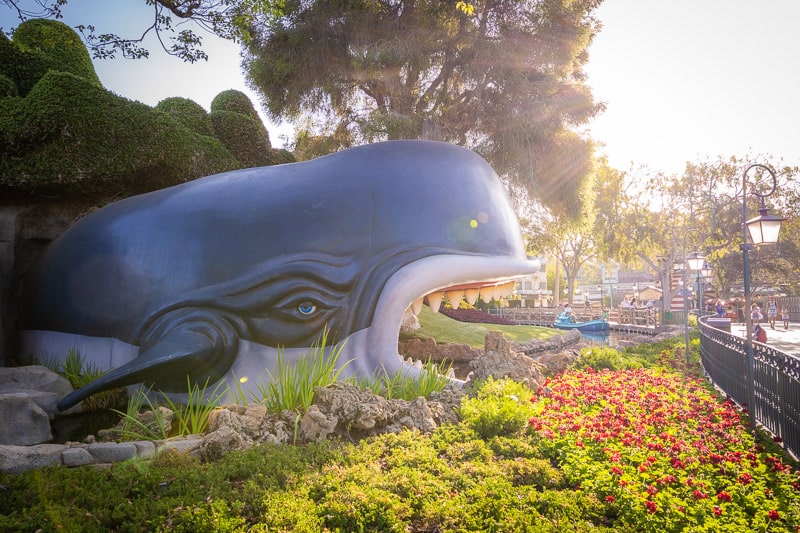
De Haro also shared a couple of specific stories, one of which she recently observed while walking through Fantasyland.
She was walking through the land and saw a little girl crying because she didn’t want to get out of a stroller. The girl’s parents were struggling, as the child was inconsolable. I’m pretty confident that every parent has been there–that point in meltdown mode when, no matter what you do, it somehow only makes the situation worse. Rational thought has gone out the window; there is no deescalation.
At that moment, a Cast Member working in Fantasyland interjected, pulling out a Rapunzel sticker and giving it to the child. Like flipping a switch, it completely calmed the child. All was right with the world once again. The parents silently mouthed “thank you” to the Cast Member, and breathed a sigh of relief.

This might sound absurd…if you’re not a parent. Three years ago, I would’ve been cynical, finding this story strained credulity. As I sit here today, old and grizzled from the frontline of toddler tantrums, I can sadly assure you that this story is all too accurate.
Two of our daughter’s favorite places in the world are Trader Joe’s and the carved Big Al in Grizzly Peak. While I’d like to pretend that we’ve taught her to have exquisite taste, that’s not it. You may not think these two places have anything in common, they very much do: stickers. The DVC kiosk by Big Al and TJ’s cashiers are both the keepers of the stickers.
It may seem silly, but it’d be great if all Cast Members were armed with ample stacks of stickers and encouraged to act similarly in such circumstances. I couldn’t tell you what it is about third party intermediaries bearing stickers that can instantly diffuse a meltdown, but 60% of the time, it works every time.
No sane parent will hold it against a CM for trying and failing, and you will be our hero if it succeeds. I am not even remotely kidding. To the contrary, I couldn’t be more serious right now. Please, please, please do this!

De Haro also cited a recent monorail incident as an example of how Cast Members can step up and turn-around a bad situation. Or at least mitigate its negative impacts.
During the monorail breakdown, which left guests stranded for several hours, one Cast Member continued to spiel throughout. He kept monologuing to provide guests with regular updates and reassurances, even when there were no substantive updates to speak of.
When the monorail was finally evacuated, guests gave the Cast Member a round of applause. Disney officials pointed to that as a moment of take-charge leadership, underscoring how a negative experience can be turned around with clear communication and empathy. And that’s the lasting memory many of those guests will walk away with, as opposed to being stuck for hours.

She also shared how, after the monorail had been unloaded, there was additional guest recovery to be done. One guest had missed their train, so a manager ensured they were able to get home safely by purchasing alternative transportation for them.
Another Cast Member was taken aback by this, not realizing they had the authority to do something like that. In another example, there was a direct hit on a guest’s clothing via an aerial attack by a bird (e.g. poop). An intrepid Cast Member bought the guest a change of shirts.
All of these examples were positive and good to hear, but this was the one that most ‘spoke to me.’ One of the biggest persistent frustrations we’ve had is that some Cast Members are not empowered to actually help or offer guest recovery.

This is partly understandable, as social media means that everything gets exploited. But there are plenty of other times when an unfolding situation is very obviously not anyone trying to cheat the system, and nevertheless, nothing is done to diffuse a situation or prevent it from escalating.
Cast Member service is typically superlative, but it’s largely defined by its warm and friendly quality. This is as contrasted with many real world hospitality companies, especially those at price points commensurate with Disney, which offers attentive and pampering service.
If you’ve experienced both, you likely fully understand and appreciate the distinction. This is most evident at Disney’s higher-end hotels, which offer too many frustrating service lapses for their price points. Whereas real world luxury hotels proactively address problems, Disney is more reactive. And that’s often the best case scenario; sometimes, service at the resorts is more like a shrug.
Cast Members being able to actually step up and do something in these situations would be fantastic. This is less of a critique in the parks and more at the resorts. And really, it’s a bigger issue at Walt Disney World than Disneyland due to the hotel inventory at the respective resorts. Nevertheless, we’ve had a couple of frustrating experiences at the Grand Californian, and its soft product has a lot of room for improvement.

Disneyland officials also underscored how they value feedback, of both the positive and negative variety. They shared that leaders read all guest communications, and gave examples of how they had responded to guest complaints with efforts at recovery.
Although unstated, one of the things that was evident to me from the feedback they shared is what’s most effective is being measured and reasonable. This should be fairly obvious, but as someone who receives many such complaints, it very clearly is not.
Suffice to say, rather than ranting and raving and getting outwardly angry, keep your cool in letters. Be deferential and diplomatic. Share the good along with the bad. It’s more useful to Disney and more effective for you if you demonstrate that you’re reachable.

Disney leaders once again touted the Cast Compliment feature in the Disneyland app, and shared plans to expand this.
As we’ve shared before, Cast Compliments are significant for internal recognition and career advancement opportunities within the company. They ensure that the Cast Members who are living up to Walt’s legacy and making magic for guests are recognized and promoted, which is exactly what we should all want to see. The cream rise to the top.
For this reason, we’d recommend giving Cast Compliments liberally to anyone delivering exemplary guest service. This is something we discussed at length recently in Disney Hits 3 Million Cast Compliments. Here’s How & Why You Should Give Thanks to Cast Members!, so I don’t want to belabor that point.

Ultimately, it was great to hear Disney leadership engage in a candid conversation about Cast Member training, the road to recovery post-COVID, and what’s already working in terms of morale, retention, and so forth. All of this should be vindicating for both those fans who have felt service wasn’t what it was back in 2019 and those who still feel that Cast Members are the magic. Because both can be true!
Cast Members are the heart and soul of Disney–the people who breathe life into the parks, making them truly special places. One of the reasons we became lifelong fans in the first place is because Cast Members left a lasting impression long after our trips were over. We know we’re not alone–the outsized impact of Cast Members is probably why many of you are on this blog. It’s fantastic to see that Disney is getting back to the basics, investing in Cast Members, and working to improve its ‘special sauce’ to the guest experience. From our perspective as guests, there’s more work to be done—but this sounds like a good start, and step in the right direction.
Planning a Southern California vacation? For park admission deals, read Tips for Saving Money on Disneyland Tickets. Learn about on-site and off-site hotels in our Anaheim Hotel Reviews & Rankings. For where to eat, check out our Disneyland Restaurant Reviews. For unique ideas of things that’ll improve your trip, check out What to Pack for Disney. For comprehensive advice, consult our Disneyland Vacation Planning Guide. Finally, for guides beyond Disney, check out our Southern California Itineraries for day trips to Los Angeles, Laguna Beach, and tons of other places!
YOUR THOUGHTS
Thoughts on Disneyland’s efforts to retrain Cast Members and improve service and the guest experience? Thoughts on the stats shared by Disneyland about Cast Members and their desire to have careers with the company? What about the specifics of empowering CMs to delivery an exemplary experience and exceed expectations? Have any magical memories made by Cast Members? Agree that they’re the heart and soul of the Disney magic, and the true stewards of Walt Disney’s legacy? Hearing your feedback is both interesting to us and appreciated by other readers, so please share your thoughts below in the comments!