

The Walt Disney Company has shared executive compensation for CEO Bob Iger, as well as the CFO and others in the current c-suite. This looks at those numbers, Disney’s explanation for the salaries & bonuses, as well as the latest on the succession planning process and the annual shareholder’s meeting.
It’s now been three years since Bob Iger returned as CEO of the Walt Disney Company, after the Board of Directors pulled off a classic Bob Swap™️, replacing Chapek with once former and now current CEO Bob Iger. The palace intrigue continues to play out in our still-ongoing Battle of the Bobs series. The latest ‘development’ in that came less than two weeks ago, albeit indirectly, via 11 Surprises Revealed About Walt Disney Imagineering’s Comeback, After Chapek, Cutbacks & Costly Mistakes. At least one book on the subject is likely to be released this year. We can’t wait.
In his letter to shareholders, Iger discussed it was a year of great progress for The Walt Disney Company as “we advanced our strategic priorities and charted a path for the future.” This included Disney’s $6.5 billion year at the box office, streaming profitability, and ESPN’s evolution
Of course, you’re probably here for Parks & Resorts, so here’s what Iger said about that business segment in his letter:
We advanced our ambitious investment plans across our Experiences segment. We have more expansion projects underway at each of our theme parks globally than ever before, including the largest expansion ever of Magic Kingdom at Walt Disney World, as well as five additional cruise ships scheduled for launch beyond fiscal 2026 and a new theme park planned for development in Abu Dhabi. These strategic investments will strengthen our best-in-class experiential offerings and fuel our ability to continue appealing to new and global audiences.
The only thing that really stuck out to me here was the language used for Disneyland Abu Dhabi–that it’s a new theme park planned for development. Maybe it’s just oddly worded, but this has ‘concept of a plan’ energy. It’s not yet being developed, it’s planned for development. Regardless of where that project actually stands (and I’m guessing most of you don’t care, anyway), it’s still my firm believe that it’s a 2030s project. And probably closer to 2035 than 2030.

Turning to executive compensation, CEO Bob Iger saw his total compensation package increase to $45.8 million for the 2025 fiscal year, up “only” 11.5%. His package included a $1 million salary, $21 million in stock awards, $14 million in option awards, and $7.25 million in non-equity incentive plan compensation.
For reference, Iger’s compensation in the previous year was $41.1 million, up 30% from the the $31.6 million in the previous year. For whatever it’s worth, that’s still down from $45.9 million in fiscal 2021, his last full year of employment at the company before returning to the helm last year shortly after the new fiscal year began.
It’s also down from the all-time high of $65.8 million in 2018, when it soared 80% in a single year as a result of bonuses from the 20th Century Fox acquisition. Maybe Bob’s a bargain even at $45.8 million?!
Hugh Johnston, the Chief Financial Officer, received a total compensation of $20.2 million (down from $24.5 million–due to a one-time signing bonus); Horacio Gutierrez, the Chief Legal Officer, was awarded $16.3 million (up from $15.8m). Other key leaders included Chief People Officer/HR head Sonia Coleman, who earned $7.4 million in total comp, and Chief Communications Officer Kristina Schake, whose total pay reached $6.2 million.

In accordance with SEC rules, Disney provides the ratio of the annual total compensation of its Chief Executive Officer to the annual total compensation of Disney’s median employee. To determine this, Disney reviews the annual base salary of the global workforce as of the last business day of the fiscal year, September 26, 2025.
The median Disney employee works in a full-time hourly role in theme parks and has been with the Company for over eight years. For fiscal 2025, the median employee’s total annual compensation was $56,932. Bob Iger’s total annual compensation, including the Company’s contribution to health insurance premiums, was $45,851,157.
The ratio of these amounts was 805:1. That’s up from last year, when the ratio was 746:1, and from the year before that, when it was 595:1. You can probably surmise the ratio in the years before that, and it’s general trajectory (although it was undoubtedly over 1,000:1 when Iger was paid $65 million in 2018).
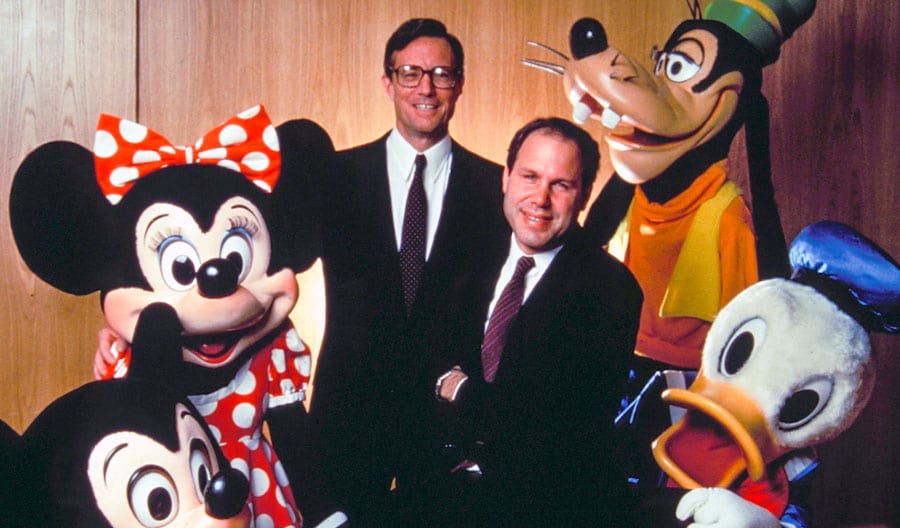
That ratio is always eye-popping. As I’ve said before, I do not necessarily have a problem with high compensation when the exec is clearly responsible for success. When former Disney CEO Michael Eisner exercised stock options worth $565 million in the late 1990s, he was arguably worth every penny after turning the troubled company around and building it into an entertainment behemoth. (Would Disney even exist today but for Michael Eisner and Frank Wells?!)
It’s fair to say that the company had a good 2025–or at least a better year than 2023 or 2022, which was a pretty low bar. At the same time, it seems like there has to be a better formula–like ‘value over replacement’ or something–for executive compensation. There’s not really a market rate for executive compensations, because the market is hardly free and undistorted.
At least when it comes to monster contracts in the NFL or MLB, there’s a statistical basis for those paydays. Sure, fans may quibble over how much players are “worth,” but it is a free market. So when the Browns pay Myles Garrett $40 million per year, it’s because that’s the rate that equivalent talent commands. Although maybe the Browns are a bad example there, what with the Deshaun Watson contract continuing to be an albatross for the franchise–the exception that proves the rule.

In any case, as this ratio continues to grow between executives and frontline Cast Members, we can’t help but think that they are the ones who are underpaid. Once again, Parks & Resorts has kept chugging along and had a record fiscal year, even with nothing new opening. Cast Members on the frontlines, are doing the hard work and heavy lifting to make magical memories and keep people coming to the parks.
This blog has repeatedly advocated for higher pay for Cast Members. This is not a matter of trying to score easy points. It is selfish. Quality Cast Members who are treated right, feel valued, and are loyal to the company are a good thing for me, as a guest who can see and feel a difference when Disney takes care of its people.
Companies don’t attract and retain top talent without competitive wages. There are a lot of people who want to work to make the magic for guests and are willing to accept less to do it, but that’s not the norm. There’s a lone valid reason why Disney has had to lower its hiring standards since 2020, and that’s pay. The labor pool, competition, and everything else–it’s all excuses.
Cast Members are the difference-makers, and the company investing in them is just good business. Even if you think the quality of Cast Members has gone downhill over the last few years–actually, especially if you think that–it makes sense to pay top of market rates for frontline Cast Members.
That’s how you attract the best employees, and the labor market for frontline theme park employees in Anaheim and Orlando most definitely is a free market. Frontline Cast Members are the Myles Garretts to the executives’ Deshaun Watsons.

Turning to succession planning, Chairman of the Board James P. Gorman had this to say in his letter to shareholders:
Management succession planning remains a top priority for the Board, reflecting its importance to business continuity and long-term shareholder value. Oversight of the process is led by our dedicated Succession Planning Committee, and all directors have actively participated in a rigorous and ongoing evaluation of potential successor candidates, including direct engagement, performance assessment and consideration of leadership capabilities aligned with the Company’s long-term strategy. The appointment of the next CEO will be determined by the full Board, and we currently expect to announce the appointment of the Company’s next CEO in early 2026.
To be completely clear, I (still) think it’s a good thing that Bob Iger will continue to serve as Chief Executive Officer through December 31, 2026 and that the company will announce his successor in early 2026. The almost year-long window between anointing the chosen one and having them take the helm is probably savvy, so long as Iger doesn’t get second (third? fourth? fifteenth?) thoughts about leaving.

We’ve already discussed this subject at length, most recently in Josh D’Amaro Gains Steam as Bob Iger’s Successor. Here’s Why He Should be Disney’s Next CEO. The first sentence of that title is where the horse race seems to stand; the second is our position, as a totally-unbiased blog that cares only about theme parks and not so much movies, streaming, ESPN, etc.
My hope is that the next time we revisit this topic, it’ll be because an announcement has been made, naming Josh D’Amaro as Disney’s next CEO. Timing-wise, it’s safe to expect that as early as the morning of the next earnings call on February 2, 2026 or as last as the morning of March 18, 2026, which is the day the Annual Meeting of Shareholders of The Walt Disney Company will be held. Our expectation is that it occurs at least a few days in advance of the annual meeting, but either way, the clock is ticking.
From our perspective, the more interesting question at this point–and one that hasn’t been discussed to death is who will replace Josh D’Amaro as head of Parks & Resorts. He’s presumably going to vacate that position one way or the other, so who gets promoted? And once they’re promoted, who else leaves Disney or is shuffled into a fake, face-saving job?

Previously, we’ve mentioned the following as being names to watch for the next head of Parks & Resorts/Experiences: Thomas Natacha Rafalski, Présidente of Disneyland Paris; Thomas Mazloum, President of Disneyland Resort; and Michael Moriarty, Executive Vice President and Chief Financial Officer of Disney Experiences. I’d now add Joe Schott, who became President of Disney Signature Experiences (DCL, etc.) when Mazloum left that role. I had the chance to talk to him recently and was impressed; he knows Disney inside and out, is very down to earth and human. I would be surprised if the current President of Walt Disney World is in the running; I’m kind of surprised he’s still around.
The horse race to replace Bob Iger as CEO is obviously more exciting, but the downstream changes are equally consequential. That’s especially true during an era of growth and expansion, and at a time when Walt Disney Imagineering is making a comeback and delegating more authority to site-level portfolio executives. This means that a lot more decisions are being made in Florida, France, Hong Kong, etc. as opposed to being dictated from on high in California. Having the right people in the other Parks & Resorts leadership positions over the next 5 years will matter a lot.
Need Disney trip planning tips and comprehensive advice? Make sure to read Disney Parks Vacation Planning Guides, where you can find comprehensive guides to Walt Disney World, Disneyland, and beyond! For Disney updates, discount information, free downloads of our eBooks and wallpapers, and much more, sign up for our FREE email newsletter!
YOUR THOUGHTS
What are your thoughts on Bob Iger’s fiscal 2025 compensation and severance? Think he is “worth” 805x the average Parks & Resorts Cast Member? Is Iger a Myles Garrett or Deshaun Watson? Do you agree or disagree with our assessment? Any questions we can help you answer? Hearing your feedback–even when you disagree with us–is both interesting to us and helpful to other readers, so please share your thoughts below in the comments!