


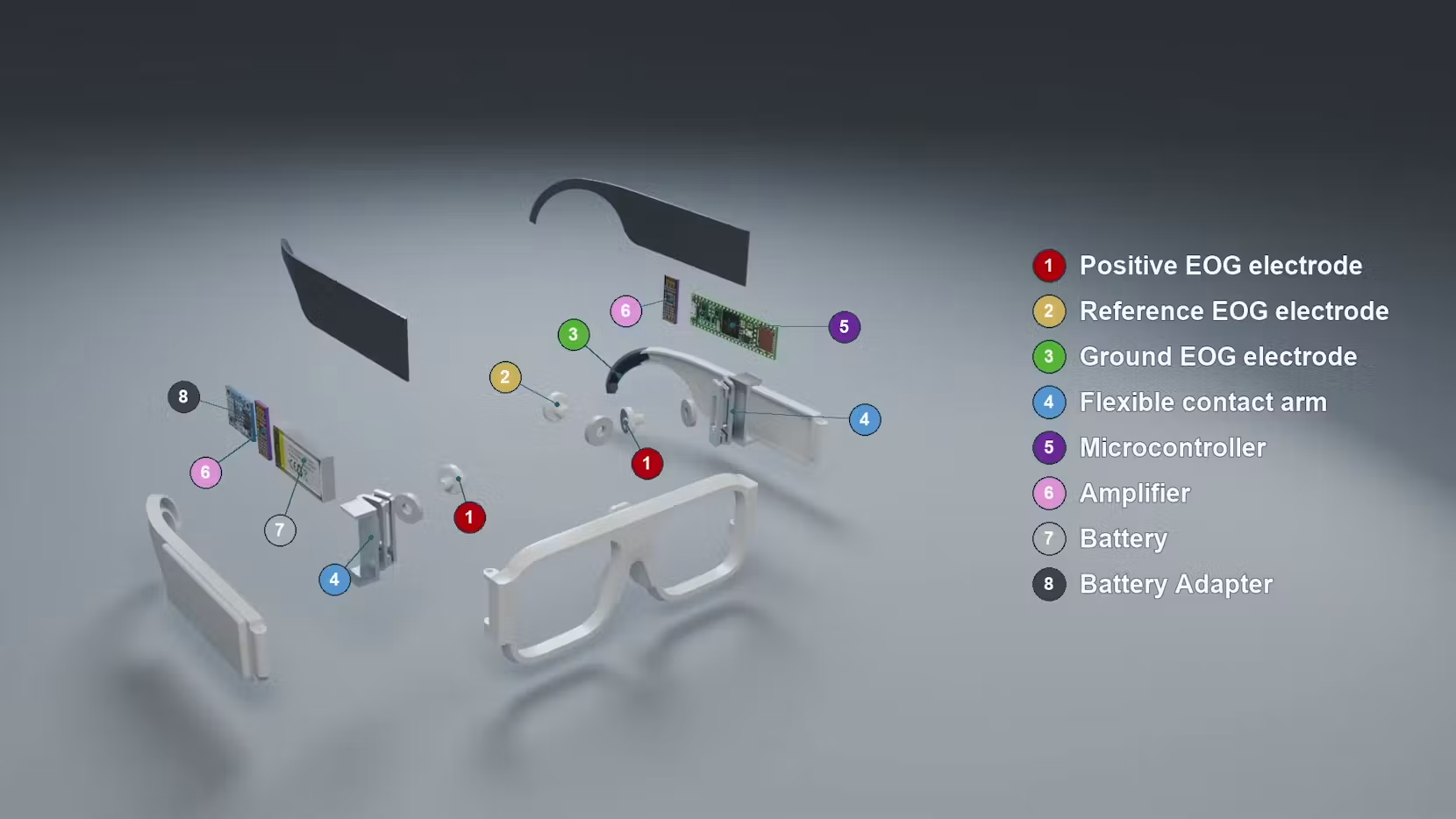
The system tracks how the eyes move when shifting focus between nearby and distant objects to enable hands-free control.
Researchers from Carnegie Mellon University, Tsinghua University, and Wuhan University have developed VergeIO, a gaze-based control system for smart glasses. It detects the movement of the eyes that occurs when your focus shifts from a nearby object to a distant object and vice versa. It converts this into commands that are followed by the smart glasses.
The natural movement of the eyes is called vergence, and VergeIO takes advantage of this. The eyes rotate inwards to focus when you look at something nearby, whereas when you look at something far away, the eyes rotate outwards. This happens constantly throughout the day, and the system converts this into recognisable commands for the smart glasses.
The team has used electrooculography (EOG), a technique that measures the tiny electrical signals generated by the movement of the eyes. However, commercial eyewear already comes with EOG sensors. The difference lies in detecting vergence.
Interference from eye movements makes it very difficult to distinguish the actual electrical signals. The researchers have developed a new electrode arrangement to measure signals from each eye independently to resolve this issue. One electrode is placed against each temple, allowing the system to measure electrical signals from the two eyes independently. A shared reference electrode is placed on the bridge of the nose. It provides a common reference for measuring the signals. A fourth electrode sits behind the ear and acts as a ground electrode.
The prototype uses dry electrodes, which detect electrical signals from the skin without requiring adhesive or conductive gel. It uses a Teensy 4.1 microcontroller to process the signals in real time. The analogue sensing circuitry consumes just 3 milliwatts (mW) of power. The researchers also estimate that a 570 mAh battery could theoretically support approximately eight days of continuous sensing.
The team tested VergeIO on 20 participants, and the system achieved 97% accuracy for four different depth-based gestures and 77% when all six possible gestures were included. Although VergeIO is still a research prototype, further development could enable smart glasses to select virtual objects at different depths, automatically adjust varifocal lenses, and help screen for certain vision disorders.