


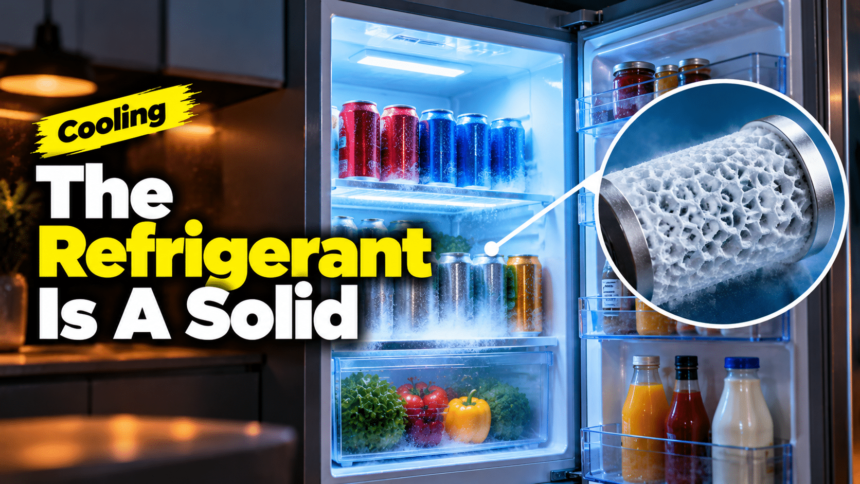
A porous solid-based cooling technology could reduce energy consumption and refrigerant emissions, with commercial deployments planned for beverage coolers.
US-based startup Pascal is developing a cooling technology that uses a porous, sponge-like solid and carbon dioxide to transfer heat, potentially offering an alternative to conventional refrigeration systems. The company claims that its technology can improve energy efficiency by about 20 per cent compared with existing refrigerators and heat pumps. On 21 October 2026, Pascal announced US$9.3 million in additional funding to support early commercial deployments with a multinational beverage manufacturer, beginning with beverage coolers.
Founded in 2023 by Adam Slavney and Jinyoung Seo, Pascal is developing the technology for applications ranging from beverage refrigeration to commercial air conditioning, industrial cooling and data centres. The funding comprises US$839,000 in grants and incentives, bringing the company’s total funding to US$17.3 million.
Conventional refrigerators and air conditioners generally use vapour-compression systems, in which a circulating refrigerant absorbs heat from one location and releases it elsewhere. Pascal’s approach uses a pressure-responsive solid material to perform the cooling process, with carbon dioxide acting as the working gas. The company aims to reduce dependence on conventional refrigerants that can contribute to global warming when released into the atmosphere.
The system uses cartridges containing a porous solid. When carbon dioxide enters the material under pressure, the solid heats up, allowing a heat exchanger to remove the heat. When the pressure is reduced and the gas is released, the material cools and absorbs heat from the refrigerated space. Two cartridges operate alternately, allowing one to release heat while the other provides cooling.
Pascal says its technology can operate at pressures used in conventional refrigeration and can use standard industrial components. The company also describes its solid refrigerant materials as non-flammable and says they can eliminate direct emissions associated with conventional refrigerants. However, the system still uses carbon dioxide gas, and its overall environmental performance depends on the containment design, operating efficiency and potential for gas leakage.
Pascal claims that its technology offers approximately 20 per cent better energy efficiency than existing refrigerators and heat pumps. This remains a company claim rather than an independently established improvement across commercial applications. The actual benefits will depend on the equipment design, cooling requirements and operating conditions.
The company has also reported that its material has undergone up to 300,000 cycles, which co-founder Adam Slavney has described as roughly a year of operation. However, laboratory cycling results do not establish the service life of a complete refrigeration system. Long-term reliability will depend on operating conditions, cycle frequency and the durability of other system components.
Pascal reports having built four fully functional cooling systems, with further development under way. Its immediate priority is to demonstrate the technology in beverage coolers before expanding into other applications. An initial prototype was expected in early 2027, with more advanced refrigerator units planned for 2028. These are planned milestones, and the technology is not yet widely commercially available.
For India, alternative cooling technologies could become increasingly important as demand for refrigeration and air conditioning grows. Household refrigerators commonly use isobutane (R-600a), while room air conditioners may use refrigerants such as R-32 or R-410A, depending on the model. These refrigerants have different environmental characteristics, making refrigerant selection, leakage prevention and energy efficiency important considerations.
India’s Cooling Action Plan, released in 2019, established targets for reducing cooling demand by 20–25 per cent, refrigerant demand by 25–30 per cent, and cooling energy requirements by 25–40 per cent by 2037–38. India is also scheduled to freeze hydrofluorocarbon (HFC) production and consumption at the applicable baseline level from 2028 under the Kigali Amendment to the Montreal Protocol, followed by a phasedown. Technologies that reduce electricity consumption or dependence on refrigerants with high global warming potential could therefore contribute to India’s longer-term cooling objectives.
Pascal’s technology could support these goals if independent testing confirms its efficiency claims and the complete system demonstrates reliable operation with a low environmental impact. Its commercial viability will depend on manufacturing costs, cooling capacity, maintenance requirements, durability and performance under different climatic conditions.
Pascal has not announced an Indian launch, local pricing or product availability. The planned beverage-cooler deployments will provide an early opportunity to evaluate the technology in commercial use and determine whether it can progress towards wider refrigeration and cooling applications.
For more information, click here.