

Exploring the night sky usually means learning how to use a telescope first. French company Vaonis builds smart telescopes that skip the learning curve. You pick a target from your phone, and the scope’s built-in brains find it and track it. Now it’s launching Atlas, a modular unit that lets you swap optics as your stargazing ambitions grow.
Atlas is controlled through an app called Gaia. You pick a target from a live view of the sky, the mount slews toward it, and the telescope starts collecting images. According to the company, it can shoot deep-sky objects, the Moon, the Sun and, in future iterations, even planets in our Solar System.
Vaonis says three patented systems make the concept work. The SkyDock connection system lets you swap imaging modules in seconds, no tools required. SkyTwin aims two identical modules at the same target, doubling the light so fine detail shows up sooner. SkyGuard is an all-sky camera built into the mount. It overlays what is really visible from your backyard in augmented reality, and it can turn the whole night into a timelapse.
Vaonis
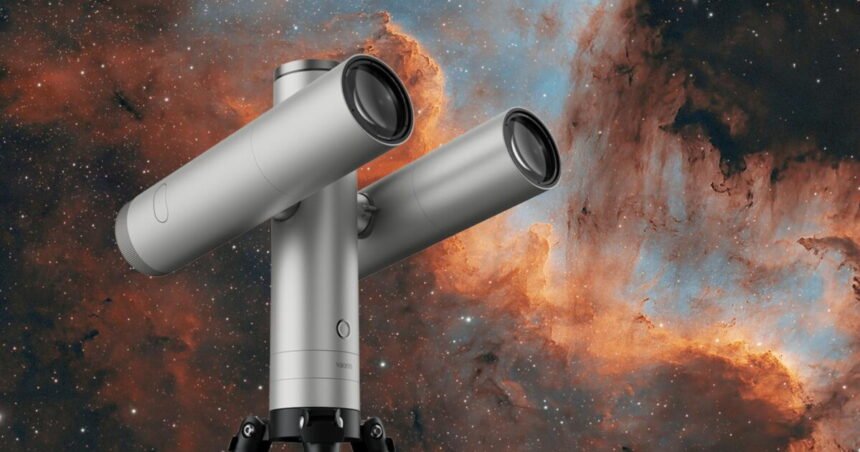
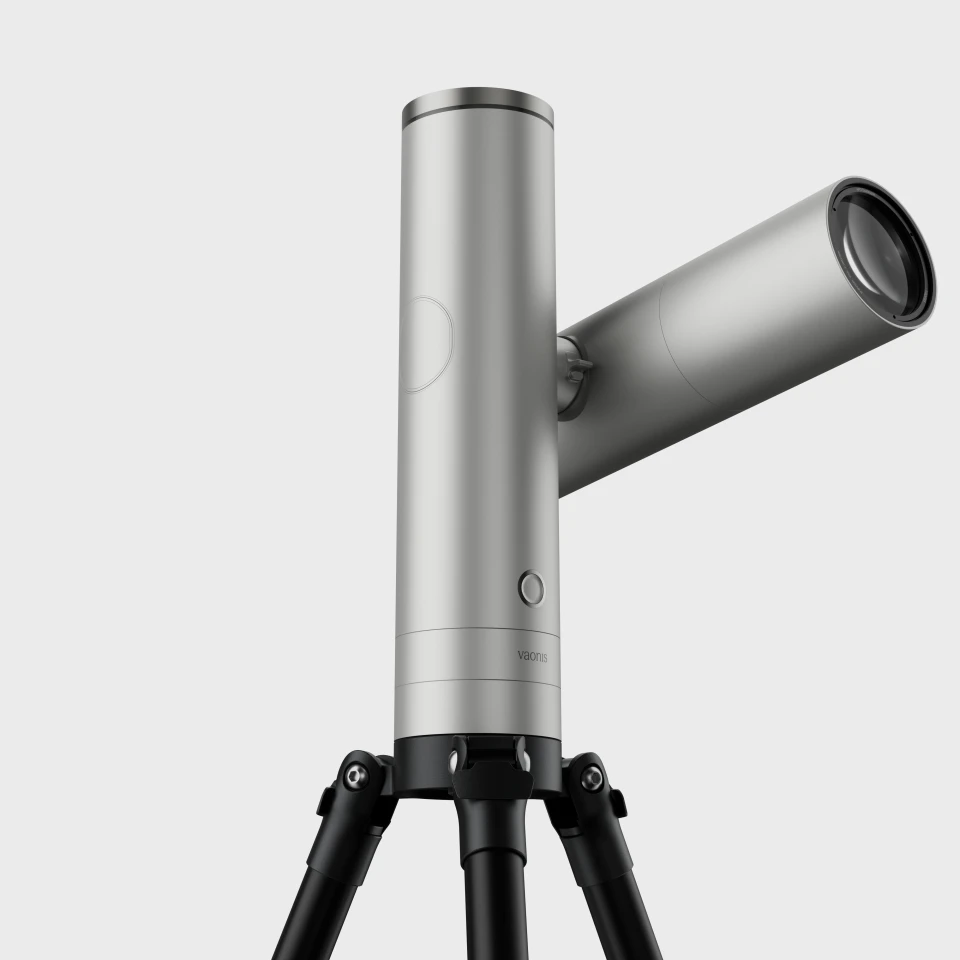
The company likens Atlas to an interchangeable-lens camera. Each module works as a self-contained lens with its own camera sensor, and clicks onto the main body in seconds. Users can employ a single-module setup or mount two identical tubes side by side, depending on what they want to observe.
Atlas 80 is the first imaging module available for the system, and Vaonis says more sizes are on the way. Within its tubular housing are four lenses, and there’s an 80-mm opening for catching light. Those lenses are arranged (the technical term is apochromatic) so each of the red, green and blue wavelengths lands in the same spot, which keeps stars from sprouting rainbow fringes. Each module has a 360-mm focal length (roughly how zoomed in/out the view is), an f/4.5 rating (a lower number means the scope gathers light more quickly, so images build up faster) and its own 8.3-megapixel Sony IMX585 sensor. Pair two modules and Vaonis says the focal ratio improves to f/3.2.
Vaoinis
With one module and the cylindrical body, Atlas stands 41 cm (16.1 in) tall and weighs 6.5 kg (14.3 lb) without its tripod – the aluminum tripod adds 1.9 kg (4.2 lb). Optional filters can be slotted in each module (when available) to suppress city lighting, adjust for solar imagery, and cater for different wavelengths. Battery life for this single-module configuration is up to 6 hours per charge. The unit is rated IP64 against dust and splashing water, and works from −20 °C to +40 °C (−4 °F to 104 °F), according to Vaonis, so it should survive a light shower or two as well as deployment under crispy winter skies or balmy summer nights.
Some of the modular promises are still a wish list, though. Mixing different optics and filters in twin-scope mode isn’t possible yet. Neither are the planned backpack, filters, equatorial wedge (a tilted base that helps the scope follow the sky more smoothly), extra module sizes or a planetary module.

Vaonis
Reservations for the Atlas open today, and the first units are expected to ship from March 2027. During presale, which runs until November 15, the single setup (body/mount plus one Atlas 80 module) is priced at US$3,990 and the dual-module setup comes in at $5,490. Once presale ends, prices climb to $4,990 and $6,990, respectively. The mount has a 10-year warranty and each module has five years.
Atlas sits at the premium end of the Vaonis range but far below the roughly $99,000 Hyperia observatory, which the company introduced earlier this year. That model pairs Canon optics with a 150-mm aperture. The line began with Stellina in 2018, which Vaonis calls the world’s first smart telescope, followed by book-sized Hestia and the compact Vespera II.
“Stellina changed the way we look at the sky,” said Cyril Dupuy, founder of Vaonis. “Atlas changes what a telescope can become. Until now, you were limited by the physical and technical capabilities of the telescope you owned. With Atlas, your telescope can evolve as your interests and experience grow.”
Source: Vaonis