

How do factories move loads weighing several tonnes without relying on forklifts? An autonomous platform is taking on repetitive pallet movement.
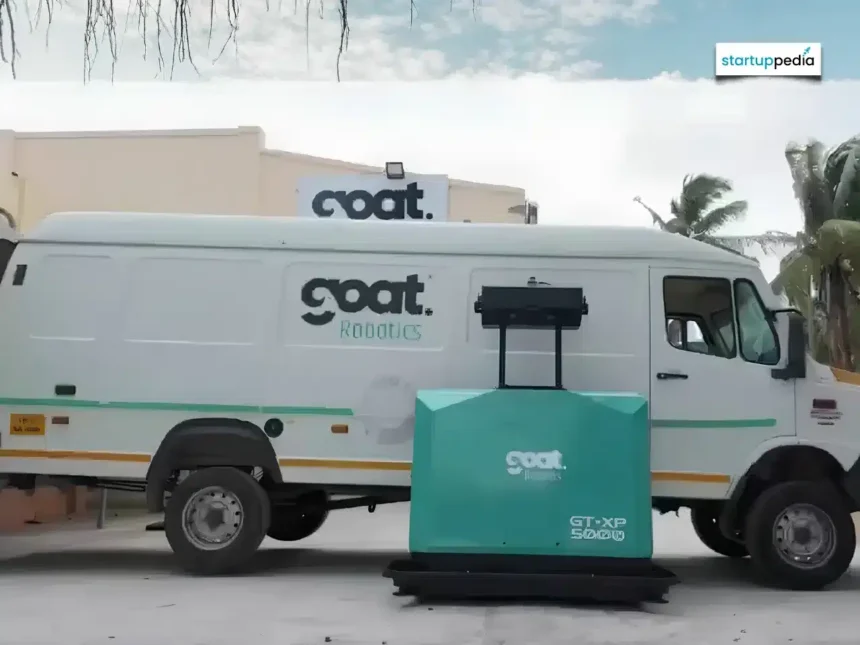
GOAT Robotics, a Coimbatore-based industrial robotics startup, has demonstrated GT-XP, an autonomous mobile robot (AMR) designed to pick up, transport, and drop off pallets weighing up to 5 tonnes. The system is aimed at manufacturing plants, warehouses, and distribution facilities where heavy pallets have to be moved repeatedly.
Instead of following magnetic tapes or other fixed routes, GT-XP uses SLAM-based navigation to find its way through industrial environments. LiDAR, an inertial measurement unit (IMU), wheel encoders, and a depth camera work together to map the surroundings, track the robot’s position, and detect obstacles as it moves. The system can travel at up to about 1.2 metres per second and operate for around eight to 10 hours on a charge.
The AMR supports autonomous, manual, and assisted modes, along with Wi-Fi connectivity, obstacle avoidance, and an emergency-stop system. Its pallet interface can accommodate standard pallet formats as well as custom dimensions. Docking and alignment assistance also allows the robot to work with equipment such as conveyors and storage racks, extending its role beyond simply transporting a load from one point to another.
The system can be deployed individually or as part of a multi-robot fleet. Potential uses include moving incoming materials, feeding production lines, transporting finished goods, and transferring pallets across warehouse operations. According to the company, the approach is intended to work with existing factory layouts rather than requiring major infrastructure changes.
For industrial facilities, the significance lies in bringing autonomous navigation to one of the heavier and more repetitive parts of internal logistics. Combining pallet lifting, movement, navigation, and fleet operation could allow material transfer between production, storage, and dispatch areas to become part of a continuous automated workflow rather than a task that depends on repeated manual movement.
Click here for the official announcement.