

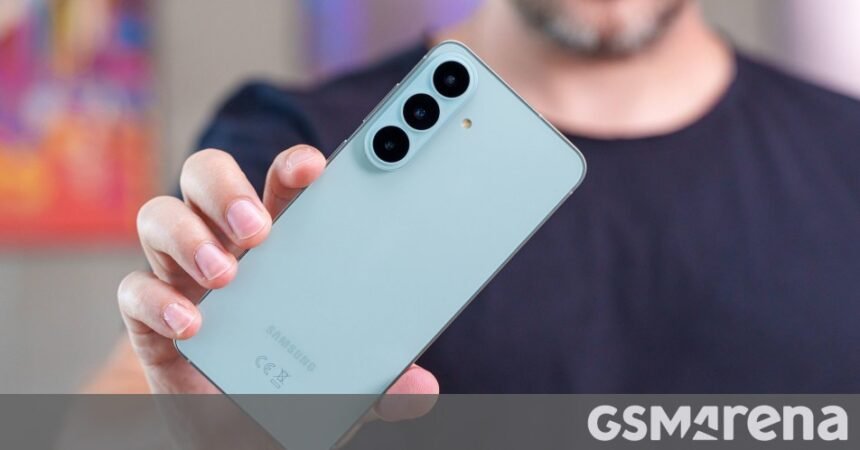
The Samsung Galaxy S26 FE went on sale in multiple markets around the world today – the $700 / £700 / €800 phone has a lot to prove given its price tag. However, Samsung equipped it with a previous-generation 3nm Exynos 2500 chipset and kept the battery capacity at 4,900mAh, the same as last year’s S25 FE. The 45W wired and 15W wireless charging specs are the same too. That didn’t give us much hope for seeing an improvement, but the results are better than expected.
We have a review unit at the office, and we are ready to share some of our findings about the battery life and charging speed of the new FE.
Samsung bundles the Galaxy S26 FE only with a USB C-to-C cable, bring your own charger
The new Galaxy S26 FE shares the same key components with last year’s S25 FE – the battery capacity on both is 4,900mAh, and they both use a 6.7” 1080p+ OLED screen. The old model, however, ran on the Exynos 2400, whereas here we get the Exynos 2500 (like in the Z Flip7).
Samsung has clearly done a lot of work to optimize the energy consumption of the Exynos 2500, and the Galaxy S26 FE beats its predecessor by nearly 3 hours in our Active Use Score ranking. Web browsing and video playback show great improvements with smaller but still solid uplifts in talk time and gaming endurance.
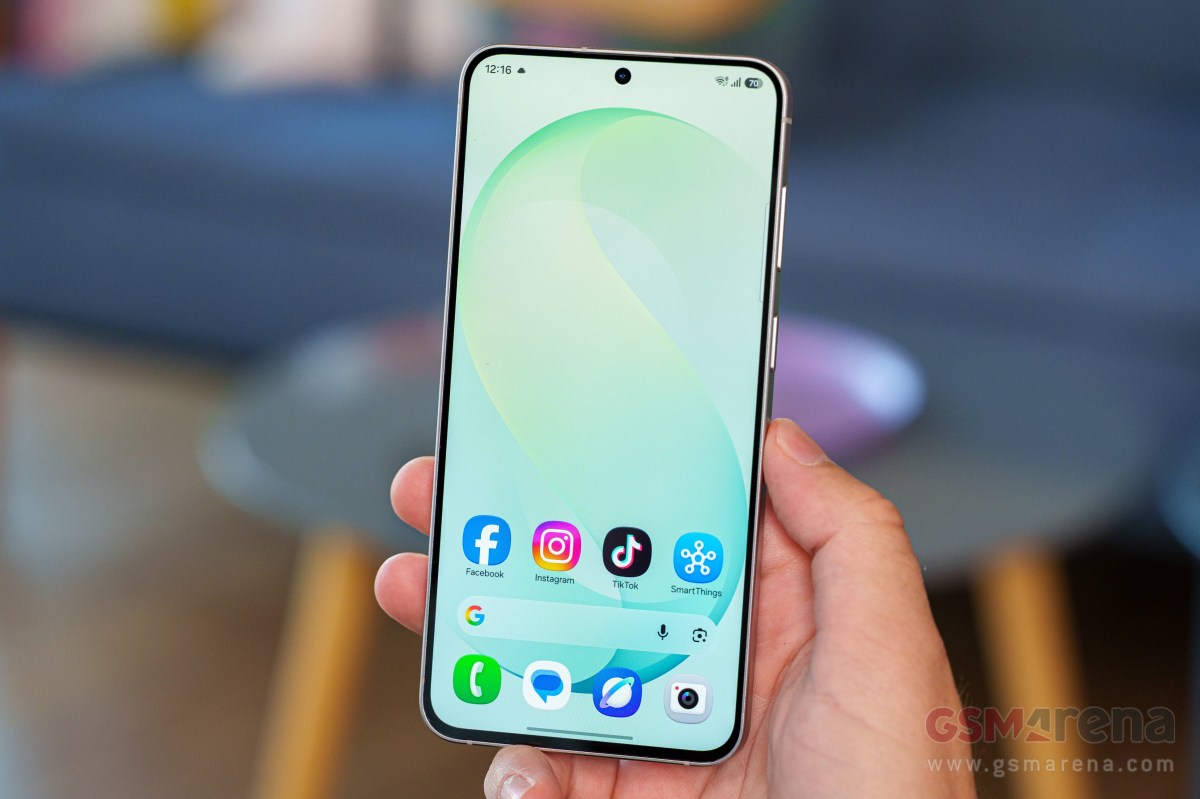
The Galaxy S26 FE has a 6.7” 1080p+ OLED display and a 4,900mAh battery
Things don’t look quite as good when compared with the Galaxy S26+ – note that our results come from the Exynos 2600 model. The S26+ may have the same battery capacity and the same screen size, but it’s a different panel with a higher resolution (1440p+ vs. 1080p+). The higher pixel count is offset by the ability to reach lower refresh rates since the Plus has an LTPO panel – this is felt in the video playback and gaming tests, which are a better fit for LTPO displays.
The Galaxy A57 has a comparable 5,000mAh battery and a 6.7” 1080p+ OLED display (non-LTPO). However, its Exynos 1680 is a 4nm part from the same generation as the Exynos 2400. The A-phone did well for itself, surpassing the old S25 FE, but the new FE got slightly better results.
Phones from other brands last longer as they don’t share Samsung’s reluctance to adopt high-capacity batteries. But even the Nothing Phone (4a) Pro with a marginally bigger 5,080mAh battery and 6.83” OLED display (1260p+, non-LTPO) edged out the S26 FE, despite having a mid-range Snapdragon 7 Gen 4 chipset (4nm).
Charging speed
Moving on to charging, Samsung introduced a 60W system this year, but you can only find it on the S26 Ultra – the S26 FE has to slum it with most other Galaxy models with 45W wired charging.
But as it turns out, this power pairs well with the 4,900mAh capacity – the Galaxy S26 FE achieved a solid 40% charge in 15 minutes and got to 69% in 30 minutes. This is slightly better than the official spec, which claims 65% charge in 30 minutes.
The only problem is that charge speed tapers off – despite its early lead, the Galaxy S26 FE still needed about an hour and 10 minutes for a full charge, which is the same as the A57 and S25 FE. The Galaxy S26+ finished charging 7 minutes faster than the S26 FE, despite being neck-and-neck with it at the 15- and 30-minute checkpoints.
In summary, the Samsung Galaxy S26 FE offers a tangible improvement in battery life (14:49h) over the S25 FE (11:56h) and the older S24 FE (11:47h). If you have an older FE, which is struggling to last you a full day of use, you should consider upgrading to the S26 FE.
However, charging speed hasn’t budged in two generations – the S24 FE had a slightly smaller 4,700mAh battery, but it was only officially rated for 25W wired charging. And yet it could do a full 100% charge in an hour and 10 minutes – the same as the two models that followed it, both of which boast 45W charge speed. It’s clear that Samsung is using a conservative charge curve, likely to extend the battery’s longevity.