


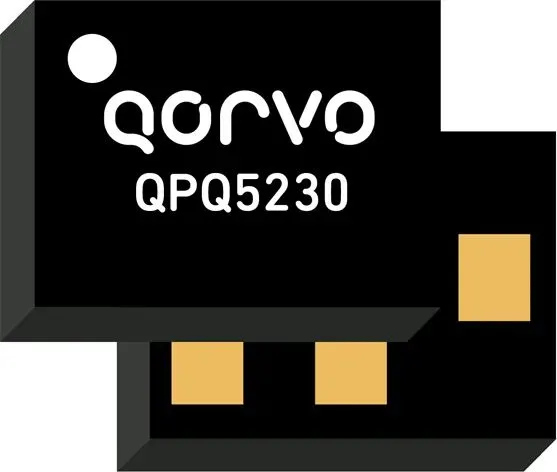
Qorvo’s QPQ5230 filter enables Wi-Fi and LTE coexistence in compact wireless devices, combining low WLAN loss with steep rejection of adjacent cellular bands for connectivity.
Qorvo has introduced the QPQ5230, a high-performance Bulk Acoustic Wave (BAW) band-pass filter designed to support Wi-Fi and LTE coexistence in compact wireless devices. The component combines low loss in the WLAN band with high rejection of adjacent cellular bands, helping prevent interference when both technologies operate within the same device or in close proximity.
The filter is designed with extremely steep skirts, providing strong selectivity between the 2.4GHz Wi-Fi spectrum and nearby LTE bands. It covers a frequency range of 2,412MHz to 2,472MHz, with 20/40MHz bandwidth options and an insertion loss of 0.8dB.
A key feature is its compact package, measuring just 1.1 x 0.9 x 0.6mm. Qorvo uses common module packaging techniques to achieve the small footprint, making the device suitable for applications where board space is limited.
The QPQ5230 also provides an extended upper corner of the WLAN band to accommodate Bluetooth operation, while offering high rejection across B40, B7, B741 and n41 bands. Its single-ended operation is intended to simplify integration into wireless designs.
The component is specified for operation from -30°C to +85°C and is supplied in a RoHS-compliant, lead-free and halogen-free module package. These characteristics support deployment across a range of wireless electronics where size, interference control and operating reliability are important.
Potential applications include access points, wireless routers, residential gateways, cellular-enabled mobile clients, mobile phones and Internet of Things equipment.
By combining filtering performance with a small footprint, the QPQ5230 is aimed at wireless designs that need to accommodate multiple radio technologies without requiring significant additional board space. Its steep rejection characteristics can help designers manage coexistence challenges as connected devices increasingly combine Wi-Fi, Bluetooth and cellular connectivity.