


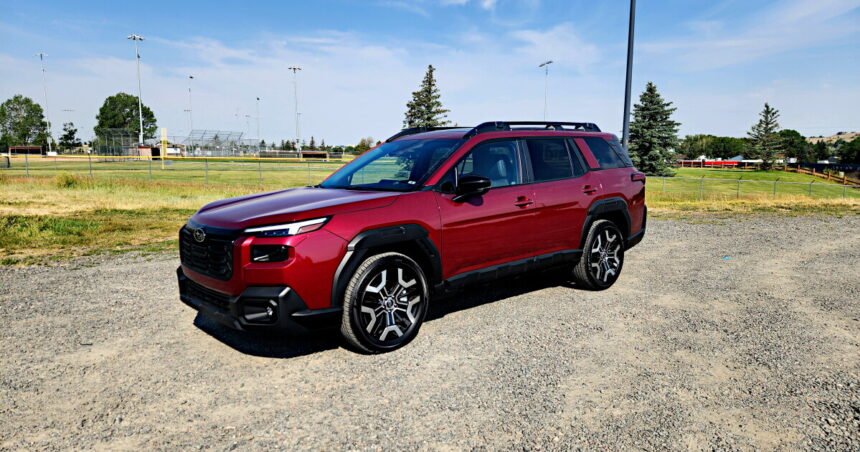
The biggest change for the Outback’s 2026 redesign is immediately obvious. Subaru has completely abandoned the Outback’s swoopy wagon profile for something taller, boxier, and more conventionally SUV-shaped.
At a Glance
- The Outback is firmly a sport utility now
- More usable interior space
- Two engine options, middling MPG returns
- Comfortable, practical, and capable – as always
I have mixed feelings about these changes. The Outback has been morphing into this SUV shape for a while now. The first Outback was basically a Subaru Legacy with a lift kit and some added “rugged” cladding. Then it became its own thing, but very much station wagon-shaped. Over time, it got boxier and bigger. So today’s square-bodied SUV design is where things were obviously headed.
The old Outback had character, though. It was obviously different from the other Subaru models, which themselves kind of have a progression from sedan to SUV when lined up. The Legacy was a car, the Crosstrek was a lifted compact hatch in between a standard car and an SUV, and the Outback was a large station wagon with SUV underpinnings. Then the Forester was a full-blown utility. You could line them up on the dealer’s lot and see an evolution chart akin to the famous monkey-to-man silhouette.
Aaron Turpen / New Atlas
Beyond the visuals, however, the Outback has also been changing thanks to who it’s sold to. The Outback finds a different buyer than the Forester does. It’s an intangible difference, but Outback buyers tend to be a little more upscale in preference, preferring nicer interiors and being willing to pay for that. The Forester is allowed to be a little cheaper in fit and finish by comparison. Less refined. Outback buyers will pay for the uptick. Those buyers are now asking for more interior space. That comes with more squareness to the body and less wagon.
As a result of the body changes, the 2026 Outback has more usable interior volume, with Subaru claiming as much as 112.3 cubic feet (3,180 liters) of passenger space and 80.5 cubic feet (2,279.5 L) of maximum cargo capacity. That’s a gain of over six percent in cargo space. But that only tells part of the story. The roofline is flatter, the rear compartment is more accommodating, and loading bulky stuff is easier.
The 2026 Subaru Outback isn’t exactly tiny, measuring an inch (2.5 cm) longer, 2 inches (5 cm) taller, and about an inch and a half (4 cm) wider, but it is still a reasonably manageable midsize vehicle. Ground clearance is 8.7 inches (22 cm) on most models and a healthy 9.5 inches (24 cm) for the Wilderness. And because this is a Subaru, all four wheels are powered. There is no “premium AWD package” to check off the options list. Symmetrical All-Wheel Drive is standard.
Subaru offers two engines for the 2026 redesign. The standard engine is a 2.5-liter naturally aspirated flat-four producing 180 horsepower (132 kW) and 178 lb-ft (241 Nm) of torque. The optional 2.4-liter turbocharged Boxer-four produces a much healthier 260 hp (191 kW) and 277 lb-ft (375.5 Nm). Both use Subaru’s Lineartronic CVT.
The base engine is perfectly adequate. Which is a polite way of saying you should probably get the turbo. The naturally aspirated engine isn’t broken. It will move the Outback down the highway, merge into traffic, and climb a mountain. It just won’t do those things with any particular enthusiasm.
With a vehicle this size, 180 hp isn’t exactly a recipe for spontaneous joy.
The turbocharged engine, on the other hand, gives the Outback the shove it needs. The 277 lb-ft of torque arrives from 2,000 rpm, and the difference is immediately noticeable. It’s also the engine you want if you plan on towing. Turbo-equipped Outbacks are rated for 3,500 pounds, versus 2,700 pounds for the naturally aspirated versions.
The CVT remains a CVT, which means it isn’t going to fool anybody into thinking there’s a nine-speed hiding underneath. Subaru does, however, program simulated ratios and provides an eight-speed manual mode to make acceleration feel more conventional. It works well enough, but remains artificial and probably unnecessary for most drivers.
The point of a CVT is to keep the engine in the useful part of its torque curve and help the Outback remain reasonably efficient. Which is what it does.
The non-turbo models can return up to 31 mpg (7.6 L/100km) on the highway and 25 mpg city (9.4 L/100km). Turbo models drop to 29 mpg (8.1 L/100km) highway, while the Wilderness manages 27 mpg (8.7 L/100km) highway. In the real world, expect those numbers to differ. Driving the Limited model with the turbo, I managed just 26 mpg on the highway. The Wilderness model, also with the turbo, was slightly better than expected at very near its 26 mpg EPA highway rating.

Aaron Turpen / New Atlas
That’s not hybrid territory, but Subaru isn’t selling the Outback as a hybrid. Truth be told, Subaru has rarely, if ever, been the most fuel-efficient option in any class. The Outback has never been an MPG leader. It’s always been reasonably efficient, which it still is, but not ground-breakingly so. Subaru generally aims for being a combination of efficient, practical, and capable. Which is exactly what the Outback is.
The interior is probably the biggest improvement without having the same visually jarring impact the exterior’s changes have. Previous-generation Outbacks were functional but had an unfortunate tendency to look as though their infotainment system had been installed by somebody who strongly disliked both computers and human beings. The 2026 model is much cleaner.
There’s a new 12.1-inch central touchscreen, wireless Apple CarPlay and Android Auto, and, thank the heavens, physical controls for the climate system. This is an important detail. Subaru knows its audience, and its buyers would not stand for an infotainment-only design.
The rest of the cabin is similarly practical. There’s good visibility, plenty of storage, comfortable seats, and a large rear compartment. Subaru has retained cargo-area release levers, making it easy to fold the rear seats flat directly from the tailgate.
The Outback remains one of those vehicles that makes sense for people who actually use their vehicle. Dogs. Camping equipment. Groceries. Bicycles. Snowboards. Home-improvement-store mistakes and reruns. It’ll take them all.
For buyers who believe “off-road” means more than driving over the occasional gravel road, Subaru offers the Outback Wilderness. My personal favorite version of this new Outback.
The Wilderness gets the turbocharged 260-hp engine, additional ground clearance, all-terrain tires, and a more aggressive version of the X-MODE traction system. Subaru also gives it specific Snow/Dirt and Deep Snow/Mud modes and hill-descent control. Plus those cool copper/bronze accents all Wilderness models have.
No, it isn’t a Wrangler Rubicon. It doesn’t have solid axles, a two-speed transfer case, or the kind of articulation that allows you to climb over obstacles that look like small geological formations. But that’s not the point. The Outback Wilderness is for the person who wants to drive 300 miles on pavement to get to the dirt road, then spend the afternoon exploring it. And that’s exactly where the Outback has always made sense. There’s a reason for the trope-joke about finding a stock Subaru already parked at the trail summit.
On pavement, the new Outback is comfortable, quiet, and composed. It isn’t a sports car, obviously, but it’s getting close to a luxury model in its relatively quiet and calm demeanor.
It soaks up broken pavement well, remains stable at highway speeds, and has the kind of relaxed demeanor that makes long trips easy. The turbocharged version adds enough muscle that passing slower traffic doesn’t require a formal committee meeting. It also adds a bit more interior engine noise, so keep that in mind during a test drive, and Subaru still hasn’t completely eliminated side-mirror wind whistle.
The 2026 Subaru Outback starts at US$34,995 according to Subaru’s official trim comparison, but the real, destination-inclusive starting figure is closer to $36,500. Higher trims climb rapidly, with the Touring XT approaching the upper-$40,000 range. That puts the Outback into an increasingly crowded market.
There are hybrids that use less fuel. There are SUVs with more horsepower. There are luxury crossovers with nicer interiors. There are off-roaders with more extreme capabilities. And yet the Outback remains difficult to replace.

Aaron Turpen / New Atlas
It has standard AWD. It has good ground clearance. It has excellent cargo flexibility. It gets respectable fuel economy. It can tow. It has a useful interior and a robust suite of driver-assistance technology. And it doesn’t require the buyer to assemble a complicated list of expensive options to get those things.
The biggest question is whether Subaru has sacrificed some of the Outback’s personality in the process of making it more practical. And this is where I think Subaru might have missed the mark. I think it has lost personality. But I’m both an enthusiast and a station wagon lover. I think of the AMC Eagle as the pinnacle of AWD wagon design. So maybe I’m not the best judge of what the Outback should be.
The 2026 Outback still does just about anything requested of it. Now it just wears a more conventional SUV costume while doing it. For most, this is probably a tradeoff willingly made.
Product Page: 2026 Subaru Outback