


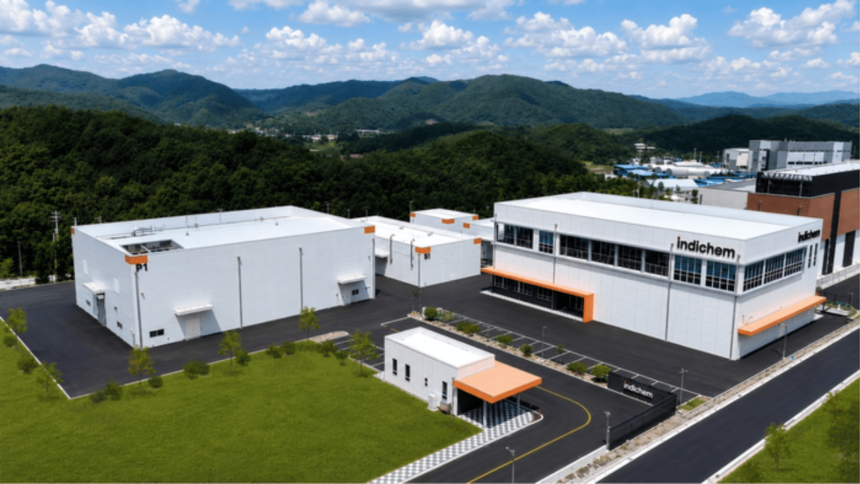
Indichem, an India-Korea joint venture, has completed a semiconductor materials plant in Gongju using Indian feedstock, with shipments starting in September.
Indichem, a joint venture between Acutaas Advance Material Limited of India and South Korea’s J & Materials Co. Ltd, has completed a semiconductor materials plant at Gongju in South Chungcheong Province, South Korea. The facility represents an investment of KRW 30 billion, which is about ₹186 crore at the 28 August 2026 reference exchange rate. Acutaas itself has reported the investment as approximately ₹200 crore. Acutaas Advance Material holds a 75 per cent stake in Indichem, with J & Materials holding the remaining 25 per cent.

Photoresist is the light-sensitive material used during semiconductor lithography to transfer circuit patterns onto a wafer. It is a formulated chemical system rather than a single compound, combining components such as polymer or resin materials, photoacid generators (PAGs) and other additives that control how the film responds to exposure and develops. Indichem is producing organic chemical materials used in semiconductor photoresists, rather than simply making a finished resist formulation. The Gongju facility is intended to supply semiconductor-grade materials using feedstock supplied from India and processed to high purity in South Korea.
The site covers about 16,500 square metres, with roughly 6,600 square metres currently built out. The completed facility includes a production building, a combined headquarters, research and pilot-production building, and a warehouse. Construction took about eleven months, beginning in September 2025. The company says the facility has been designed to support ultra-high-purity refining for semiconductor materials. Shipments are scheduled to begin in September 2026.
Semiconductor photoresist supply is concentrated among a small group of chemical companies, with Japanese suppliers holding particularly strong positions. Tokyo Ohka Kogyo, JSR and Shin-Etsu Chemical together account for about 60.5 per cent of the global photoresist market in a recent Nikkei-based survey, while Japanese suppliers have an even stronger position in advanced ArF and EUV resists. That concentration has made photoresist a strategic semiconductor material during trade disputes and supply-chain disruptions. Indichem’s proposition is a two-country chain in which chemical synthesis takes place in India before materials are refined and qualified to semiconductor grade in South Korea. The company says the materials require parts-per-billion purity levels, making ultra-high-purity refining and quality control central to the business rather than simply increasing synthesis volume.
India’s semiconductor build-out now includes fabs and assembly plants, but the domestic materials ecosystem remains comparatively thin. Micron’s Sanand assembly and test plant, Tata Electronics’ Dholera fab and CG Semi’s Sanand facility will require materials such as photoresists, developers, strippers and specialty gases, much of which is currently sourced from overseas. Indichem has stated plans for a research and synthesis centre in India in 2027, with a development activities split between India and South Korea, potentially bringing more of the photoresist-material supply chain into India. India’s semiconductor policy recognises the importance of materials and other manufacturing inputs, but there is no separately announced ISM 2.0 programme specifically dedicated to semiconductor chemicals that I could verify, nor could I confirm an Acutaas application under such a programme. India already supplies the world with a wide range of fine chemicals; the challenge is taking that manufacturing base to the purity, consistency and qualification levels required for semiconductor production at scale.
For more information, click here.