

A humanoid robot has reportedly completed 100 metres in 9.32 seconds, highlighting advances in robotic speed, balance, endurance and autonomous movement.
Honor’s Lightning humanoid robot has reportedly completed a 100-metre sprint in 9.32 seconds, surpassing Usain Bolt’s 9.58-second world record. Developed by the smartphone maker, the robot reached a peak speed of 14.5 metres per second during a test event in Beijing.

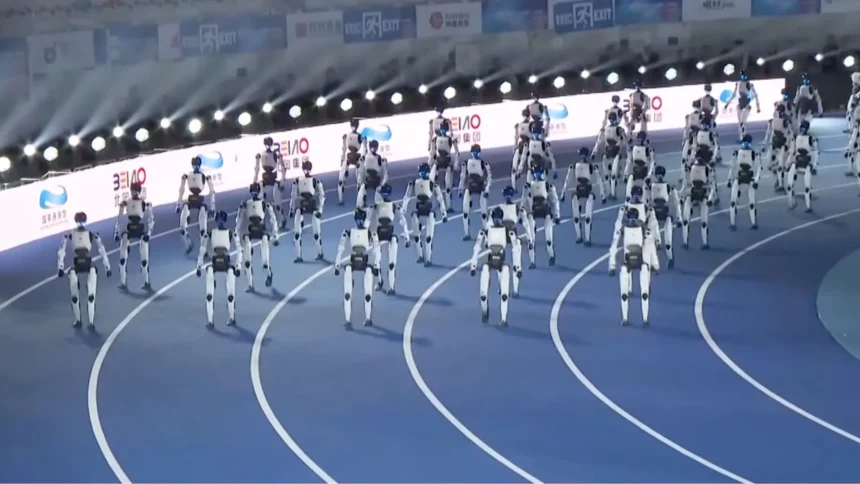
The performance took place ahead of the second World Humanoid Robot Games, which features humanoid robots competing in several sporting events. Lightning’s reported result highlights the growing focus on speed, stability and autonomous movement in humanoid robotics.
The robot is designed as a high-performance platform rather than a general-purpose machine. Its development focuses on fast running, rapid navigation and high-speed motion control, with its mechanical design intended to reproduce aspects of human running biomechanics.
Lightning stands around 169 cm tall and uses 950-mm-long legs designed to mimic the stride and biomechanics of human runners. Its reported running system includes hydraulic components adapted from the developer’s smartphone-manufacturing expertise, with a flow rate exceeding four litres per minute.
The platform has also reportedly undergone earlier testing. In April 2025, Lightning became the first humanoid robot to complete a half-marathon, covering the 21-kilometre course in Beijing in 2 hours and 40 minutes while operating autonomously. A second, remotely controlled unit completed the course in 48 minutes.
According to the article, the robot uses an electronic system for leg-length control, alongside inertial sensing and terrain estimation for autonomous navigation and obstacle avoidance. However, details about its battery capacity and exact control algorithms remain undisclosed.
The reported sprint demonstrates the potential of humanoid robots for demanding physical tasks, particularly where fast movement, balance and autonomous control are required. Rather than targeting conventional industrial applications alone, the platform is being developed primarily for high-speed robotics research, embodied AI development, autonomous navigation and athletic-grade bipedal control.