

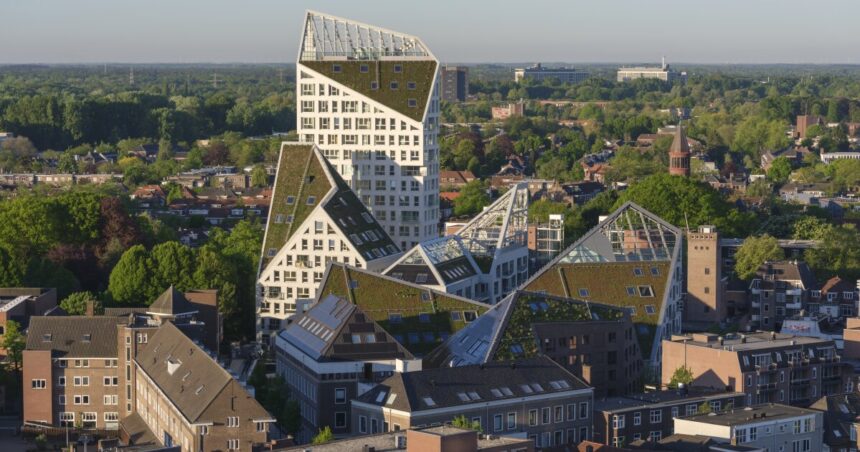
Dutch architectural firm MVRDV has completed a green-roof residential development in Eindhoven, the Netherlands, bringing 237 new homes into the city’s historic Bergen district. Dubbed Nieuw Bergen, the project combines new construction with the repurposing of two existing buildings, adding housing while respecting the area’s established scale.
The development is broken into a sequence of buildings that rise gradually across the site. Lower volumes align with the surrounding streets, with the tallest building rising 17 floors at the far end. Boasting angled roofscapes, the upper portions of the buildings are designed so that daylight can filter deeper into the upper apartments and shared spaces below.
“The neighborhood of De Bergen is one of the oldest and most authentic parts of Eindhoven, known for its small restaurants and boutique shops, making it a charismatic neighborhood close to the city center,” says MVRDV founding partner Jacob van Rijs. “… we wanted buildings with character, embedded into the neighborhood in a way that feels natural. The sloping roofs achieve this in a way that benefits both residents in their apartments and visitors in the streets. The result is a chain of polite, yet simultaneously radical buildings with an exciting contour resembling a mountainous landscape – adding ‘bergen’ in De Bergen!”
The Nieuw Bergen project retains two 20th-century structures at the street edge, both of which previously served as police stations. The buildings have been adapted and integrated into the new scheme, preserving a layer of the site’s history. Behind this historical frontage, five new buildings increase in height, including the six-story Orange block, which contains the majority of the development’s 54 social housing units.
The roofscapes also feature a number of shared outdoor spaces. Several of the stepped roof peaks are used as communal terraces, while one includes a glazed greenhouse. These elevated areas provide space for gathering and informal use, adding a social layer to the development beyond the apartments themselves.
At ground level, commercial spaces have been integrated into several of the buildings. These spaces sit alongside pedestrian-friendly walkways and open areas, encouraging movement and activity throughout the site.

© Ossip van Duivenbode
Sustainability is addressed through a combination of passive and active measures. The roof design allows solar panels to be integrated into the building, while green roofscapes introduce vegetation that supports biodiversity and helps manage heat and rainwater. As with many such strategies, their long-term effectiveness will depend on maintenance and how they are used over time.
Nieuw Bergen presents an innovative and attractive approach to inner-city housing, demonstrating how housing developments can be introduced without overwhelming the character of an existing neighborhood.
Source: MVRDV