


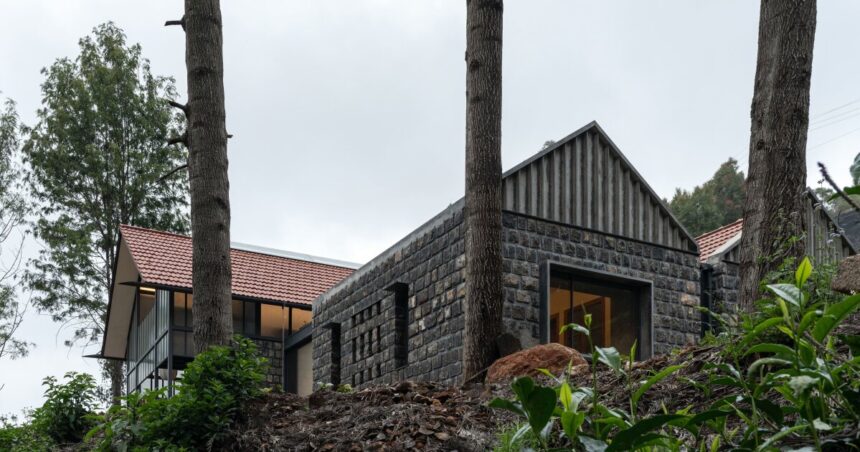
Architecture firm Meister Varma has completed a house in Kotagiri, a hill town in India’s Nilgiri Mountains, that’s held up by the stones of the collapsed colonial-era cottage that once occupied the same plot. It’s called Shilaya, which is from the Sanskrit word for stone. It’s a clear nod to the structure that stood there before it. Shilaya looks south over a garden earmarked for future cottages, with staff quarters to the west.
Kotagiri was once a hill station from the British era, and that’s why many of its older houses feature the same heavy stone masonry. It’s almost like a tradition. So the principal architect Krishnan Varma didn’t clear the rubble from the ruin. Instead, he treated it as a foundation on which the new house would rise. In an interview with Dezeen, he said it took several iterations until Shilaya took its final form.
Meister Varma Architects
Sydney’s 19 Waterloo Street, named World Interior of the Year in 2023, did something similar but on a smaller scale. It reclaimed a nearby brick project to finish its rooms. Shilaya pushes the idea further, building salvaged material into the structure, not just the surface.
The remnants of the old cottage can be seen clearest in the walls, as the base of the house is still made from the salvaged stone. Meister Varma couldn’t quarry or manufacture new materials on the plot because it’s prohibited in these ecologically sensitive regions. This is what largely drove the decision to design the house this way.

Syam Sreesylam/Meister Varma Architects
It’s only the stone walls at ground level that sourced their materials on site. Everything above that, including the roof, the first floor, and the partition walls of the central volume, was largely prefabricated in steel and shipped to the plot, ready to be installed.
That central volume is where Shilaya’s main living, dining, and kitchen areas are located. It sits below a gabled roof with a long skylight running along the ridge line, illuminating everything below with natural light. There’s also a spiral staircase that leads to a study mezzanine directly below the roofline.
There are two other volumes that extend from the central volume, making it a three-part layout. In the middle, there’s the bathroom volume, which has a flat roof that doubles as a sun deck and is accessible via the study mezzanine above the living space.

Meister Varma Architects
After that is the two-bedroom volume with a gabled roof and accessible through a skylit corridor that cuts through the bathroom. The two bedrooms sit behind stone walls half a meter (1.6 ft) thick, divided by a built-in storage partition. While those thick walls of reclaimed material look sturdy, they also double as the volume’s thermal mass. They absorb and release heat slowly, easing the load on the heating system throughout Kotagiri’s cold winters.
This is a passive heating solution that echoes the Magnolia eco cabin in the US. It also leans on heavy, low-tech materials (a mixture of hemp wool and hempcrete) rather than mechanical systems, while being enclosed in a compact timber shell.
Source: Meister Varma Architects