


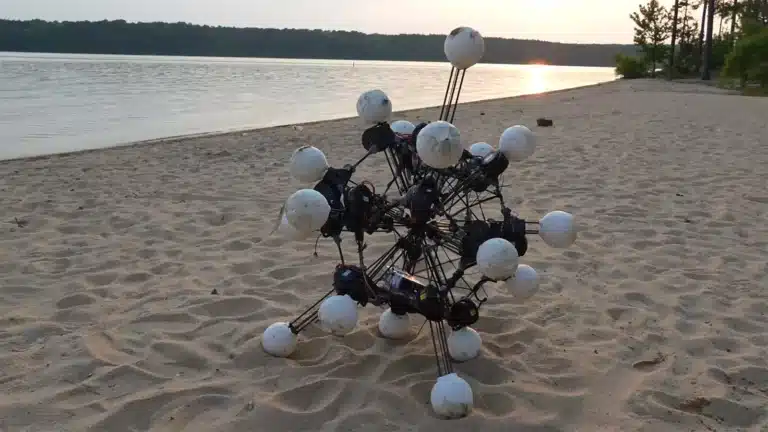
What if a robot had no front, no back, and could move equally well in every direction? Researchers believe that may be the future.
Researchers at Duke University have developed an unusual robot called Argus that abandons one of robotics’ oldest design assumptions: the need for a defined front and back. Inspired more by sea urchins than animals or humans, the robot serves as a proof of concept for a new design principle known as dynamic isotropy, which focuses on how uniformly a robot can move rather than how closely it resembles a living creature.
Argus features 20 telescoping legs arranged around a central body, each equipped with a depth camera. This configuration gives the robot nearly equal mobility and visibility in every direction. According to the research team, the design emerged after simulating more than 1,500 different robot configurations to identify structures that maximised movement symmetry.
The approach offers several advantages over conventional robots. Because it can accelerate and react equally well in any direction, Argus does not need to reorient itself before moving. This improves stability, resilience, and efficiency while allowing it to operate effectively in unpredictable environments.
Field tests demonstrated the robot’s ability to traverse sand, forests, wet terrain, grass, and dense foliage. It could recover quickly after being pushed, continue operating even with three damaged legs, carry payloads weighing up to 10 pounds, and climb between parallel vertical walls. The robot also successfully tracked and pushed large objects while continuously rolling.
At the core of the design is a mathematical measure called dynamic isotropy, which scores how evenly a robot can accelerate its centre of mass in all directions. While most quadruped and humanoid robots score below 0.6, Argus achieved 0.91, approaching the theoretical maximum.
“Most robotics research has framed symmetry as a question about the body, but we argue that the more powerful symmetry is at the level of what the robot can do,” says Boyuan Chen, Dickinson Family Assistant Professor of Mechanical Engineering and Materials Science at Duke University.