

Soft robotic grippers use sensors to check fruit ripeness and harvest fruit without damage, aiming to reduce waste and improve harvesting efficiency.
Researchers from West Virginia University and Cornell University have developed a soft robotic gripper that can assess fruit ripeness and harvest delicate produce without causing damage, aiming to reduce food waste and improve harvesting efficiency.
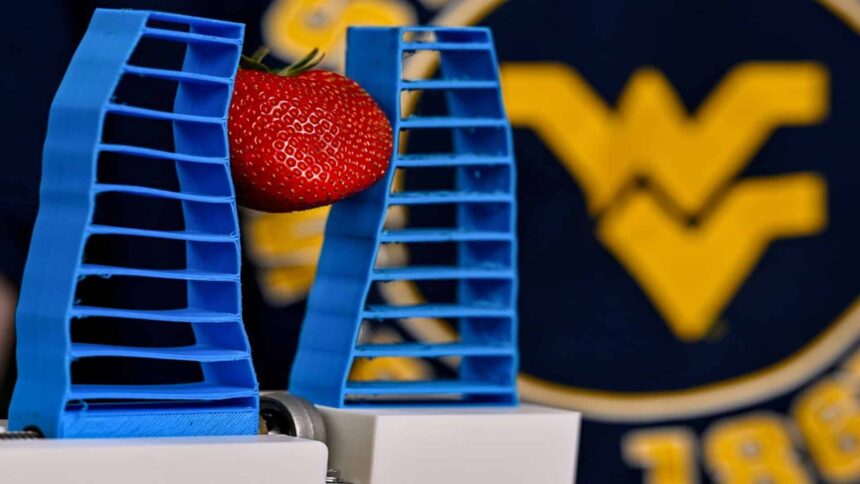
The system uses soft silicone and polyurethane fingers embedded with sensors that measure a fruit’s size, shape, color, and firmness. Based on this data, it determines whether the fruit is ready to be picked. In strawberry trials, the gripper removed fruit by twisting the stem instead of cutting it, helping reduce bruising.
It addresses a key agricultural challenge: harvesting soft fruits such as strawberries and raspberries within a short ripeness window while avoiding damage during picking, transport, and storage.
Current harvesting still relies heavily on human labor, which faces issues such as labor shortages, physical strain, and inconsistent judgment of ripeness. Many robotic systems also struggle in open-field conditions, while rigid grippers can damage fragile produce.
To overcome this, the researchers designed a soft robotic system that combines tactile and visual sensing. Stretchable optical fibers inside each finger act as touch and bending sensors, while a small camera and distance sensor in the palm provide additional visual input.
The five-finger gripper can detect shape, stiffness, ripeness, and slippage during handling. It operates in under two seconds, lifts up to one kilogram, and achieved nearly 100% accuracy in shape detection during tests.
The approach may also help in crops where ripeness is not clearly visible, such as avocados, where growers rely on touch rather than appearance.
Inspired by biological systems, the design from WVU’s Robotics Lab resembles both a human hand and a starfish. The soft structure helps it absorb force and handle delicate objects more safely than rigid robotic systems.
Beyond agriculture, the same sensing approach could be used in space exploration, healthcare, food handling, and underwater manipulation. Researchers say combining tactile and curvature sensing could also improve biomedical and rehabilitation devices.