


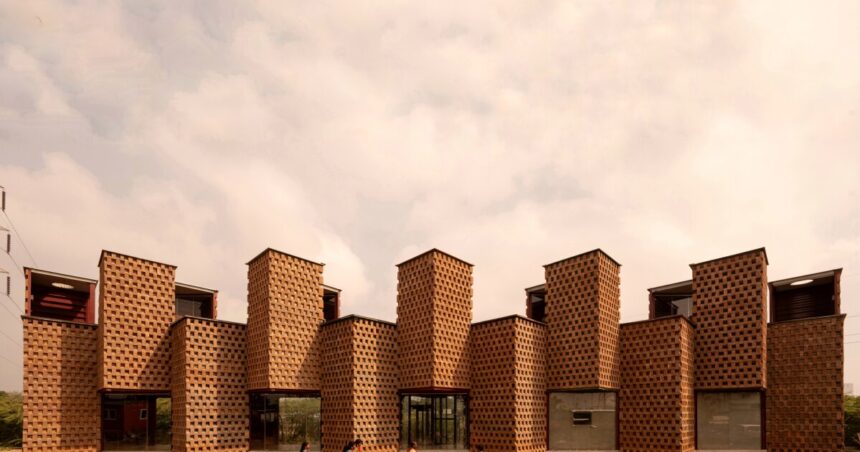
Shipping containers can be turned into everything from tiny houses to art galleries, but they all share one issue: poor thermal performance. The Petti Restaurant mitigates this by covering the containers in mud, creating a striking building that stays a little cooler in India’s intense heat.
The project, named Petti Restaurant – Petti means Box in Tamil – is designed by Wallmakers. It’s located in the industrial port city of Tuticorin, India, where the firm says there were lots of steel containers discarded locally.
IKSHA
Wallmakers used 12 in all, modifying them with large openings for ventilation and adding concrete, as well as the mud exterior, which looks so good that we’re thinking more container projects should be finished in this way.
“Each container was set vertically, as we wanted better room heights, as opposed to the 2.4 m (7.10 ft) dimensions that are generally available when containers are set horizontally,” explains Wallmakers. “The twelve cut containers were placed using a crane in a span of one week and then welded together to form the basic structure of the building along with a few RCC [reinforced cement concrete] slabs that were added to connect at the floor levels.
“Being situated in an open site in a region that was hot throughout the year, we added a layer of poured earth on the external surface of the containers to reduce the heat gain and provide insulation. The pattern was further worked out to make it an alternatively recessed one for better thermal efficiency and to reduce the load on the air conditioning systems by 38 percent. Every alternate container was staggered and we designed the South-facing first floor without any wall openings so that the floating containers allowed for better ventilation (in the case of a passively ventilated scenario).”
The interior measures 4,720 sq ft (438 sq m), spread over two floors, with the shape of the boxes themselves forming a useful layout that puts each seating area in its own niche. Instead of trying to hide its industrial roots, the decor sensibly highlights the textures of the containers. The restaurant is lit naturally by skylights during the day and by chandeliers in the evening, which was made from old pipes. Additionally, discarded wood from ship decks forms the flooring.

IKSHA
Wallmakers has lots of experience using discarded and recycled materials in its projects, and the firm previously impressed us with its Toy Storey and Chuzhi houses.
Source: Wallmakers