


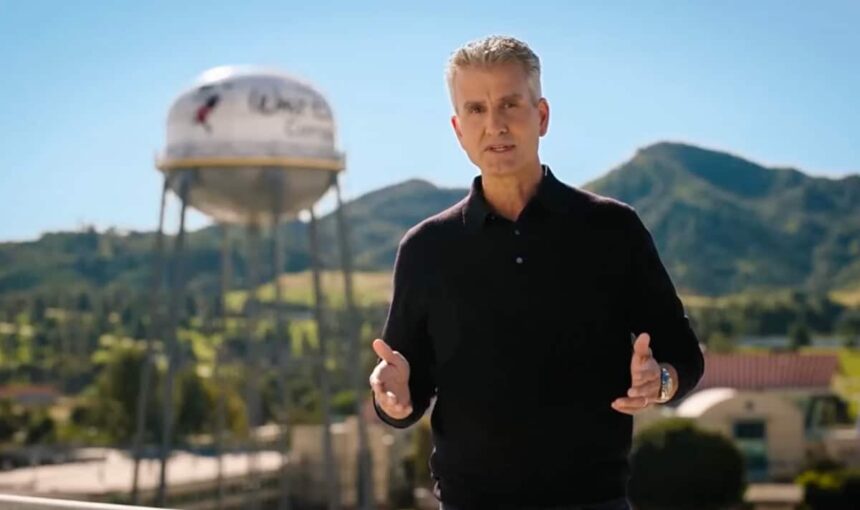

After a first month on the job that could fairly be described as “Chapekian,” it seems that the honeymoon is over for new Disney CEO Josh D’Amaro. Here’s a rundown of the challenges, plus the latest report of rumored layoffs on the horizon.
In case you missed it, Mr. D’Amaro’s Wild Ride as CEO of the Walt Disney Company officially started as of March 18, 2026. D’Amaro became CEO as of the 2026 Annual Meeting of Shareholders, at which point, Bob Iger transitioned to a new advisory role until his retirement from the company on December 31, 2026. That was only three weeks ago, but it probably feels like an eternity for D’Amaro.
His first day was fairly uneventful and went surprisingly smoothly. He handled the Q&A during the meeting with ease, even the more contentious subjects (see CEO Josh D’Amaro on Disney Parks High Prices vs. Guest Satisfaction, DAS Changes, Lightning Lane Rules). A couple of days later, there was some controversy/cancellation with the Bachelorette that I don’t fully understand. Seven days later, things started to get really rough.
First came trouble in paradise with the Epic Games partnership. That studio announced the layoffs of over 1,000 employees, aimed at putting Epic Games in a “more stable place,” according to a memo sent to employees by CEO Tim Sweeney.
The downturn in Fortnite engagement that started in 2025 means the company is spending significantly more than it’s making, and has to make major cuts to keep the company funded. This layoff, together with over $500 million of identified cost savings in contracting, marketing, and closing open roles is the means to that goal.
The Epic Games layoffs comes amidst industry-wide challenges that include slower growth, weaker spending, and tougher cost economics; current consoles are selling less than last generation’s, development costs and timelines have exploded, there’s been a slowdown coming out of COVID, and games are competing for time against other increasingly-engaging forms of entertainment.

The Epic Games partnership was one of D’Amaro’s marquee initiatives while head of Disney Experiences. The drop in Fortnite engagement strikes me as a potential red flag, and I’m concerned that the Fortnite fad is coming to an end, or at least post-peak. Live service games strike me as something that cannot be sustained indefinitely as its core audience ages out of the product or the next hot new thing comes along.
At the same time, Disney needs success in the gaming realm to capture the time and mindshare of younger generations. This is seemingly why Disney made the deal in the first place, and why it’s been such a big initiative for D’Amaro. I’m not sure what the solution is, but fear it might be trying to acquire Epic Games.
Either way, this one struck me as a big blow for Disney and D’Amaro. (It’s also one that’s outside the interest of our audience, as evidenced by the meager 4 comments on our original post about the Epic Games layoffs and cost-cutting.)

Later that same day came the announcement that OpenAI was “saying goodbye” to Sora.
The announcement came just three months after Disney made a supposedly groundbreaking deal with OpenAI. Under the three-year licensing agreement, Sora would have been able to generate user-prompted videos from a set of more than 200 masked, animated or creature characters from Disney, Marvel, Pixar and Star Wars.
Sora and ChatGPT Images were to generate “fan-inspired” videos with Disney’s licensed characters in early 2026, with Disney+ to add a curated selections of Sora-generated videos later in 2026. According to the companies, the agreement brought these “leaders in creativity and innovation together to unlock new possibilities in imaginative storytelling.”
Disney has now ended its partnership with OpenAI, which included plans for the media conglomerate to take a $1 billion stake in the AI company led by CEO Sam Altman. That deal never closed and Disney never paid the $1 billion. This means that the billion dollars is now unaccounted for, and could be spent on something of value instead of metaphorically lit on fire.
Just one day before that announcement, Disney and OpenAI teams were working together on a project linked to Sora, OpenAI’s AI video tool, according to reporting by Reuters. Disney was blindsided with word that OpenAI was dropping the tool altogether, and “it was a big rug-pull,” according to the Reuters source.
Unlike the Epic Games deal, this one actually struck me as a stealth win for Josh D’Amaro. It wasn’t a great news day for Burbank, but it was probably a net positive in the long term. The original OpenAI announcement felt very Iger-esque, and seemed like an impulsive agreement made to try to have some say in the wild west of the AI landscape. (And also for a stock boost that did not happen.)
I don’t doubt that Disney will involve itself in AI somehow, and it wouldn’t surprise me if whatever they land on ends up being another misguided idea. But the Sora arrangement seemed haphazard and laden with landmines; Disney can do better, even at making lemonade out of lemons. The optics of two deals souring on the same day weren’t great for D’Amaro, but this was nevertheless a blessing in disguise.

All of this has been occurring against the backdrop of the Iran war, which obviously was not a D’Amaro decision but could nevertheless have huge negative ramifications for Disney’s core business. Perhaps more so than anything else discussed here depending upon how long it drags on.
The first is the more direct and immediate impact, which is a potential slowdown in summer travel caused by $4 per gallon gas. We’ve covered this on several occasions, albeit not through the lens of D’Amaro’s start as CEO, so I’m not going to fixate on it. (See Why the Iran War Could Cut Crowds at Disney World & Negatively Impact Your 2026 Travel Plans.)
Parks & Resorts has been the biggest bright spot for Disney in the last several years, and what landed D’Amaro in the CEO seat. The conflict and gas prices are obviously outside of his control, but shareholders will take little solace in that if/when there’s an impact on bookings and per guest spending at Walt Disney World and Disneyland.

There’s also the wildcard of Disneyland Abu Dhabi, which was a big talking point when D’Amaro was first announced as CEO. It is perhaps noteworthy that the project was not mentioned by name during the shareholding meeting, but instead referenced indirectly as a park in a “new corner of the world.”
At this point, there have been signs that it’s full steam ahead of Disneyland Abu Dhabi, but I would strongly emphasize the “at this point” portion of that sentence. The Middle East has more announced-but-unbuilt theme parks than it does operational ones.
Disneyland Abu Dhabi is a licensing deal with no financial exposure for Disney and its regional partner, Miral, clearly wants to proceed with the project (at this point), which are both positives. However, this park is not without risk for the Walt Disney Company. If regional instability persists (or resumes at a later date), there is no more distinctly “American” target than a Disney theme park, and Iran has demonstrated no reluctance to strike allies in the region.
I’m glad I’m not the one who has to decide whether the financial reward and brand expansion are worth that risk. It’ll be a tough decision for D’Amaro to make, and one that is far from a “done deal” no matter what media reports currently suggest. No one knows what the geopolitical landscape will look like in this corner of the world in 2035 or so when Disneyland Abu Dhabi would likely debut.

The latest development that’s sparking backlash on social media is a report by the Wall Street Journal that Disney will laying off up to 1,000 people in the coming weeks. The report indicates that the layoffs will be in the consolidated marketing department, and largely (if not exclusively) impact the streaming and studio side.
As WSJ points out, layoffs have become a brutal reality across the entertainment industry. Sony Pictures, Paramount and Warner Bros. Discovery have already cut staff. More layoffs are expected if and when Paramount acquires Warners.
Disney and these other studios have been adjusting to the ‘new normal’ of smaller profits from streaming as contrasted with linear television, as well as diminished box office, and intense competition from tech companies. Disney is also combining the staff of its Disney+ and Hulu as it merges the streaming services into one app, and redundancies will result from that.

On top of that, Disney wants to free up money to invest in businesses where it sees growth potential. The company has laid off more than 8,000 people since Bob Iger returned as CEO in 2022 and began a major restructuring. Plans for the coming layoffs began before D’Amaro took the helm as CEO, according to WSJ sources.
Disney employed 231,000 people at the end of its 2025 fiscal year, some 80% working in the Experiences division, which includes the labor-heavy theme parks and cruise line (plus consumer products). Most layoffs since 2022 have occurred in Disney’s entertainment, ESPN and corporate side.
At the same time, Walt Disney World, Disneyland, and Disney Cruise Line have all seen their headcounts increase since 2022. Based on digging back into the DTB Archives, we find no evidence of any frontline Cast Member layoffs since 2022–only growth. The big round of 7,000 layoffs under Iger concerned mostly the metaverse, streaming and studios. Disney specifically stated at the time that it would not impact frontline Cast Members at the parks.

Disney has been consolidating operations to cut costs and coordinate its efforts across divisions. Earlier this year, the company combined marketing departments for entertainment, experiences and sports under new Chief Marketing Officer, Asad Ayaz.
Ayaz’s plan to unite the marketing group and reduce expenses is code-named Project Imagine, according to WSJ. Disney has been working with consultants from Bain & Co. to strategize its cost-cutting.
Beyond his plan for united the company as “One Disney,” D’Amaro hasn’t laid out specifics for reshaping the company since taking over last month. Those close to the company said one of his priorities is having different divisions collaborate more quickly and efficiently, according to WSJ. Unsurprisingly, employees have feared layoffs would be part of that equation.

In terms of commentary, it’s worth underscoring which divisions these layoffs are impacting and the financial realities of said businesses. More so, it’s important to note that, to the extent this is relevant to Parks & Resorts, it’s not a story about layoffs, but rather, freeing up resources from struggling segments to increase spending in successful ones.
I’d also add that we routinely refer to Disney as a ‘bloated bureaucracy’ incapable of doing anything quickly. I’d stop short of expressing a positive opinion of “One Disney” since we know almost nothing about it at this point, and several past strategic initiatives have been half-baked or bad. I like the idea of the company being more nimble, interconnected, and operating with less internal friction. The devil is in the details, though, so it’ll come down to execution.
The worst part of this is the unforced error of giving a code-name to a project that’ll involve layoffs. I understand that the code-name refers to the unification initiative, but c’mon, it also entails layoffs. It doesn’t take a genius to foresee that media reports are going to draw a connection between the code-name and the layoffs. Never give a code-name, especially a positive and cutesy one, to anything involving layoffs. It just seems callous and cruel.
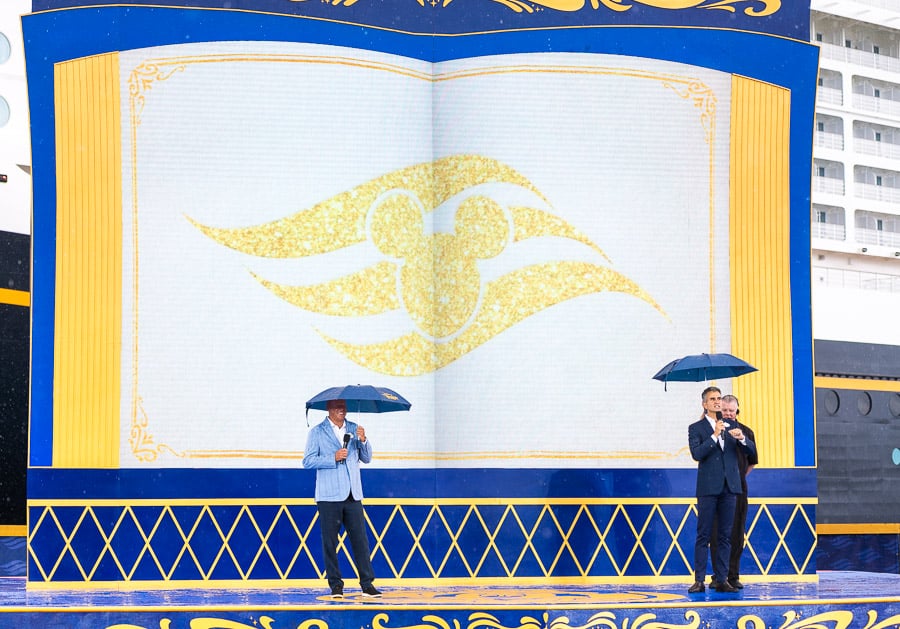
None of this is a great look for D’Amaro so early on in his tenure. No matter what the nuanced reality or the fact that layoffs are part of business, especially a contracting one, this is the latest in a continuation of what’s already been a rough first month for D’Amaro.
As someone who watched the slow motion Chapek crash from the front row, D’Amaro should be cognizant of just how much optics matter. If these layoffs were planned under Iger, I’m honestly shocked they weren’t also announced under him to spare the new CEO from the fallout.
Failing that, I’m surprised D’Amaro didn’t wait a bit longer to make these cuts, especially since I’d assume more are probably on the way once the whole “One Disney” initiative launches in earnest.

While I don’t believe every challenge above has been an actual negative (at minimum, the Sora deal falling through is a blessing in disguise), perceptions are paramount–and it’s been a rough first (less than) month for Josh D’Amaro. Not quite Chapekian, but that was also during COVID, so the business environment was different.
After he was named CEO, we published 11 Great Changes Josh D’Amaro Could Make at Walt Disney World for Big Wins. It’s not too late to implement a couple of those suggestions, and score wins with theme park fans. It won’t undo the negative PR from all of the above, but it would nevertheless be welcome news.
As someone who pretty much only cares about the theme parks, I am a staunch advocate of the company investing more money in Walt Disney World and Disneyland, and less in almost everything else. This has been one of our big complaints over the years–that Walt Disney World is treated as the cash cow that finances the company’s forays and follies into other endeavors, and is milked when said projects operate at a loss.
Need Disney trip planning tips and comprehensive advice? Make sure to read Disney Parks Vacation Planning Guides, where you can find comprehensive guides to Walt Disney World, Disneyland, and beyond! For Disney updates, discount information, free downloads of our eBooks and wallpapers, and much more, sign up for our FREE email newsletter!
YOUR THOUGHTS
What do you think of Josh D’Amaro’s first three weeks as Disney CEO? Is the honeymoon over, or is at least some of this negative news actually positives in disguise? Do you agree or disagree with our assessments? Any questions we can help you answer? Hearing your feedback–even when you disagree with us–is both interesting to us and helpful to other readers, so please share your thoughts below in the comments!