

AI-referred traffic has increased by 600% since January 2025, and marketers are racing to understand what that means for brand discovery. For teams seeking clarity on how AI impacts brand and pipeline means investing in new tools like Profound or Athena AI for Answer Engine Optimization (AEO). 
This guide provides a comprehensive comparison between Profound and AthenaHQ, covering what each platform does and how they differ in practice. For SEO strategists building out a new AEO practice, marketing ops leaders evaluating AI search tooling, or agencies scaling visibility programs across multiple clients, this comparison breaks down which tool fits which growth stack.
Table of Contents
Profound vs. AthenaHQ AI for AEO: At a glance
Profound vs. AthenaHQ compared
Here’s a breakdown of some key features of both Profound and AthenaHQ, and how each GEO tool handles the feature.
Monitoring vs. Action
One of the biggest differentiators between Profound and Athena AI in the AEO comparison is the primary problem each tool solves.
Profound is an AEO platform for monitoring and analytics. It includes a visibility intelligence command center where data from multiple engines gets synthesized into competitive insight.
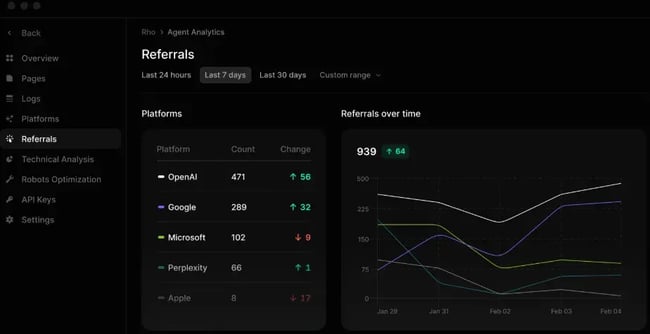
Here’s a screenshot showing what the monitoring analytics looks like. The screenshot shows a graph with referral traffic from AI systems in one place. SEO experts can use this graph to identify the AI agents working best for the business, and those with the greatest opportunity:
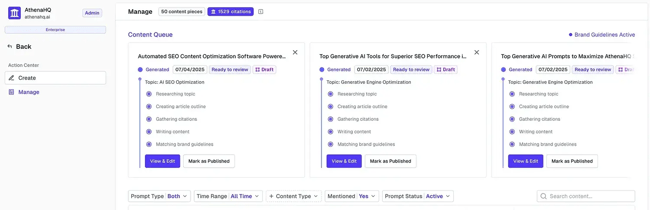
AthenaHQ AI is an AEO and GEO platform focused on automation and workflow integration. It’s built to close the gap between insight and execution through its Action Center, automated content production, and outreach tools.
The screenshot below shows the Action Center:
Which platform wins? Both platforms are excellent for monitoring, but AthenaHQ offers the added value of the Action Center, which helps teams turn insights into actions. The best tool depends on team needs and existing capabilities. Teams whose SEO staff can identify actions from analytics will find Profound a strong fit. Teams that need support with briefs and next steps will find AthenaHQ the more guided option.
AI Engine Coverage
Profound supports ChatGPT, Perplexity, Google AI Overviews, Copilot, Gemini, and Claude, and extends coverage to 10+ AI engines, including DeepSeek, Grok, Meta AI, and Google AI Mode.
Athena AI supports ChatGPT, Perplexity, Google AI Overviews, Copilot, Gemini, and Claude, covering the core engines with additional platforms available on request. It also covers Google AI Mode and Grok.
|
AI Agents Covered by AthenaHQ vs. Profound |
|||
|
Plan |
AI Engine Coverage |
Price |
Capabilities with custom plans |
|
Profound’s Growth Package |
ChatGPT Perplexity Google AI Overviews |
$399/month for the Growth package |
Google Gemini Microsoft Copilot Meta AI Grok DeepSeek Anthropic Claude Google AI Overviews |
|
AthenaHQ |
ChatGPT Perplexity Google’s AI Overviews Google’s AI Mode Gemini Claude Copilot Grok |
$295/month |
Additional models available on request |
Which platform wins? Athena covers more AI engines in its plan than Profound, but with custom plans, both solutions cover many AI engines.
Analytics and Visibility Tracking
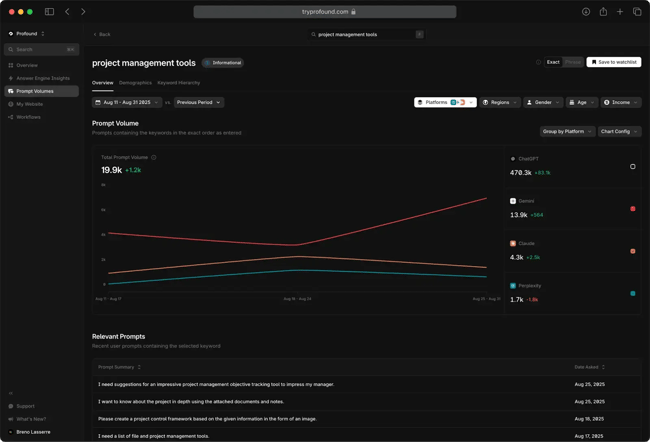
Profound offers analytics for agent tracking, conversation analysis, and shopping visibility. Its Answer Engine Insights monitors AI responses and citations across AI engines. Profound users can track up to 100 prompts (depending on the plan) and can change them at any time.
Here’s a view of what the Prompt Volume tool looks like, exploring conversations around “Project Management tools”:
AthenaHQ’s analytics are built around its proprietary Query Volume Estimation Model and real-time trend tracking. Its advanced tier includes real-time trends, unlimited monthly response analysis, and full data history with custom export options. It’s more accessible for teams without dedicated analysts, surfacing prioritized recommendations rather than raw data.
Which platform wins? For teams going deep on AI SEO, Profound‘s analytical depth is unmatched. For teams that need a clearer “here’s what to fix” for an AI best-practice workflow, AthenaHQ helps them output faster.
Content Optimization and Workflow Tools
Profound‘s workflow layer surfaces gaps between current content and what’s needed to increase citation frequency, using its AEO Content Score built from millions of top-cited pages. It’s powerful, but assumes teams have the capacity to act on detailed, data-heavy briefs.
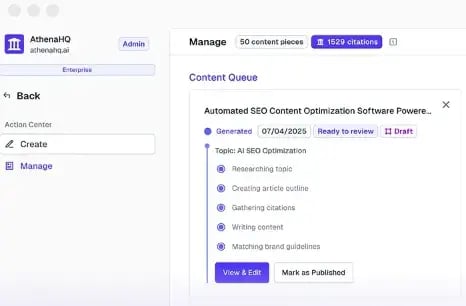
Athena AI offers content brief creation, optimization suggestions, and automated outreach. Its Action Center combines automated content production, unlimited outreach to influential third-party sources, and operational recommendations. Within the Action Center, content teams can manage their workflow:
Who wins? Profound helps teams understand what content will win. AthenaHQ helps them produce it faster. Both AI tools will help content teams create the best content for Search Generative Experiences (SGE)
Brand Sentiment and Reputation Monitoring
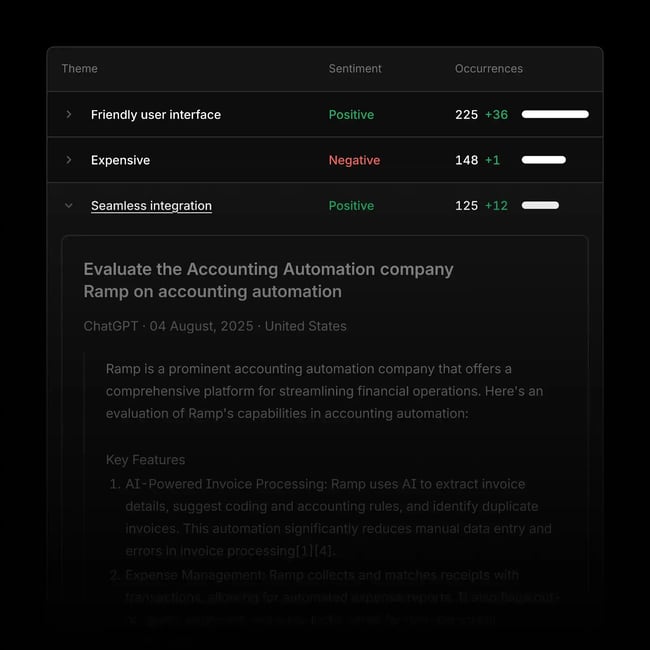
Profound’s advanced sentiment analysis and brand accuracy scoring are designed to identify misinformation, especially important for enterprise brands where AI hallucinations about products or pricing can cause real reputational damage. Its timestamped screenshot archive also creates an evidential record useful for compliance and reporting.
AthenaHQ measures brand sentiment, analyzes market trends, compares share of voice, and identifies trending topics. It also monitors brand reputation across news and social channels through its intelligent PR search.
Who wins? For brand protection and compliance, Profound’s accuracy scoring is the stronger solution. For growth and comms teams looking for AI sentiment integrated with PR and social in one view, AthenaHQ is more intuitive day-to-day.
How to Evaluate Profound vs. AthenaHQ for Your Growth Stack
When choosing between any tools, leadership should clarify the evaluation criteria that actually matter for the team and business goals. Here are three factors to consider when deciding whether either platform becomes a core part of a growth stack or an expensive subscription that the team stops logging into.
Integrations and Tech Stack Compatibility
Both platforms integrate with CRM, CMS, and analytics tools, but in different ways. Profound’s integrations are primarily at the server and infrastructure levels, connecting to Vercel, AWS, Cloudflare, and Google Analytics for data collection, rather than providing a direct connection to marketing workflows like a CRM. This makes Profound powerful for technical teams managing AI crawler data, but less plug-and-play for marketing ops teams who live in their CRM day-to-day.
AthenaHQ takes a more workflow-native approach to integration. Its platform includes unlimited seats, SSO/SAML, and white-glove onboarding — signals that it’s built for multi-team deployment within larger martech ecosystems.
For HubSpot-led growth teams specifically, it‘s worth considering what’s already built into the stack.
HubSpot Content Hub offers:
- SEO recommendations
- AEO website building capabilities
- Content suggestions
Content Hub is equipped with integrated AI through the Breeze content assistant, which can draft, expand, and adapt copy for both clarity and conversational tone, while automated SEO recommendations help ensure every asset is ready for both search and AI engine consumption. When marketing teams combine Content Hub with HubSpot’s Smart CRM, Marketing Hub, and Breeze AI Suite, they get a native AEO execution layer that works alongside whichever monitoring platform in the tech stack. HubSpot provides AI search grader, Smart CRM, Marketing Hub, Content Hub, and Breeze AI Suite for operationalizing AEO.
For teams evaluating the broader AEO tools landscape, the integration question often comes down to this: does marketing need a platform that feeds data into an existing stack, or one that replaces parts of it?
Pricing and Accessibility
Pricing is a key differentiator in the Profound versus Athena AI for AEO comparison. The cost of AI could easily help decide because if the budget simply isn’t there for more expensive tools, then decisions are made.
Profound‘s pricing starts at $99/month for ChatGPT only, but for brands that are serious about AI, the Growth package is $399/month. The platform’s most valuable features, including full AI model coverage and API access, are reserved for the Growth plan.
AthenaHQ’s pricing starts at $95/month for the first month, then $295/month, and there’s a credit-based system. The credit model offers flexibility, but it can add up quickly as more prompts and AI answer engines are enabled beyond the base 3,500 credits.
For teams not yet ready to commit to either platform, HubSpot’s free AEO Grader is a strong starting point. It analyses a brand’s AI visibility, sentiment, and competitive positioning across leading AI platforms — including GPT-4o, Perplexity, and Gemini. The analysis reveals how generative AI characterizes a brand when users ask questions about an industry, products, or services. It won’t replace a full AEO platform, but it gives teams a clear baseline before investment.
Ease of Use and Learning Curve
User feedback on Profound frequently describes the interface as data-heavy and unintuitive. Without a dedicated analyst, teams can easily find themselves overwhelmed by the volume of data the platform surfaces. Multiple reviewers also note recurring technical issues and a steep onboarding curve, both of which should be factored into the total cost of ownership beyond the subscription fee.
AthenaHQ is more accessible by design. Its Action Center surfaces prioritized recommendations rather than raw data, and its AI-generated suggestions are tailored fixes, content restructuring, additional FAQs, schema changes, or strategic outreach, saving marketers from manually evaluating prompts and responses. For growth teams without dedicated data analysts, that guided workflow makes a real difference to adoption and time-to-value.
The honest summary: teams with analysts comfortable interpreting layered data sets will find that Profound’s depth rewards that investment. Teams that are leaner and need to move from insight to output quickly will find AthenaHQ has the lower-friction path.
Which should you choose for AEO: Profound or AthenaHQ?
The right platform depends heavily on where an organization sits and what it needs AEO to do for the business right now.
Startups should start lean. AthenaHQ’s lower entry price and guided workflow make it more accessible for small teams with limited analyst capacity. The HubSpot AEO Grader is also worth running first as a free baseline before committing to any paid platform.
Mid-market teams with a growing content operation and moderate analytics maturity will find AthenaHQ’s balance of visibility tracking and workflow automation a strong fit. It connects insight to execution without requiring a data engineering layer, which is exactly what most mid-market growth teams need from their AI agent types and tooling.
Enterprise organizations with compliance requirements, global audiences, and dedicated analytics resources are where Profound earns its premium. Profound is purpose-built for enterprise brands that need cross-engine monitoring, programmatic AEO content workflows, SOC 2 compliance, and dedicated support with SSO. Its HIPAA compliance certification also makes it one of the few viable options for healthcare and life sciences brands operating in regulated environments.
Agencies have a strong case for Profound’s Agency Growth plan, which includes pitch workspaces and consolidated billing, purpose-built for agencies selling AEO services, with 10 pitch workspaces per month for prospecting and client workspaces for ongoing management. AthenaHQ is also a viable agency option, particularly for those running mid-market client programs that prioritize action over deep analytics.
International teams should weigh engine coverage heavily. Profound’s broader roster, including DeepSeek, Meta AI, and regional LLMs, gives it a material advantage for brands with meaningful audience share outside English-language markets.
It’s also worth flagging Xfunnel here, suitable for any organization. HubSpot recently acquired Xfunnel, an innovative platform that helps businesses monitor, test, and optimize AEO performance across LLM ecosystems, signaling a clear strategic direction toward native AEO capabilities within the HubSpot platform itself.
For teams already deeply embedded in the HubSpot ecosystem, Xfunnel’s integration with the platform may reduce the need for a standalone AEO tool over time, particularly at the mid-market level.
Frequently asked questions about Profound vs. AthenaHQ for AEO:
How do Profound and AthenaHQ differ in their approach to measuring AI search visibility?
Profound measures visibility through deep, multi-engine data — tracking share of voice, citation rate, and prompt volume across 10+ AI platforms for teams who want to interrogate the numbers. AthenaHQ tracks the same core metrics but surfaces them as prioritized recommendations, making it faster to act on but less granular in its raw output.
What are the unique features that set Profound apart from AthenaHQ?
Profound’s standout differentiators are its Conversation Explorer (drawing on 400M+ real user prompts), Agent Analytics with GA4 integration, Shopping Analysis for AI commerce visibility, and SOC 2 Type II compliance. These features have no direct equivalent in AthenaHQ and are purpose-built for enterprise teams with technical depth and compliance requirements.
Which tool is better for tracking brand sentiment across AI-generated responses?
Profound’s sentiment layer focuses on brand accuracy and misinformation detection — particularly for regulated industries or brands where AI hallucinations pose a real risk. AthenaHQ connects sentiment to PR and social monitoring in a single view, making it more practical for day-to-day comms and growth teams.
Do Profound and AthenaHQ support integration with existing marketing technology stacks?
Both integrate with CRM, CMS, and analytics tools, though Profound skews toward infrastructure-level connections like GA4, Cloudflare, and AWS, while AthenaHQ offers easier multi-team deployment with SSO/SAML and unlimited seats on a single plan. For HubSpot users, both can complement Content Hub and Breeze AI — but neither replaces the native AEO capabilities already inside the HubSpot stack.
Choosing the Right AEO Platform for Your Growth Stack
Choosing between Profound and AthenaHQ for AEO comes down to one core question: does the team need depth or speed to act? Profound delivers unmatched analytical rigor for enterprise teams with the resources to act on detailed data. AthenaHQ delivers faster time-to-value for growth teams that need insight and execution in one place. For teams already in the HubSpot ecosystem, the native AEO capabilities in Content Hub, Breeze AI, and the recently acquired Xfunnel platform offer a compelling third path — one that may reduce the need for a standalone tool over time.