

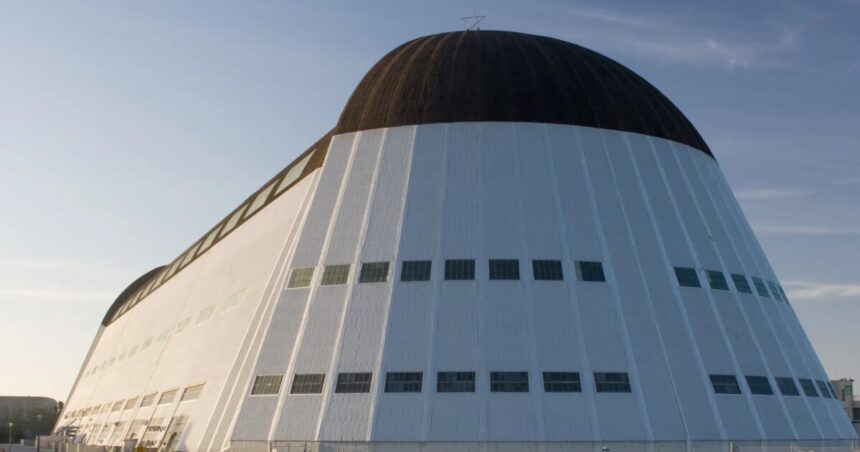
For anyone who has driven Highway 101 through Mountain View, California, Hangar One at Moffett Field is as familiar as the mountains in the distance. For most of the past decade, though, it was a haunt rather than a landmark – a hulking steel skeleton and reminder of engineering ambition looming over Silicon Valley. That changed last month. On March 20, officials and community members gathered inside the fully restored hangar to mark a moment many had stopped believing would ever come.
Of fog and airships
Hangar One is among the world’s largest freestanding structures, covering eight acres at Moffett Field near Mountain View. Eight football fields could fit inside its cavernous interior, where fog sometimes gathers near its 198-ft (60-m) high ceiling. It measures 1,133 ft (345 m) long and 308 ft (94 m) wide.
In 1933, the United States Navy built it as the West Coast base for the USS Macon, a massive dirigible measuring 785 ft (239 m) in length. The Macon was a marvel of its era – a “flying aircraft carrier” capable of launching smaller planes mid-air. It crashed during a storm off Point Sur, California, in 1935, but the hangar built for it thrived for decades, housing training aircraft and becoming an iconic fixture of the Bay Area.
NASA
In 1994, the Navy transferred Hangar One to NASA after Moffett Field was decommissioned, where it became part of the space agency’s Ames Research Center. The plan was to turn it into a thriving space and science center, but those plans were soon derailed.
A toxic legacy
In 1997, NASA discovered polychlorinated biphenyls – commonly known as PCBs – in the center’s storm drain basin. By 2002, sampling confirmed that the composite material used for Hangar One’s original exterior siding was the source, along with asbestos and lead paint.
The hangar was closed to use in 2003. When the Navy proposed tearing it down, a coalition of environmentalists, preservationists and veterans formed the Save Hangar One Committee and fought back hard enough to keep it standing. Instead, the Navy stripped the hangar’s exterior and coated the steel frame with epoxy – a remediation critics considered inadequate – leaving behind a big bare skeleton. By 2008, Hangar One was on the National Trust for Historic Preservation’s list of the 11 most endangered historic places in the United States.
The following video gives you a good background on the project, including the way in which redwood salvaged from the facility was incorporated into a new football stadium for the San Francisco 49ers.
Second Life for Historic Hangar One Wood
Enter Google
Amid budgetary constraints, NASA lacked the resources to do much more with it. So the agency put the entire 1,000-acre Moffett Field up for a competitive lease, with restoration of Hangar One as a condition. Google was the only serious contender. The resulting 60-year lease gave Google’s real estate subsidiary, Planetary Ventures, control of the airfield – including three hangars, two runways, and a golf course – in exchange for US$1.16 billion in rent and $6.3 million in annual savings to NASA. On top of that, Planetary Ventures committed to investing more than $200 million in the property and creating an educational facility open to the public.
Despite the price tag, the strategy makes sense if you’re a mega corporation like Google.
The company plans to use Moffett Field for research and development in space exploration, aviation, robotics, and other technologies. The enormous enclosed volume of Hangar One is uniquely suited to testing drones, balloons and large-scale aerial systems. Add a working airfield four miles from Google’s main headquarters, on federally owned land no competitor can touch, locked in at a fixed rate for 60 years, and the restoration starts to look less like philanthropy and more like one of the shrewder real estate deals in Silicon Valley history.
The restoration, and what comes next
Physical work began in 2022. The project addressed decades of contamination and structural deterioration while preserving the hangar’s historical appearance, removing toxic materials, remediating the steel frame, and installing new siding, windows, and doors. The new cladding used metal panels with a silver aluminum color mirroring the 1934 original. All work was completed on December 1, 2025 and the EPA certified full remediation earlier this year.
What happens inside the building now remains conspicuously unclear. Planetary Ventures has said only that it is “committed to innovation.” The community has pushed for a public museum covering the history of the USS Macon and lighter-than-air flight. Former Congresswoman Anna Eshoo, the hangar’s most vocal political champion, called such a museum a top priority. Google’s lease terms do require an educational facility, but that language leaves hangar-sized room for interpretation.
Sources: Overlook Horizon; The Almanac; San Francisco YIMBY; SpaceNews; Mountain View Voice; NASA