


Disney has filed a patent application for an innovative new ride system that describes and illustrates an articulating arm attraction (say that 5 times fast) that could move a ride vehicle up and down, and side to side along a ride path. Here are full details and diagrams, along with our thoughts on where this could be used.
Curiously, the patent application was first filed back in July 2024 but recently published on the United States Patent and Trademark Office website. The application was filed by Disney Enterprises for what’s labeled as a “Ride System Having an Articulating Arm” by inventors Derek Lee Howard of Burbank, Gaku Sato of Los Angeles, and Edward Allen Nemeth of Ohio.
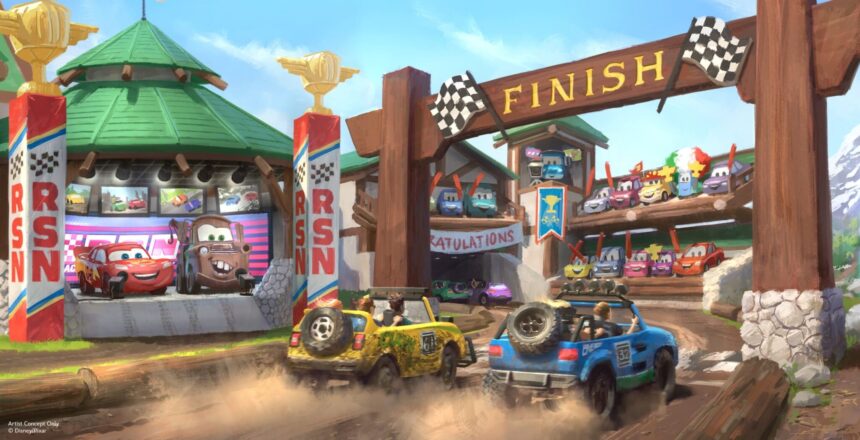
We would note that July 2024 was only one month before the D23 Expo, during which Parks & Resorts made a ton of announcements for Walt Disney World, Disneyland and before. One such announcement was for a Cars miniland in Frontierland at Magic Kingdom, which later came to be known as Piston Peak National Park.
The ride system is summarized in the patent abstract as follows:
A ride system may include a ride vehicle configured to move along a ride path adjacent a track, and an arm coupled to the ride vehicle. The ride vehicle may be movable separately from the arm. The ride vehicle may include features to support the ride vehicle on a ride surface of the ride path, such that the ride vehicle may follow the ride’s terrain.
The arm may articulate (e.g., move between positions) to adjust a position of the ride vehicle relative to the ride path. The arm may adjust the lateral and/or vertical position of the ride vehicle along the ride. The ride system may include a chassis coupled to the track, and the arm may be coupled to the chassis. The arm may be extendable and pivotable relative to the chassis, such that to adjust the position of the ride vehicle as the chassis rides along the track.

Disney indicates that the ride system offers an immersive guest experience by facilitating ride vehicle articulation and accelerations independent of track curvature. The system may allow a ride vehicle to span gaps in the ride or show floor and/or allow for jumping-type (vertical lift) experiences through attachment to an articulating arm.
The patent indicates a wide range of potential uses, with water, land and flying ride implementations. The ride vehicle could be a boat, car, airplane, or another type of vehicle. The illustrations in the filing support all of this, showing a boat on a water channel and a land-based vehicle with wheels.
Curiously, they also show what’s essentially a “racing” configuration with two ride paths, similar to Radiator Springs Racers, except with the aforementioned arms connecting both ride vehicles.

There’s another configuration that allows the rider adjust a lateral position of the ride vehicle, allowing the rider to steer the vehicle to avoid obstacles (bumps, jumps, rocks, etc.) or hit obstacles.
The vertical position of the ride vehicle may also be controlled to simulate physical dynamics of the ride vehicle and/or provide a level of guest control to the ride. The suspension may move with the arm and coupling to allow the ride vehicle to follow the terrain of the ride path or ride surface.
It’s worth reading and reviewing the 15-page patent in full (most of which is pictures!), because this sounds like a fairly flexible ride system platform that has a wide variety of potential uses. We could see it pop up in a number of places over the next decade.

Obviously, we’ve already invoked Radiator Springs Racers with a comparison. In reading the patent, my mind immediately goes to Cars. I cannot be alone in that.
It’s not just Radiator Springs Racers, though. This feels like a mix of the KUKA arm (Stark Flight School, Harry Potter and the Forbidden Journey, Monsters Unchained) and the ride system for Donkey Kong Mine Cart Madness over at Epic Universe. There’s a ton of potential for racing style attractions.
In fact, this seems pitch perfect for Radiator Springs Racers: Off-Road Rally Edition. Just think about it. Instead of staying on flat ground, as is the case with Radiator Springs Racers (or Test Track), this would offer the more dynamic capability of traversing rough and rugged, steering, dropping suddenly…all while racing another set of guests. Almost like Radiator Springs Racers mixed with Indiana Jones Adventure, but in a novel ride system!
Real-world engineering meets Disney magic. 🚙✨ Walt Disney Imagineering shares a behind-the-scenes look at off-road testing for the new Cars attraction coming to the Magic Kingdom at @WaltDisneyWorld. https://t.co/oBkKleOwz8 #SXSW pic.twitter.com/jfpSYdsz59
— Disney Parks (@DisneyParks) March 8, 2025
The only problem with this is that we’ve been down that road before.
After the above test footage was shown at D23 Brazil, many fans assumed that this would be a trackless off-road E-Ticket. We got to sleuthing, which resulted in this article: Cars E-Ticket Trackless Off-Road Thrill Ride System for Magic Kingdom Revealed?
At the time, we were incredibly confident–based on the test footage shared by Imagineering and the third party ride system we found–that Frontierland was getting a trackless Cars ride. And we weren’t the only ones–that was the consensus among the fan community.
And video of a proof of concept for the new attraction: pic.twitter.com/crgjhRSq8z
— Scott Gustin (@ScottGustin) March 8, 2025
Fast-forward to the “The Future of World-Building at Disney” during South by Southwest (SXSW) on March 8th of last year, when Imagineering released the above video. (I’m pretty sure brief clips of this has since been reused elsewhere, too.)
The crude video might seem odd to the uninitiated. A giant arm looming over a small car to push around a ride vehicle. A decidedly low tech visual at a SXSW presentation largely focused on Disney’s innovations. My thought at the time was that it felt very purposeful.
That the brief glimpse was aimed at telling us all that we were wrong without saying so in as many words. It telegraphed a message to adjust expectations so speculation didn’t get out of control and signaled that the E-Ticket would be a traditional, tracked attraction. That, it was clever subterfuge and Imagineering was trying to throw us off the track.
During that presentation, the Piston Peak project team also shared that they took a trip out to the Arizona desert to jump in a real off-road vehicle to see what it felt like driving over the rocky terrain. Imagineers also worked with a motocross company to build a real dirt track to race around on and took that data back to begin work on creating how the ride vehicles will eventually move and race.

The next big update on the project came last June, when Imagineers shared the Inspiration for Cars Land in Magic Kingdom. That was largely meant to assuage fears ahead of the closure of the Rivers of America and Tom Sawyer Island, with Piston Peak National Park aimed at making the Cars franchise fit in Frontierland.
As part of that, we attended a presentation led by key Imagineers working on the Piston Peak project. The Walt Disney World-based project team shared how they’re taking sightlines and sound into account when creating the new Piston Peak National Park area of Frontierland, among many other things.
In addition to explaining this, Imagineers shared video of the Cars miniland model and a fly-through around the perimeter of the land so that we could see for ourselves how the new area would mesh with the existing Magic Kingdom. All together, this painted a picture of how the Tom Sawyer Island and Rivers of America replacement will take shape, bringing the land into sharper focus than previously-released details at D23 and concept art released shortly thereafter.

At that time, Walt Disney World also released the Piston Peak Fun Map. In the center of this is Ranger Headquarters building that will be the queue for the family fun attraction. This is what we’re assuming is a flat ride, given space constraints.
We pointed out back then that the family fun attraction itself is not pictured on the Fun Map. It was also blurred out in the model and fly-through we saw. At the time, we noted that it was interesting that Disney was being so secretive about what was likely just a flat ride. We assumed it was because they hadn’t settled on a ride system yet. That wasn’t the point of any of the Piston Peak stuff, so we didn’t really dwell on it.
Today’s development now offers another explanation: that Disney did not want to inadvertently reveal the subject of a pending patent application, so out of an abundance of caution, they both blurred out the ride in the fly-through video and kept it off the Fun Map. I still think the latter is a bit curious, especially since the Fun Map is highly stylized, but I could see Disney Legal insisting upon it. And since the whole point of that was placemaking and not a ride reveal, not many fans noticed.

Personally, I’m inclined to buy the ‘preserving the patent’s secrecy’ explanation and bet that the new patent concerns the family fun flat ride as opposed to the E-Ticket. That explains the radio silence on that secondary attraction despite updates on the headliner, although it is amusing that the ride system is so versatile that it could be plausibly utilized for either attraction–or both!
Beyond that, I’m skeptical that the E-Ticket would use this ride system, as it looks like it would be prominently visible from outside the attraction. Perhaps this is a failure of imagination on my part, but the Cars E-Ticket is going to be an outdoor, kinetic element that weaves throughout the land, visible from all angles.
I’d be very surprised if Imagineering used an obtrusive ride system given that alone. They will probably want to minimize the ride system’s appearance to the greatest extent possible, which is why I had previously assumed trackless would be the way to go with this.

Ultimately, it’ll be interesting to see where (or whether) this new articulating arm ride system ends up being used. Piston Peak is the obvious candidate, and between the timing of the patent, its illustrations and explanation matching a Cars implementation, and the way that Imagineering has shrouded the second ride in secrecy…that makes the most sense to me.
The most likely candidate beyond that is nothing at all. One of the big reasons we don’t usually cover patents is because there’s a sky-high pile of them that have never been implemented anywhere. In fact, that’s typically how this plays out. Fans get excited about the possibilities and potential of a patent…and then crickets. We all forget about it, the patent collects dust, rinse and repeat when the next patent is filed.
I really don’t think that’ll be the case here, and that we will see this articulating arm ride system in Piston Peak National Park. Perhaps Disney will “make up” for the patents collecting dust by using this for both Cars rides, but the family one fun seems more likely. And that should make for a pretty compelling flat ride!
Planning a Walt Disney World trip? Learn about hotels on our Walt Disney World Hotels Reviews page. For where to eat, read our Walt Disney World Restaurant Reviews. To save money on tickets or determine which type to buy, read our Tips for Saving Money on Walt Disney World Tickets post. Our What to Pack for Disney Trips post takes a unique look at clever items to take. For what to do and when to do it, our Walt Disney World Ride Guides will help. For comprehensive advice, the best place to start is our Walt Disney World Trip Planning Guide for everything you need to know!
YOUR THOUGHTS
What do you think of this articulating arm ride system? Expect it to be used in Piston Peak at Magic Kingdom? If so, on which of the two attractions–or both?! Do you think the Cars E-Ticket will be tracked or trackless? Do you agree or disagree with our assessments? Any questions we can help you answer? Hearing your feedback–even when you disagree with us–is both interesting to us and helpful to other readers, so please share your thoughts below in the comments!
Get our free newsletter!
Sign up for news, Disney deals & free planning tips